Bohol
PhilippinesDescription
Island of the Chocolate Hills — tarsiers at Corella, the Loboc river cruise and diving at Balicasag.
Wiki
Bohol is a large island and a province of the same name in the central Philippines, in the Central Visayas region. It is known for a combination of unusual nature, colonial heritage and time on the water: in one full day you can see the strange conical hills, tiny nocturnal primates, and dive coral walls with sea turtles.
Geography and overview
The island lies south-east of Cebu, across a strait. Bohol is the tenth largest island in the Philippines, and the province has a population of about 1.4 million. The capital is the coastal town of Tagbilaran. The interior is hilly and built of limestone, which is what produced the famous landform, while the coast is cut into bays with white sand. The climate is tropical, with a drier stretch from roughly December to May and a wet season in summer and autumn. In October 2013 the island was hit by a strong earthquake: a number of old stone churches were destroyed, some later rebuilt and some left as ruins.
The main sights
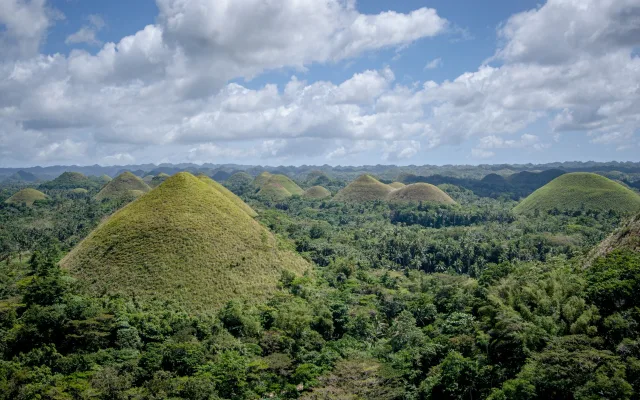
- The Chocolate Hills. Bohol's emblem: around 1,268 almost symmetrical conical mounds scattered across the centre of the island. In the dry season the grass on their slopes burns brown, so that the landscape looks like a scattering of chocolate truffles. The best viewpoint is in the municipality of Carmen.
- The tarsier sanctuary at Corella. A protected area where Philippine tarsiers — miniature nocturnal primates with disproportionately huge eyes — live in natural conditions. This sanctuary is run for conservation, unlike the more commercial sites near Loboc.
- The Loboc river cruise. An unhurried trip on a floating restaurant raft along green banks, usually with a buffet lunch and live folk music.
- Baclayon church. A stone church of the early eighteenth century (1717), one of the oldest in the archipelago and an important monument of the Spanish period, with a museum of religious art attached.
- Hinagdanan Cave. A karst grotto on Panglao island with a turquoise underground pool and stalactites.
- The Bilar man-made forest. A dense avenue of red mahogany along the road between Loboc and Bilar, the standard photo stop on the tourist circuit.
Beaches and diving
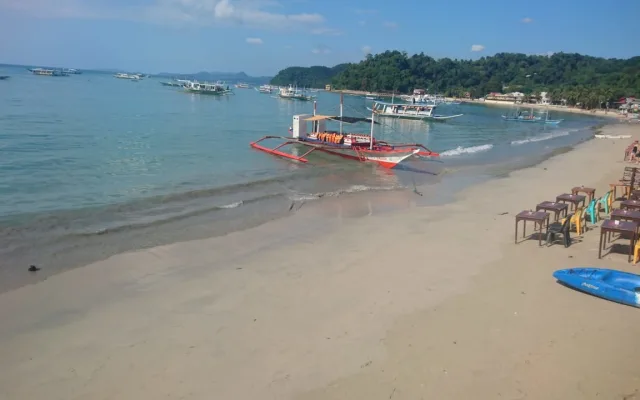
Panglao, joined to Bohol by a bridge, is where people go for the sea. The best-known beach is Alona, a busy strip of white sand with restaurants and dive centres. Quieter options are Dumaluan and the long sandy shores of Anda municipality in the east of the province. The real prize for divers is the small island of Balicasag: sheer coral walls, schools of barracuda, shoals of sardines and sea turtles. Trips to Virgin Island with its sandbar are also popular, along with snorkelling in the strait, where dolphins are sometimes seen.
Food
The cooking is a Visayan variation with an emphasis on pork and seafood. Try humba, pork braised in soy sauce with sugar and spices; kinilaw, the local answer to ceviche, raw fish or tuna "cooked" in vinegar and citrus; and for dessert halo-halo, a refreshing mix of shaved ice, fruit, jelly and sweet beans. Bohol's own speciality is kalamay, a sticky paste of coconut milk, sugar and glutinous rice sold in halved coconut shells. A modest lunch in a roadside carinderia costs around 300–500 pesos ($5–8), a seafood dinner 1,200–2,400 pesos ($20–40), and tropical fruit at the market next to nothing. Prices are as of 2026.
Practicalities
Bohol-Panglao International Airport (TAG) is about 15 km from Tagbilaran and takes flights from the main Philippine carriers. The alternative is the ferry from Cebu to Tagbilaran, around two hours. Getting around the island is easiest by tricycle for short hops, by rented scooter at roughly 500–730 pesos a day ($8–12), or with a car and driver for a full day. The classic guided country tour combines the hills, the tarsiers, the river cruise and the churches in a single run.
A four-day itinerary
- Day 1. Arrival, settle in on Panglao, time on Alona beach, an evening walk along the shore.
- Day 2. The full country tour: the Chocolate Hills, the tarsier sanctuary, the Loboc cruise, the man-made forest and Baclayon church.
- Day 3. A day on the water — diving or snorkelling at Balicasag and Virgin Island.
- Day 4. Hinagdanan Cave, the quieter beaches of Dumaluan or Anda, souvenirs and the flight out.