El Nido
PhilippinesDescription
The gateway to the Bacuit Archipelago in northern Palawan: limestone islands, hidden lagoons, island-hopping boat tours and dozens of empty beaches.
Wiki
El Nido is a coastal municipality in the north of Palawan in the Philippines, and one of the most beautiful gateways to tropical Southeast Asia. The town is the jumping-off point for the Bacuit Archipelago, with its limestone cliffs, hidden lagoons and dozens of deserted beaches, and it turns up every year in global rankings of the best island destinations.
Geography and background
El Nido lies about 230 km north of Puerto Princesa, the capital of Palawan province. Around 45,000 people live in the municipality, and the settlement itself is a compact town squeezed between the sea and high karst cliffs. The main natural asset is the Bacuit Archipelago: some 45 islands and islets in the bay of the same name, built of limestone hundreds of millions of years old. The cliffs rise tens of metres straight out of turquoise water, forming lagoons, grottoes and underwater caves.
"El Nido" is Spanish for "the nest", and the name comes from the swiftlet nests plastered inside the limestone caves. These edible nests were historically exported for soup, a delicacy in Chinese cooking. Before the Spanish arrived the settlement was called Talindak; under them it was Bacuit, and it only took its present name in 1954.
Island-hopping tours
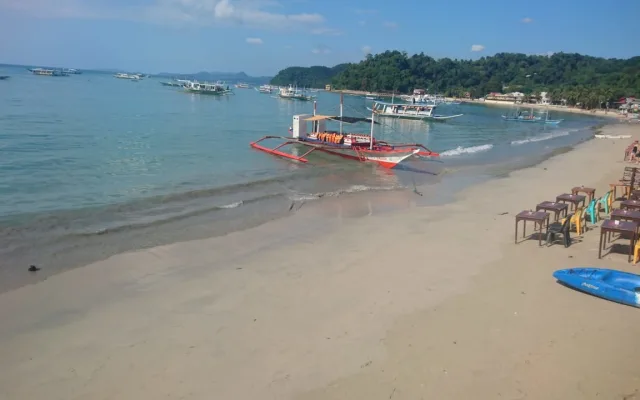
Seeing Bacuit is organised as a set of standard boat routes, A to D, on traditional bangka outriggers. This is the basic format, because most places can only be reached by water.
- Tour A — the most popular: the Big Lagoon, the Small Lagoon, the Secret Lagoon, Shimizu Island and Seven Commandos Beach.
- Tour B — Snake Island with its sandbar tombolo, Pinagbuyutan Island, Cudugnon Cave and the Pangulasian area.
- Tour C — Hidden Beach, Secret Beach, Helicopter Island, the Matinloc Shrine and Talisay Beach.
- Tour D — Cadlao Lagoon on the largest island of the archipelago, Paradise Beach, Natnat and Pasandigan.
The Big Lagoon is El Nido's calling card: a wide sheet of clear water ringed by sheer cliffs, entered by boat through a narrow channel. The Small Lagoon can only be reached by swimming or kayaking through a gap in the rock. Hidden Beach is tucked inside a ring of rock, and Secret Beach, by the popular story, gave Alex Garland the idea for The Beach. To protect the environment there are visitor quotas, compulsory eco fees and a ban on sunscreens that damage coral.
Beaches, diving and things to do
Beyond the tours, people head out independently. Nacpan Beach, 20 km north of town, is a long stretch of golden sand and one of the best on Palawan. Taraw Cliff, climbed by via ferrata, gives a panorama over the bay and the town. El Nido is a well-known diving area: dives at Helicopter Island with its through-tunnel, the coral gardens of South Miniloc, reefs with sea turtles and Napoleon wrasse. Snorkelling, kayaking between the islands, walks to waterfalls and night trips out to see bioluminescent plankton are all established.
Food
Local cooking combines Filipino traditions with Palawan seafood: grilled fish and squid (inihaw), the sour soup sinigang, adobo, and dishes with coconut milk. The markets and waterfront places have crab, lobster and mussels. The town also has plenty of international cafés aimed at travellers — pizza, bowls, and fresh juices from mango, calamansi and coconut.
Getting there and practicalities
The nearest airport is little Lio, just outside El Nido, with flights from Manila and Cebu. The cheaper option is to fly into Puerto Princesa and travel overland for five to six hours by bus or van. There are also ferries to Coron in northern Palawan. The best time to come is the dry season from November to May; in the rains (June–October) it gets stormy and tours are regularly cancelled.
The town's infrastructure is compact: a seafront strip of guesthouses, dive centres and tour agencies, with the boats leaving from in front of them. El Nido markets itself as an ecotourism destination, so the rules have to be respected: do not touch the coral, take your rubbish with you, pay the environmental fees.
How long to plan for
About five days is right. That covers two or three boat tours (A and C are the standard pair), a trip to Nacpan, the climb up Taraw Cliff and one day for diving or doing nothing. At that pace you see the key lagoons of Bacuit without rushing, and you keep a spare day in case the weather cancels a boat.