Constantine
Description
The city of bridges over the Rhumel gorge, ancient Numidian Cirta, and a base for Timgad and Djemila.
Wiki
Constantine stands on a rock plateau split by the canyon of the Rhumel — not a picturesque metaphor but literal topography: the centre hangs over a two-hundred-metre drop, and bridges are thrown between the quarters. That spectacle is what people come for: the city is both ancient Numidian Cirta and a living Algerian metropolis without any tourist polish.
What is genuinely worth seeing
Constantine's main impression is not a single monument but the relief itself. Plan the route around the Rhumel gorge and the bridges:
- The Sidi M'Cid bridge — the suspension bridge that is the city's symbol (1912, 168 m long, 175 m above the canyon). Walk across it: the views in both directions and down into the gorge are the strongest thing here.
- The El Kantara bridge — the oldest crossing, with Roman origins, and a good place to feel the scale of the drop.
- The path along the gorge floor — in places walkways and stairs run beside the Rhumel; going down gives a completely different angle on the bridges from below.
- The Palace of Ahmed Bey — a 19th-century Ottoman residence with inner courtyards and painted decoration, the best indoor option in heat or rain.
- The Casbah and the old city — a maze of narrow lanes, shops and mosques; go by day, travelling light and without displaying equipment.
- The Great Mosque (Souk El Ghezel) and the Cirta Museum, with Numidian, Roman and Berber artefacts — compact and to the point.
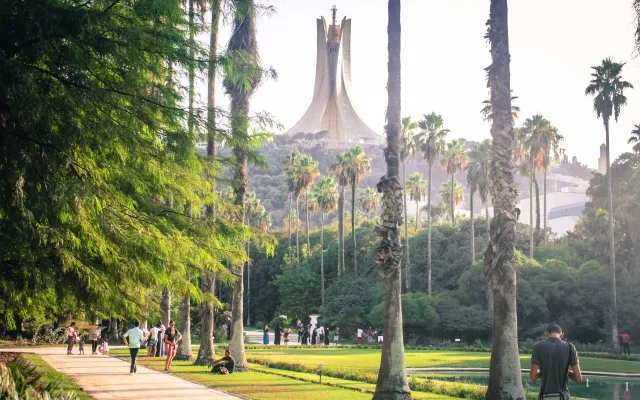
- The Monument aux Morts — a 21-metre replica of the Arch of Trajan at Timgad, raised in 1930 on the Sidi M'Cid hill at the northern end of the bridge of the same name. The semicircular terrace in front of it at 635 m is the best viewpoint over the whole island-city; come towards evening, when the bridges stand against the light.
If you allow two days, spend the first on the bridges, the gorge, the Casbah and the palace; the second is best given to a day trip to the Roman ruins.
Day trips: Timgad and Djemila
Two UNESCO sites within a day's reach are the reason to linger in the region. Timgad (about 90 km) is an exemplarily preserved Roman town with a grid of streets, the Arch of Trajan and a theatre — the "African Pompeii". Djemila (about 100 km) sits in scenic hills, and many rate it above Timgad for atmosphere. One of them plus the driving is realistic in a day; both at once is hard. The simplest arrangement is a car with a driver for the day, as public transport there is awkward and eats all the time.
Getting there and getting around
Mohamed Boudiaf airport lies outside the city; from it into the centre take a taxi and agree the fare in advance, as meters are rarely used. There are rail and bus links with Algiers, Annaba and other cities, and the train is more comfortable for long stretches.
Much of the city can be covered on foot, but the terrain is punishing: constant climbs, descents and stairways, so allow for the effort and bring comfortable shoes. Between the outlying points (the monument, the airport) take a taxi — they feel cheap. There is public transport too, including a cable car across the gorge that doubles as an attraction with a view.
Where to stay, and how long
Stay in the centre, close to the bridges and the Casbah: the main views are then within reach and you are not dependent on transport. Two days covers the city plus one trip to the ruins. To see both Timgad and Djemila without rushing, add a third day.
When to go
Spring and autumn are the optimum, comfortable both for walking the hills and for trips to the ruins, where there is almost no shade. Summer is hot and draining on open sites; winter is cool and rainy, the gorge looks striking in fog, but the stairways become slippery.
Safety and practicalities
This is not a well-worn destination, which is part of its appeal — but come prepared. Cash matters: cards are rarely accepted and ATMs are temperamental, so it is better to change money in advance in the capital. Dress modestly, especially near mosques; women are more comfortable in covering clothes. Be careful at the edges of the gorge and at the viewpoints, where railings are not reliable everywhere. When photographing people and bridges, avoid shooting checkpoints and government buildings. Basic French or Arabic is enough; English is poorly understood.
Food
The cooking is local and substantial: couscous, chorba frik (a soup of cracked wheat with meat), chakhchoukha — torn flatbread in a spiced sauce — the local lemon baklava, and coffee with cardamom. Eat in simple cafés and at street stalls, where it is both better and cheaper; food and transport feel inexpensive here, and the main costs are lodging and the car for day trips. A typical mistake is to economise on water and pace: with the changes in level and the heat it is easy to overrate your stamina, so carry water and do not try to cover the whole city and both sets of ruins in one push.
Updated