Description
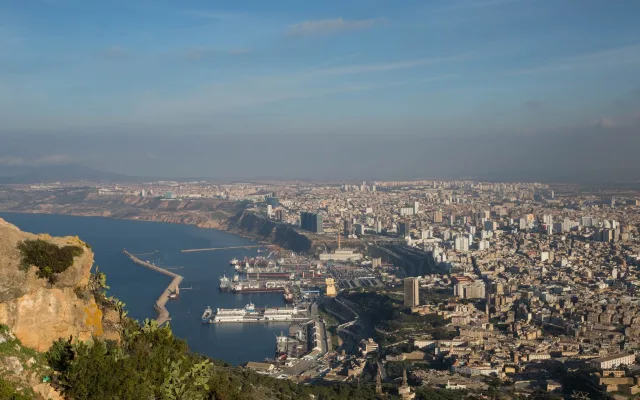
Algeria's second city — the Spanish fortress of Santa Cruz above the bay, and the birthplace of raï music.
Wiki
Algeria's second city and the main sea gate of the west of the country, Oran spreads like an amphitheatre above a broad Mediterranean bay. Around 800,000 people, a deeply layered history and a distinctive blend of Arab, Berber, Ottoman, Spanish and French culture make it one of the most characterful places in the Maghreb.
History and character
The settlement was founded by Andalusian Moorish seafarers around 903; the convenient harbour quickly turned it into a busy trading point of the western Mediterranean. From the early 16th century the city changed hands repeatedly: the Spanish held it for nearly three centuries with a break for Ottoman rule, in 1792 control passed to the Regency of Algiers, and in 1831 the French arrived and left a marked imprint on the architecture and the street plan. It is this patchwork of fortunes that produced Oran's particular atmosphere. Raï was born here — the popular music that absorbed Bedouin song and modern rhythm and went on to worldwide fame. Albert Camus set The Plague in the city, and spent part of his life in it.
Main sights
- Fort Santa Cruz — a 16th-century Spanish fortress on top of Mount Murdjadjo. Its walls give the best panorama of the bay, the port and the city's districts.
- The Basilica of Notre-Dame de Santa Cruz — the sanctuary of the Virgin beside the fort, a place of pilgrimage and another excellent viewpoint.
- Place du 1er Novembre (the former Place d'Armes) — the ceremonial heart of the centre, with the elegant theatre building, the town hall and a white mosque.
- The Pasha Mosque — Oran's principal mosque, an example of 18th-century Ottoman building.
- Sidi El Houari — the oldest part of the city, a maze of narrow lanes and traditional white houses running down the slope to the sea.
- The Sacré-Cœur Cathedral — a striking building in a neo-Moorish and Byzantine spirit, now occupied by the municipal library.
- The Ahmed Zabana Museum — the largest regional museum, with substantial archaeological, ethnographic and natural-history collections.
Districts and walks
It is easiest to start along the seafront boulevard, the promenade above the port, from which you can see the cranes of the cargo berths and the fishing boats. From there the road climbs to the old Spanish fortifications and the residential terraces of Sidi El Houari. The French centre, with its boulevards, arcades and colonial-era facades, contrasts with the eastern character of the markets, where spices, fabrics and sweets are sold. In the evening life gathers around the squares and coffee houses, and raï playing out of the shops is a reminder that this is the country's musical capital.
Around the city
- Aïn El Turk — a popular resort suburb about 15 km to the west, with sandy beaches and a string of seaside villages.
- Tlemcen — a historic city 170-180 km away, celebrated for its medieval Islamic architecture, madrasas and gardens.
Food
The Oran table combines general Algerian tradition with Mediterranean and Andalusian influence. The base is couscous with lamb or vegetables, rich soups such as chorba, tagine stews, and fresh fish and seafood from the local harbour. Street food means flatbreads, pastries and snacks; dessert brings sweets with dates, honey and almonds. Strong coffee and mint tea accompany unhurried conversation in the cafés everywhere.
Practical information
Two days is usually enough for Oran: the first for the centre, the old quarters and the seafront, the second for the climb to Fort Santa Cruz, the basilica and the panoramas, with an optional run out to the coast at Aïn El Turk. Spring and autumn are the most comfortable, when the heat drops and the sea stays warm. Summer is sunny and busy, winter mild and wet. Around the city there are taxis, buses and a tram; for longer trips to Tlemcen or the capital, trains and intercity buses are convenient. As in any large port, keep an eye on your belongings in the crush of the markets and at transport hubs.