Abidjan
Côte d'IvoireDescription
Economic capital of West Africa — the Plateau skyscrapers, Ébrié Lagoon, Treichville market and live jazz.
Wiki
Abidjan is the economic heart of Côte d'Ivoire and one of the busiest metropolises in West Africa, spread across the shores of Ébrié Lagoon on the Gulf of Guinea. Glass towers of the business district stand alongside noisy markets, fishing piers and palm-fringed beaches, while French mingles with Dioula, Baoulé and Bété.
History and general character
The city's name, according to legend, comes from the phrase "t'kan abidjan" — "I cut the leaves" — supposedly said by a local in response to a lost European asking for directions. From a small lagoon settlement, Abidjan grew after the railway reached it in the early 20th century and the town was made the colonial capital in 1933. The Vridi Canal, dug in 1950, connected the lagoon to the ocean and turned the city into the region's largest harbour. Until 1983 Abidjan remained the official capital, before that role was formally transferred to Yamoussoukro; yet business, finance, diplomacy and cultural life remain concentrated here. The urban agglomeration is divided into ten communes, among them Plateau, Treichville, Cocody, Marcory, Adjamé and Yopougon.
Main sights
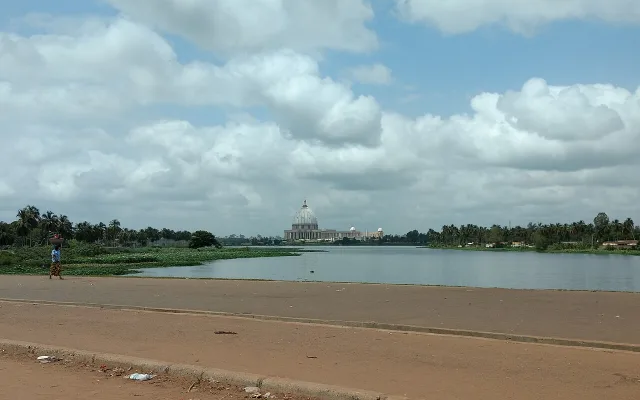
- Saint Paul's Cathedral — the city's landmark: a bold concrete structure from the 1980s whose silhouette resembles a leaning figure dragging a sail-like banner. Inside, vast stained-glass windows flood the space with coloured light.
- Plateau district — the business core, home to the country's tallest buildings, bank headquarters and sweeping water views. This is the best vantage point for the lagoon and the bridges.
- Treichville Market — a trading labyrinth selling bright fabrics, spices, ritual masks, woodcarvings and basketwork. Bargaining is expected; street food is worth trying.
- Banco National Park — a patch of humid tropical forest right within the city limits, with rare trees, monkeys and abundant birdlife; a natural oasis amid the urban sprawl.
- Cocody — the upmarket quarter of residences, embassies and Félix Houphouët-Boigny University.
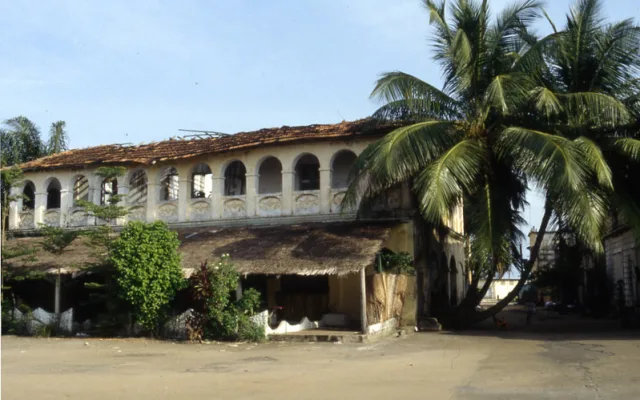
- Grand-Bassam — the former colonial capital 40 km away, a UNESCO World Heritage Site: crumbling colonial mansions from the turn of the 20th century, a costume museum and a broad ocean beach.
Culture and music
Abidjan is rightly called the continent's musical laboratory. Zouglou was born here, and coupé-décalé, invented by the Ivorian diaspora in Paris, quickly became the city's soundtrack; Afrobeat, reggae and live jazz fill the clubs of Marcory and Treichville. In the evenings the neighbourhoods fill with the rhythms of outdoor concerts, and makis — open-air spots with grills and plastic chairs — become the main meeting places. Craft traditions are represented by masks and textiles, while the art scene lives in the galleries of Plateau and at art fairs.
Food
Ivorian cooking is hearty and generously spiced. The staple is attiéké, a fluffy fermented cassava couscous served with grilled fish and a peppery onion sauce. Also popular are kedjenou (chicken or game slow-cooked in a pot with vegetables), alloco (slices of fried plantain) and thick soups made with peanuts or palm oil. A meal at a maki costs roughly 3–5 USD, dinner at a restaurant around 10–15 USD. A litre of petrol is about 1.20 USD, a bottle of water 0.50 USD, a shared minibus (woro-woro) ride around 0.40 USD. Prices are as of 2026.
Getting there and around
Félix Houphouët-Boigny International Airport (ABJ) connects the city to Europe and Africa via Air France, Brussels Airlines, Turkish Airlines, Royal Air Maroc and Ethiopian Airlines. A taxi from the airport to Plateau costs roughly 15–20 USD. Within the city, orange taxis, SOTRA buses and the ride-hailing apps Yango and Bolt all operate. One of Abidjan's distinctive features is its network of water buses and dugout canoes crossing the lagoon between districts — both a practical transport option and a mini sightseeing trip. The Houphouët-Boigny and Charles de Gaulle bridges link the various quarters.
When to go
The best time is the dry season from November to March, when temperatures reach 26–30 °C and humidity drops noticeably. December and January are peak season. April is worth noting separately: that is when the Abi Reggae festival draws musicians from across Africa. The rainy season (May to July) puts many visitors off, but accommodation and flight prices are lower and the vegetation is at its most lush.
Three days in Abidjan
Day one is best spent in Plateau and at Saint Paul's Cathedral, rounded off with a lagoon crossing by water bus. Day two belongs to Treichville Market, live music and an evening maki. Reserve day three for a trip out to Grand-Bassam or a walk through Banco Park — a striking contrast between the megacity, the colonial past and the rainforest.