Description
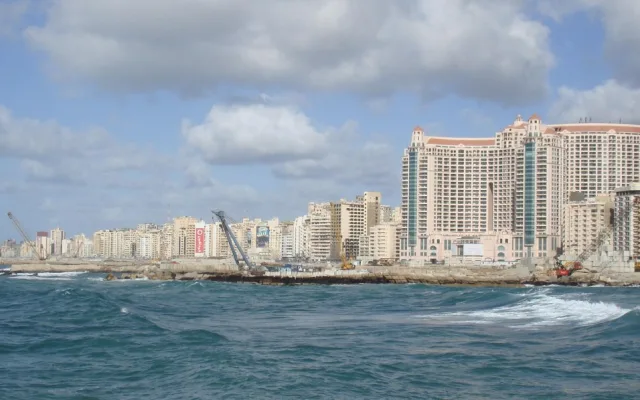
The Mediterranean city of Egypt — the library, the Qaitbay fort and the Greco-Roman catacombs.
Wiki
Alexandria stretches along the sea for a good 30 kilometres, and that is the first thing to understand about it: it is not a point on a map like most historic centres but a line, with life running along the Corniche. The second is that this is a different Egypt — no pyramids, but a sea breeze, coffee houses, old Greek and Italian facades and a rhythm far less frantic than Cairo's.
What to see in Alexandria
Alexandria is a city where there is almost nothing to "see" in the usual sense of a coherent ancient ensemble: the classical metropolis of Alexander and the Ptolemies went under the water and under the modern city. So what matters here is not individual monuments but the logic of the trip: one axis (the Corniche) plus a few key sites scattered along it. Two days is enough to cover the fort, the library, the catacombs, Pompey's Pillar and Montazah, if you do not linger too long in the coffee houses.
A practical plan: the first day for the eastern and central part (the waterfront, the library, the fort), the second for antiquity (the catacombs and the Serapeum) and the beach-and-park Montazah in the east.
Qaitbay Fort
The 15th-century citadel on a narrow spit running out into the sea is the city's calling card and its most photogenic point. It stands exactly on the site of the Lighthouse of Alexandria, one of the seven wonders of the world; some of its blocks, by tradition, went into the fort's walls. Do not expect "ruins of the lighthouse" — there are none — but the place is symbolic, and the views of the bay and the sweep of the Corniche are the best in the city.
In practice: the fort stands at the eastern end of the bay, and the sensible approach is on foot along the waterfront. Inside is a compact naval display and the circuit of the walls; allow an hour to an hour and a half. Come towards sunset, when both the light and the crowds work in your favour.
The Bibliotheca Alexandrina
The Bibliotheca Alexandrina is not a museum of antiquities but a working modern library and memorial on the site of the legendary ancient one. The building with its tilted disc of a roof and the enormous stepped reading room seating thousands is a piece of contemporary architecture worth going into even if libraries are not your thing. Inside there are permanent exhibitions, a planetarium and gallery spaces.
In practice: entry is ticketed and it runs to a schedule with a closing day (usually one day a week — check locally). It stands on the Corniche near the centre, and combines conveniently with a walk along the waterfront.
The Roman quarter
Kom El Dikka in the centre is the only excavated part of the ancient city open to visitors. A small Roman theatre survives here — the only one left in Egypt — along with fragments of baths, mosaics and the remains of residential blocks. The site is modest in scale, but this is literally all that is left above ground of Greco-Roman Alexandria; if you want to touch the ancient city, this is where you go.
In practice: it is next to Misr, the main railway station, and is compact enough to cover in 30-40 minutes.
The catacombs of Kom El Shoqafa
The largest Roman necropolis in Egypt (2nd century AD), descending several levels underground by a spiral staircase. The remarkable thing is the fusion of cultures: the chambers are cut in the Roman manner but decorated with Egyptian gods and symbols, and the guardian serpents wear both Roman and pharaonic attributes. The lower levels are usually flooded with groundwater.
In practice: one of the strongest historical sites in the city and an obligatory stop if antiquity interests you. Photography inside is sometimes restricted. Pompey's Pillar is next door, and the two are always seen together.
The Serapeum and Pompey's Pillar
The red granite column, almost 27 metres high, is the only major ancient monument still standing where it was raised. The name "Pompey's Pillar" is a mistake — it has nothing to do with the general and was put up in honour of the emperor Diocletian. Around it are the remains of the Serapeum, the temple of Serapis, which once held part of the scrolls of the Great Library. Today it is an open site with foundations, sphinxes and underground galleries.
In practice: a small site, 30-40 minutes, logically combined with the catacombs next door.
The Montazah palace and gardens
The summer residence of King Farouk in the east of the city: a palace in a mixed Florentine-Turkish style (normally closed inside), but the value here is the huge shady park above the sea and its own beaches. A good place to breathe out after rushing round the catacombs, walk among the palms and come out to the water.
In practice: the park is ticketed, with a separate charge for the beach. It is a long way from the centre, reached by taxi or minibus along the Corniche.
The Corniche and Stanley Bridge
The Corniche is Alexandria: a seafront road many kilometres long along which almost all the sights are strung. Walking it is a pleasure at any hour, and especially in the evening, when the whole city comes out. A landmark and a fine viewpoint is the Stanley Bridge viaduct over the beach bay of the same name, which looks striking at sunset.
City beaches are their own kind of leisure. They are crowded and locally conservative (people often swim in their clothes), so the sea here is more about the atmosphere than about classic beach relaxation.
History
The city was founded by Alexander the Great in 331 BC and became the capital of Hellenistic Egypt under the Ptolemies, then the greatest port and intellectual centre of the Mediterranean, with the Lighthouse, the Mouseion and the Great Library. Ancient Alexandria is largely lost: earthquakes, fires, subsidence and later building erased it, and part of the city went under water in the bay. Understanding this matters for your expectations: you are coming not for monuments but for the layering of eras — Greek, Roman, Arab, and the cosmopolitan European of the 19th and 20th centuries.
Where else to go
- The Graeco-Roman Museum — a collection of artefacts from that ancient Alexandria, complementing the catacombs and the Serapeum.
- The Abu al-Abbas Mosque — the principal and most beautiful mosque in the city, in the Anfushi quarter.
- The historic cafés — the old patisseries and coffee houses of the centre (around the station and Saad Zaghloul Square) preserve the European gloss of the early 20th century; stopping for coffee here is part of the programme.
Food
Alexandria is a fish city. The main culinary experience is fresh seafood: you choose fish and prawns on the ice, pay by weight, and they are fried or baked in front of you. For everyday eating there is ful (stewed beans), koshari (rice, macaroni and lentils with sauce) and falafel, called taameya here.
As a guide to price: a snack of ful or falafel costs very little, and lunch around 100 pounds ($2); dinner with fish and prawns is appreciably more, though still inexpensive by European standards. The saving is obvious: eat where locals eat rather than at the tourist fish restaurants on the waterfront. Drink bottled water.
Where to stay
Stay along the Corniche in the centre — the districts around Misr station, Saad Zaghloul Square and the Raml waterfront. From there it is walking distance to the library, the fort and the centre, and easy to pick up transport east to the catacombs and Montazah. Sea views cost more, but not prohibitively. The far eastern districts (nearer Montazah) are quieter and greener but tie you to transport.
Getting around
The backbone is the old tram (one of the oldest in Africa): slow, rattling, costing pennies and colourful in its own way, useful along the coast. Faster and less trouble are the Uber and Careem apps, which show an honest price and remove the haggling with ordinary drivers. Minibuses run along the Corniche for next to nothing but require knowing the routes. The centre between the station, the library and the fort can realistically be walked.
When to go
Spring (March to May) and autumn (September to November) are best: a comfortable 18-26°C and a sea that is lively without being oppressive. Summer is hot and humid, and it is peak season for Egyptians themselves escaping the Cairo heat, so it is crowded. Winter is mild (12-18°C), but it is in winter that the Mediterranean shows its character: strong winds, rain and storm waves breaking over the Corniche.
Getting there
The local airport, Borg El Arab (HBE), lies about 50 km west of the city and mainly takes budget carriers and charters, with few flights. It is more practical to fly into Cairo and travel overland: the train takes about two and a half to three hours and arrives at Misr central station in the city itself (buy first- or second-class tickets in advance), while minibuses are cheaper but less comfortable. The train is preferable — more reliable on time, and it sets you down in the centre.
Entry documents
Egypt is open to most visitors on a visa, arranged online in advance (e-Visa) or on arrival at the airport, where the visa sticker is bought before passport control. You need a passport valid for at least six months. The conditions change from time to time, so check the current rules before travelling.
Excursions and common mistakes
Alexandria is often "done" as a day trip from Cairo. It is possible, but in one day you will see three or four sites in outline and tire yourself on the road; two days is enough to take in the antiquity, the sea and the evening waterfront without a race. Frequent errors: expecting a whole ancient city above ground (there is none — go to the museum, the catacombs and Kom El Dikka), counting on beach holidays in the European format, and getting into a taxi without a meter instead of using an app. And do not schedule key sites for a Friday or a Monday without checking the closing days — some museums and the library shut on their own schedule.