Description
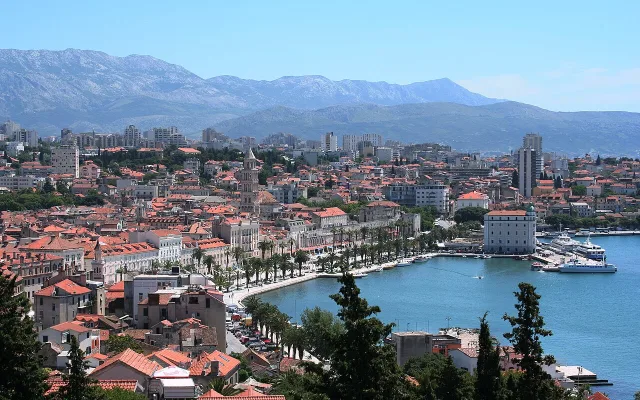
Diocletian's Palace, Bačvice beach and the ferries to Hvar.
Wiki
Split is the largest city in Dalmatia and the second largest in Croatia, spread across a rocky Adriatic peninsula between the sea and a mountain massif. Its historic centre grew up literally inside a classical palace, so Split is often called a living open-air museum, where everyday life goes on among ruins more than seventeen centuries old.
Diocletian's Palace and the Old Town
The core of the city is the residence of the Roman emperor Diocletian, raised at the turn of the 4th century AD as the place where the ruler spent his final years after abdicating. The complex covers about 38,000 m², is on the UNESCO World Heritage list and is unique in that it never became a mothballed monument: cafes, shops, hotels and private flats operate within its walls.
Key points on a walk:
- The Peristyle — the central square with its colonnade, from which the entrances to the main buildings open; concerts and street performances are often held here.
- The Cathedral of St Domnius — set in the emperor's former mausoleum, which makes it one of the oldest working Catholic churches in the world. From the Romanesque bell tower you can see the roofs of the Old Town and the harbour.
- The substructures — well-preserved vaulted halls in the base of the palace, which give a sense of the scale of the ancient building.
- The gates — the Golden, Silver, Iron and Bronze gates mark the four sides of the enclosure; by the Golden Gate stands the imposing statue of Bishop Gregory of Nin by Ivan Meštrović.
Beside the palace lies the medieval part of the city, with narrow lanes, the Narodni trg square (the Pjaca) and the fish market.
What to see beyond the centre
- The Riva — the palm-lined promenade along the port, the main place for evening walks and for residents to meet.
- Marjan hill — a forest park on the western tip of the peninsula, with viewpoints, trails, hermits' chapels and a panorama over the archipelago.
- Klis Fortress — a mountain stronghold a few kilometres from the city, which for centuries guarded the approaches to Dalmatia; it opens a wide view over the coast.
- The Meštrović Gallery — a collection of works by Croatia's greatest sculptor, housed in his former villa.
Beaches
The city beach of Bačvice is famous for its shallow sandy bottom and for the traditional game of picigin, in which players keep a ball from falling into the water. It suits families and is within walking distance of the stations. Beyond it, along the Marjan peninsula and in the western districts, there are pebble and rocky coves — Kaštelet, Bene, Ovčice — with a calmer atmosphere.
Dalmatian food
The local table rests on the gifts of the sea and Mediterranean traditions: grilled fish and seafood, black risotto with cuttlefish, pašticada beef braised and served with gnocchi, air-dried pršut ham and sheep's cheeses. Among drinks, red wine from the Plavac Mali grape and the grape spirit rakija are popular. For fresh produce, fruit and local delicacies it is worth looking in at the Pazar green market by the eastern wall of the palace.
Ferries and transport
Split is the largest ferry hub in this part of the Adriatic. From the terminal beside the centre, vessels leave for the islands of Hvar, Brač, Vis and Korčula, as well as on international routes to Italy. Fast catamarans and car ferries connect the city with the popular resorts in a matter of tens of minutes. Bus services reach Dubrovnik, Zadar, Zagreb and neighbouring countries; an international airport works nearby. Around the city itself walking is easiest — the historic core is compact — while city buses serve the outskirts.
When to go, and advice
The high season runs from May to October, with the peak in July and August, when the waterfronts and the lanes of the Old Town are especially busy and accommodation costs more and is better booked in advance. The shoulder seasons — late spring and early autumn — give comfortable weather for walking and swimming with fewer visitors. Over three days it makes sense to divide the time like this: the first day for the palace, the cathedral and the Riva, the second for Marjan, the museums and the beaches, the third for a day trip to Hvar, Brač or Klis Fortress. Comfortable shoes come in handy: the paved ancient slabs and the climbs to the viewpoints invite walking.
Photos