Ashgabat
TurkmenistanDescription
The capital of Turkmenistan: a city of white marble, monumental avenues, the Gypjak mosque and the Darvaza gas crater out in the Karakum.
Wiki
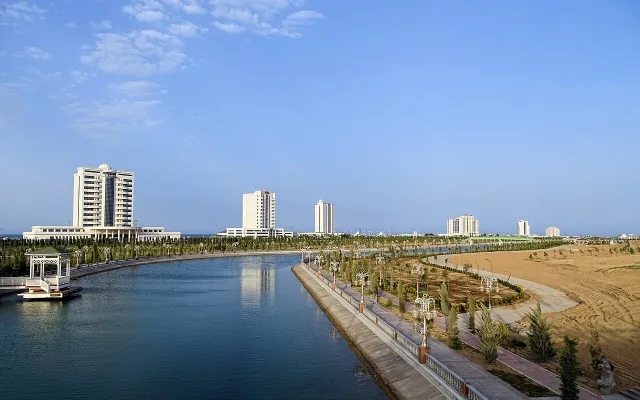
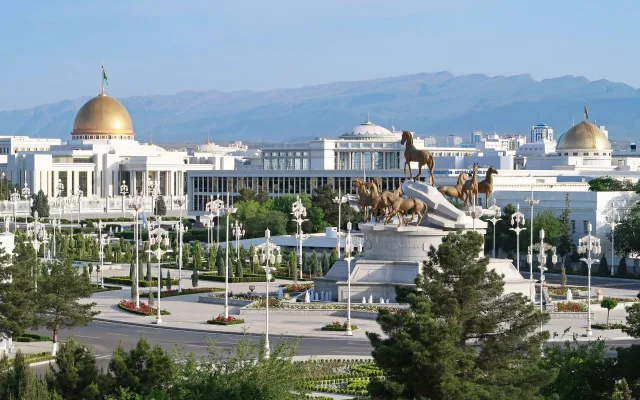
Ashgabat is that rare city where the town plan itself works as an exhibit: white marble, perfectly straight avenues, gold domes and the silence of wide squares that almost nobody crosses. It is not about charm or the atmosphere of an old town — what is interesting here is monumentality pushed to the point of absurdity, and that is exactly what independent travellers come for.
What to understand before you go
Ashgabat is not a place for wandering freely. Turkmenistan remains one of the most closed countries in the world, and that colours everything.
- A visa must be arranged in advance, usually on a letter of invitation from a local travel agency. A 3–5 day transit visa is a genuine alternative for anyone continuing to Uzbekistan or Iran: it is issued without an invitation, but with your route specified.
- Movement around the country is restricted — the regions normally require a guide and a driver. Walking around Ashgabat itself is fine.
- Photographing government buildings, palaces and people in uniform is not allowed. Put the camera away near guard posts: this is not a formality, and someone will come over.
- The internet is heavily filtered. VPNs often fail and messaging apps are blocked. Work out in advance how you will stay in touch.
The main sights
The principal monuments stand in the ceremonial part of the city and link easily into one route.
- The Neutrality Monument — a 95-metre column topped with a gilded figure of the first president; there is an observation deck inside, and the view over the marble city from above is the reason people go up.
- The Independence Monument — a 118-metre column in Independence Park, ringed by bronze figures of historical rulers. A taxi is the easy way to move between the two monuments.
- The Türkmenbaşy Ruhy Mosque in the village of Gypjak, about 15 km from the centre, is the largest in Central Asia, with the first president's family mausoleum beside it. Inside, quotations from the Ruhnama are set on the walls alongside verses of the Quran — a detail worth seeing for yourself.
- The National Museum of Turkmenistan — carpets, jewellery, finds from Nisa and Merv, and Akhal-Teke horses. Useful if you want to understand what the country is proud of besides marble.
- Parthian Nisa — the ruins of a Parthian royal fortress and a UNESCO site by the village of Bagyr, about 18 km west; the trip fits into half a day.
- The bazaars — the Russian Bazaar (Gulistan) in the centre and the vast Altyn Asyr on the edge of town, successor to the famous Tolkuchka. These are the only unrehearsed places in Ashgabat, and worth visiting for real contact with people and food.
The city is floodlit at night, and many of the monuments — along with the giant Ferris wheel in the Alem centre — look better in the dark. Allow for one evening walk.
Darvaza, the Gates of Hell
A burning gas crater in the Karakum desert about 260 km north, roughly four hours by 4x4. For many people it is the whole reason to obtain a visa in the first place.
- The crater is at its most impressive after dark, so the sensible format is a tour with a night in the desert, in a tent or a yurt. A there-and-back day trip drains the point out of it.
- A jeep tour runs to roughly $250–400 for a group, usually including dinner and the overnight stay. Compare what different agencies offer: prices are negotiable.
- The crater is gradually dying down, and the authorities have repeatedly said they intend to extinguish it, so if this is what you are coming for, do not put it off.
How much time to allow
Two days is enough for the city itself: one for the monuments and museums, half a day for the mosque at Gypjak, an evening for the floodlighting. Darvaza is another one to two days on top.
Transport
- The airport. Ashgabat International is a large terminal shaped like a flying falcon. A taxi into the centre costs $7–10.
- Around town there are taxis ($2–5, negotiated, no meters) and buses. Distances are long and walking between the ceremonial set pieces is slow and hot: take a car.
- Car hire barely exists; travel around the country is done with a driver, and that is part of the tourist formalities rather than a free choice.
- Carry cash, preferably dollars. Cards are rarely accepted and cash machines are unreliable. There is an official rate for the manat and a street rate, and the gap is substantial — change money with an eye on local advice.
Food and prices
The cooking is hearty and meat-heavy: plov, manti, chorba, kebabs and dograma (lamb with crumbled flatbread). Look for chaikhanas — cheaper and more authentic than restaurants.
- Lunch in a chaikhana is $5–8, dinner in a restaurant $15–25.
- A chorek flatbread costs about $0.30, and melons and fruit in summer are cheap and excellent.
- Alcohol is sold under licence and not everywhere — do not count on finding it freely.
Prices are as of 2026. Food and taxis genuinely are cheap; tours, the visa and the logistics are not, and most of your money goes on organisation rather than daily living.
When to go
- April to May and September to October are the sweet spot, at 20–28°C.
- Summer (June to August) brings 40–45°C in the city and worse in the Karakum; the white marble dazzles and walking in daylight is hard work.
- Winter is mild, but the ceremonial city without greenery looks bleak.
Common mistakes
- Travelling with no slack in your dates — visa and border procedures are not quick.
- Planning Darvaza as a single day: you lose the whole point of the crater at night.
- Expecting cards, internet and alcohol to work as they do elsewhere — none of it does.
- Photographing everything in sight: around restricted buildings that ends in a conversation with security.