
Description
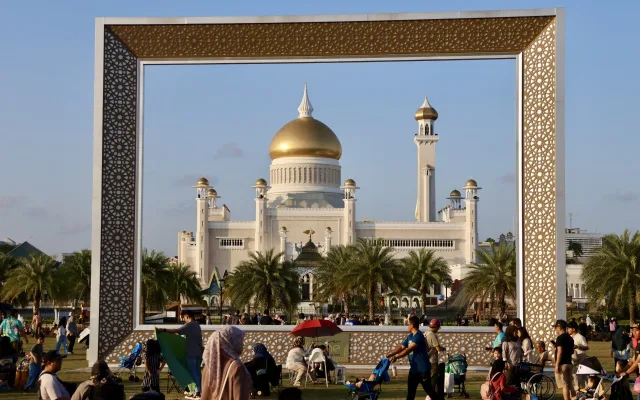
The capital of Brunei — the golden Omar Ali Saifuddien mosque, the stilt village of Kampong Ayer and the sultan's palace.
Wiki
A quiet, wealthy and unusually orderly city, where oil money has turned the capital into a shop window for the sultanate: golden domes, a village on the water and almost no tourist bustle. Bandar Seri Begawan (locals just say BSB) is a place you come to not for action but for an unusual picture and a couple of calm days between other points on Borneo.
What is genuinely worth seeing
Two days covers the essentials without rushing — the city is small and the sights are concentrated.
- The Sultan Omar Ali Saifuddien Mosque — the country's calling card. A golden dome, marble minarets and an artificial lagoon with a ceremonial barge. Non-Muslims are admitted during set hours (not during prayers, and not on Friday in the middle of the day) — you will need covering clothes, and women are given a robe at the entrance. The best shot is at sunset from the far side of the lagoon.
- The Jame' Asr Hassanil Bolkiah Mosque — the largest in the country, with 29 domes, standing a little out of the centre. Grander than the first but less of a postcard; worth the trip if the phenomenon of Bruneian mosques has caught you.
- Kampong Ayer — the stilt village, the largest in the world by population. It is not a museum but a living district with houses, schools and mosques above the water. The way to do it: take a water taxi, ride through the channels, get out and walk the wooden walkways. Many boatmen will offer a detour to the river mouth on the way, where proboscis monkeys can sometimes be seen.
- The Royal Regalia Museum — golden thrones, the coronation palanquin, gifts from heads of state. Entry is normally free and the air conditioning is a relief from the heat. A good option for the middle of the day.
- Istana Nurul Iman — the sultan's official residence and one of the largest residential palaces in the world. You cannot get inside: it opens only for a few days at the end of Ramadan. The rest of the year it is photographs from a distance, from the water or from viewpoints.
Outside the city is Ulu Temburong National Park: primary forest with a canopy walkway, reached only by longtail boat up the river. That is a separate full-day trip — better still with an overnight — and is taken as a tour.
How many days, and how to structure them
Two days is enough. Broadly: the first day for the centre, both mosques, the regalia museum and sunset at Omar Ali; the second for Kampong Ayer and the boat trip, or else the whole day out to Temburong, in which case the mosques get packed into day one.
Getting there and getting around
The airport (BWN) is 10-15 minutes from the centre. There is almost no public transport; city buses are infrequent and finish early, so do not count on them.
- From the airport — a taxi or a transfer arranged with your hotel in advance.
- Around the city — the Dart app (the local equivalent of Uber) is noticeably cheaper and easier than street taxis, of which there are physically very few.
- Kampong Ayer — water taxis run straight from the waterfront and cost very little. Agree the price for a tour of the channels before getting in.
The centre is compact and it is realistic to walk between the waterfront, the market and the museums, but it is hot and humid by day — plan your dashes from one air-conditioned space to the next.
Where to stay
It makes sense to stay in the centre, near the waterfront and the Omar Ali mosque: everything is walkable from there and the evening view is at hand. The choice of hotels is small and there are almost no budget hostels, so book ahead.
Food, prices and the alcohol ban
The main thing to prepare for: alcohol is not sold at all, and there are no bars. Non-residents may bring in a limited personal allowance for their own use, but there is no drinking in public. What there is instead is coffee, teh tarik and fresh fruit juice everywhere.
Try ambuyat (a sticky sago paste with a sour dip, the local curiosity), nasi katok (rice, chicken and sambal — the cheap popular set), satay and fresh seafood. The place to start is the Tamu Kianggeh market and the evening food stalls. Lunch at a simple eating house is cheap, and dinner at a restaurant is middling by South-East Asian standards. Fuel is among the cheapest in the world, which shows in the price of taxi rides.
When to go, and what to expect
It is hot and humid all year, 26-32°C. It is relatively drier from roughly March to October; from November to February the rain is more frequent, but usually as short downpours rather than continuous bad weather.
Keep the country's rhythm in mind: from midday on Fridays much of the city closes for prayers, some shops do not open at weekends, and during Ramadan there is almost nowhere to eat openly during the day. Dress modestly, especially near mosques. The country is very safe — street crime is practically nonexistent — but the "nightlife" here amounts to a walk past a floodlit mosque.
Common mistakes
- Arriving without a transport plan and getting stranded — install Dart beforehand.
- Turning up at a mosque in shorts, or at the wrong hour, and not getting in — check the visitor hours.
- Expecting bars and an evening scene: there are none, and the evening here is about views and food.
- Trying to get into the palace on an ordinary day — it is only realistic at the end of Ramadan.