Boracay
PhilippinesDescription
A legendary island with White Beach — paraw sails, diving and sunsets over the sea.
Wiki
Boracay is a small tropical island in the heart of the Philippine archipelago, famous for its sugar-white sand and azure water. Despite its modest size — about 7 km long and no more than 2 km wide — it regularly appears on lists of the best beach destinations in South-East Asia. After a six-month closure in 2018, when the authorities carried out a large-scale environmental clean-up, the resort changed noticeably: permanent bars and structures were removed from the shore, the number of visitors on the island at any one time was capped, and strict rules were introduced on lighting, sewage and waste. The result is a cleaner, quieter and more orderly Boracay that has kept what matters most — the sea and the shore.
Geography and layout
Administratively the island belongs to Aklan province in Western Visayas. The main settlements are the barangays of Balabag, Manoc-Manoc and Yapak. The west coast, facing calm water, holds the famous White Beach; the eastern side is open to the wind and favoured by watersports enthusiasts. There is almost no car traffic: people move by tricycle, electric cart and rented scooter, and a pedestrian promenade runs the length of the west shore.
Main sights
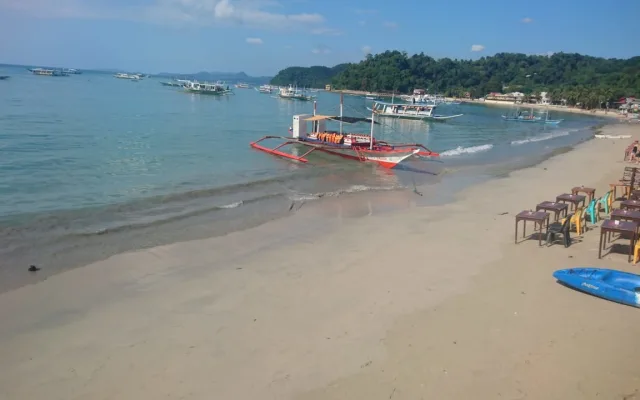
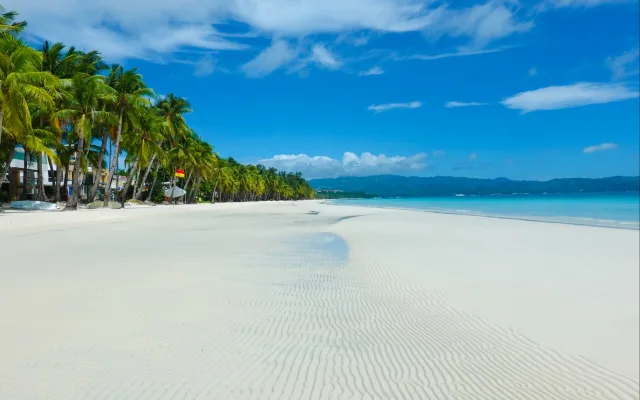
- White Beach — Boracay's calling card: four kilometres of snow-white coral sand and turquoise shallows. The beach is loosely divided into Station 1 (open views and larger hotels), Station 2 (the centre of things, next to the shopping quarter) and Station 3 (quieter and cheaper).
- Puka Shell Beach — the northern shore, named for the puka shells woven into local jewellery. Uncrowded and unspoilt.
- Bulabog Beach — the eastern beach and one of the world's centres for kitesurfing and windsurfing. The steady amihan wind season runs roughly from December to April.
- Crystal Cove — two small islands nearby with grottoes, viewpoints and a zipline.
- D'Mall and D'Talipapa — a pedestrian shopping area with cafés and souvenirs, and next to it a fish market where your chosen seafood is cooked in front of you.
- Mount Luho — the island's highest point, with a panorama over the coast and the inland hills.
Activities and the sea
Boracay is not only about lying on the sand. The coastal waters suit diving and snorkelling: the reefs hold colourful corals and shoals of fish, and the popular dive sites include walls and small wrecks. A classic outing is a trip on a paraw, the traditional Philippine outrigger sailing boat; these are especially fine at sunset, which has become a symbol of the island. Helmet diving, banana boats, parasailing and evening cruises along the coast are popular too.
Food and prices
The cooking mixes Filipino dishes with international menus. Try adobo (meat in a soy and vinegar marinade), the sour soup sinigang, roast lechon and fresh mango shakes. Lunch at a local carinderia costs roughly $6–10, dinner at a restaurant $20–40, and grilled tuna at Talipapa $15–25. Everyday costs: a litre of petrol about $1, a tricycle ride $1–3, a scooter for the day $10–15.
Getting there and around
The nearest airports are Kalibo (KLO), about two hours away, which takes more international and cheaper flights, and Caticlan (MPH), a quarter of an hour from the ferry and handy for domestic flights. From Caticlan port a ferry crosses to the island ($2–3), plus an environmental fee of about $4 and a terminal fee. On Boracay itself, tricycles and scooters are the easiest way to get around.
When to go
The best time is the dry amihan season, roughly December to May, with comfortable temperatures of 25–32 °C. During this period the west coast and White Beach stay calm while the eastern side gets steady wind for sailing sports. The summer and autumn months (habagat) bring rain and higher humidity, but lower prices and fewer visitors.
How long to allow
Five days is enough to take the island in slowly: a couple of days for the beach and sunsets at White Beach, a day for a boat trip taking in Puka Beach and Crystal Cove, a day for diving or snorkelling, and one more for kitesurfing at Bulabog or an unhurried look at the local food and markets.