Description
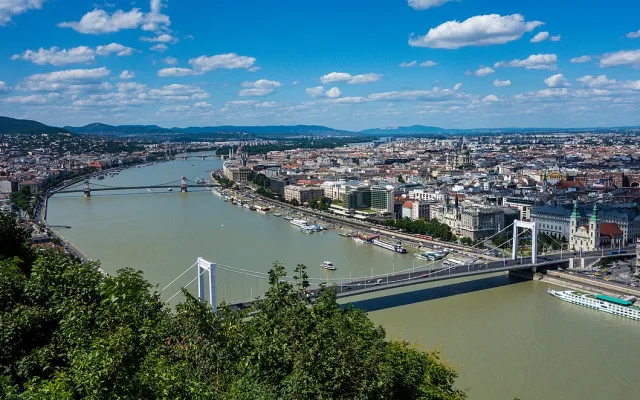
Budapest is a capital known for historic landmarks such as the Fisherman's Bastion, the Széchenyi thermal baths and the atmosphere of its ruin bars.
Wiki
Budapest is the capital of Hungary, the country's largest city and one of the most beautiful in Central Europe, spread along both banks of the Danube. The historic core, together with the embankments and Andrássy Avenue, is on the UNESCO World Heritage list, and the combination of imperial architecture, thermal springs and a nightlife scene all its own makes the city one of the most alluring destinations in the region.
General character and districts
Modern Budapest came into being in 1873 with the union of three settlements: hilly Buda and Óbuda on the west bank and flat Pest on the east. That division still defines the character of the city. Buda means quiet green hills, the Castle District with its cobbles and views over the river; Pest is the business and commercial heart, with broad boulevards, coffee houses and theatres. Bridges join the two banks, among them the famous Széchenyi Chain Bridge (1849), the first permanent crossing of the Danube and a symbol of the city.
Administratively the city divides into districts designated by Roman numerals. The ones that matter to a visitor are District I (the Castle), V (central Pest with the Parliament and the Basilica), VII (the former Jewish quarter with the ruin bars) and XIV (Városliget park with the Széchenyi baths).
Main sights
- The Fisherman's Bastion — a neo-Gothic terrace with seven towers symbolising the Hungarian tribes. It offers the finest panorama of the Parliament and the Danube; access to the upper levels is charged, the lower ones are free.
- Buda Castle — the palace complex on Castle Hill, housing the Hungarian National Gallery and the History Museum. The old Sikló funicular runs down to the embankment.
- The Hungarian Parliament Building — a vast neo-Gothic structure on the bank of the Danube, one of the largest in the world (some 700 rooms). Inside are the Hungarian crown jewels, including the crown of St Stephen. Tours are by advance registration.
- St Stephen's Basilica — the largest church in the capital, in neo-Renaissance style, holding as a relic the mummified right hand of the first Hungarian king. From the gallery of the dome a panorama of Pest opens up.
- Andrássy Avenue and Heroes' Square — the ceremonial axis of the city, with the opera house, grand houses and the Millennium Monument. Beneath the avenue runs the continental metro line, the oldest on the mainland.
- Gellért Hill with the Citadel and the Liberty Statue, along with Margaret Island, a green recreation area in the middle of the Danube.
The thermal baths
Budapest stands on dozens of hot springs and rightly holds the status of a spa city. The Széchenyi Baths in Városliget park form one of the largest thermal complexes in Europe, with their recognisable yellow neo-baroque buildings and open-air pools that work all year round. No less famous are the art nouveau Gellért baths, along with the historic Turkish baths Rudas and Király, surviving from the Ottoman rule of the 16th and 17th centuries.
Ruin bars
A distinctive feature of city life is the ruin bar (romkocsma). They grew up in the abandoned houses and courtyards of the former Jewish quarter in District VII, turned into eclectic spaces with mismatched furniture, graffiti and live music. The originator of the genre is Szimpla Kert, now an attraction in its own right. Instant, Fogas Ház and others work nearby, forming an atmospheric night-time scene.
Food
Hungarian cooking is filling and generous with paprika. Its emblem is gulyás, a thick soup of beef, vegetables and red pepper. The street classic is lángos, a fried flatbread with sour cream and grated cheese. It is worth trying főzelék (a vegetable stew-puree), paprikás, and for something sweet the kürtőskalács chimney cake and the Dobos torte. For gastronomic shopping, people head to the Central Market Hall by Fővám Square: sausages, paprika, salami, goose liver and Tokaj wines. By European standards Budapest remains a comparatively affordable city.
Practicalities
Three days are enough to cover the essentials. It makes sense to give the first day to Buda — the Castle, the Fisherman's Bastion and the baths; the second to Pest with the Parliament, the Basilica and Andrássy; the third to the ruin bars, the market and a soak in the thermal water. Public transport is well developed: metro, trams (route 2 along the Danube is especially scenic) and buses. The currency is the Hungarian forint, though cards are accepted in many places. The best time to visit is late spring and early autumn, when it is warm and not too crowded.