Description
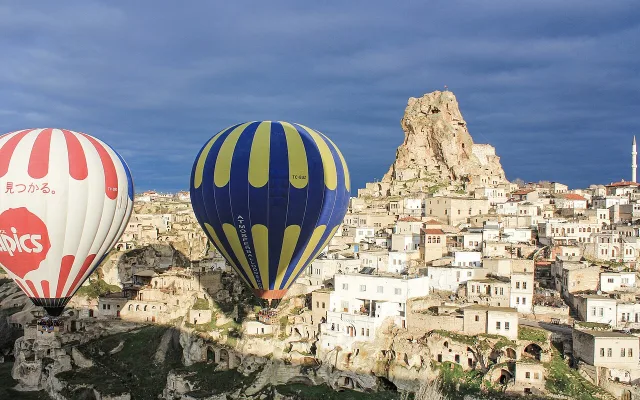
A lunar landscape with cave hotels, hot-air balloons and canyons.
Wiki
Cappadocia is a historic region in the centre of Turkey, famous for the fantastical landscape that volcanic tuff has formed over millions of years. The soft rock, compressed from the ash of the ancient volcanoes Erciyes and Hasandağ, has been worked by wind and water into whimsical cones, pillars and ridges — the celebrated "fairy chimneys". The region is on the UNESCO World Heritage list and counts as one of the most instantly recognisable places on the planet.
History and the origin of the landscape
People settled here as far back as the Hittite era, and the name "Cappadocia" goes back to the Old Persian Katpatuka; the popular gloss "the land of beautiful horses" is appealing but disputed by linguists. The soft tuff turned out to be an ideal material for digging dwellings: in the first centuries AD, churches, monasteries and whole villages appeared in the rock. In the Byzantine era the region became an important centre of early Christianity — people fled here from persecution and later from Arab raids. It was then that the underground cities were built, where thousands sheltered together with their livestock and supplies. The writings of the Cappadocian Fathers of the Church — Basil the Great, Gregory of Nazianzus and Gregory of Nyssa — also survive.
What to see
The core of touristic Cappadocia is the triangle of villages Göreme, Uçhisar and Avanos, around which the main sites are concentrated.
- Göreme — the heart of the region and a convenient base for excursions. The open-air museum preserves a complex of 10th–11th-century cave churches with frescoes, among which the Dark Church (Karanlık Kilise) stands out.
- Paşabağ Valley (Monks' Valley) — the most picturesque cluster of mushroom-shaped fairy chimneys with several caps apiece.
- Love Valley — tall, elongated rock pillars, striking at sunset.
- The Rose and Red valleys — the soft tones of the rock are especially beautiful in evening light; walking routes run through them.
- Derinkuyu and Kaymaklı — the largest underground cities, with ventilation shafts, wells, kitchens and round millstone doors.
- Avanos — a small town on the Kızılırmak river, known for its pottery made from red clay.
- Zelve Valley — an abandoned cave settlement whose inhabitants were resettled in the middle of the 20th century.
Hot-air balloon flights
The dawn flight over the valleys has become the symbol of Cappadocia. Dozens of balloons rise at once, opening a view over the rocks, canyons and vineyards from above. Flights depend heavily on the weather and the wind, so in poor conditions they are cancelled for safety. If a balloon does not fit the budget, the same picturesque scene can be watched for free from the viewpoints around Göreme or from hotel roofs.
Cave hotels
A night in a room carved directly into the rock is an attraction in itself. Stone walls hold the cool in summer and the warmth in winter, and the terraces of the boutique hotels in Göreme and Uçhisar look out over the valleys. The range is wide, from plain cave rooms to designer suites. In high season places go early, so booking is worth planning well ahead.
Food
The local food is filling and unfussy. Its emblem is the testi kebab (pot kebab): meat and vegetables are slow-cooked in a sealed clay vessel that is broken open with a flourish before serving. It is worth trying Turkish manti, gözleme, the local wines from vineyards on volcanic soil, and also dried apricots and pekmez (grape molasses). In Avanos many places combine a meal with a pottery demonstration.
Practicalities
- Getting there. The nearest airports are Kayseri and Nevşehir, both with flights from Istanbul and other cities. Transfers and shuttles run from the airports to the villages. There are also night buses from the larger cities.
- Getting around. The valleys are conveniently seen on jeep tours, by hired car or scooter; part of the routes is easily walked. The organised "green" and "red" tours are popular.
- When to go. Spring (April–May) and autumn (September–October) are best: comfortable temperatures and settled weather for flying. Summer is hot and crowded; in winter the rocks under snow look magical, but the balloons often stay on the ground.
- How long to allow. Three days are enough to see the main valleys, descend into an underground city and go up in a balloon.
Useful to know
Wear comfortable shoes — the paths are stony and dusty. Dawns are cool even in summer, so a warm layer comes in handy. Many viewpoints are free, and the best shots come in the soft light of morning and evening, when the tuff takes on pink and golden tones.