Description
Copenhagen is the capital of Denmark, known for its canals, the Nyhavn waterfront, the Tivoli amusement park, and Kronborg Castle an hour up the coast.
Wiki
Copenhagen is the capital and largest city of Denmark, situated on the eastern coast of the island of Zealand and partly on the island of Amager, by the Øresund strait. It ranks among the world's most cycle-friendly, environmentally conscious and — by international surveys — happiest capitals: around 660,000 people live within the city limits and approximately 1.3 million in the greater metropolitan area.
Character and atmosphere
The city blends royal history, contemporary Scandinavian architecture and a thoughtfully designed urban environment. There are more bicycles than residents: up to half of all commutes to work or school are made by bike, and a network of dedicated lanes covers virtually the entire centre. Copenhagen is widely regarded as the gastronomic capital of Northern Europe — the New Nordic cuisine movement was born here, and the restaurant Noma has been named the world's best on multiple occasions. The concept of hygge — a cosy, unhurried contentment — largely defines the local rhythm of life.
Main sights
- Nyhavn — the city's most recognisable waterfront, lined with colourful 17th–18th-century townhouses and wooden sailing vessels moored at the quay. The fairy-tale writer Hans Christian Andersen lived in several of the buildings at various times, including Nos. 67 and 20.
- The Little Mermaid (Den Lille Havfrue) — a bronze statue from 1913 inspired by Andersen's fairy tale, standing just about 1.25 m tall. Many visitors are surprised by how small she is, yet she remains the city's defining symbol.
- Tivoli — an amusement park dating from 1843, one of the oldest still running and said to have inspired Walt Disney. The outright record-holder is nearby Bakken (Dyrehavsbakken, 1583), also on Copenhagen's doorstep. Alongside the rides there are gardens, concert venues and spectacular illuminations.
- Rosenborg Castle — King Christian IV's Renaissance palace, housing the royal regalia and treasury, set within the Kongens Have (King's Garden) park.
- Amalienborg Palace — the royal family's winter residence, comprising four identical palaces arranged around an octagonal square; the changing of the guard takes place at noon.
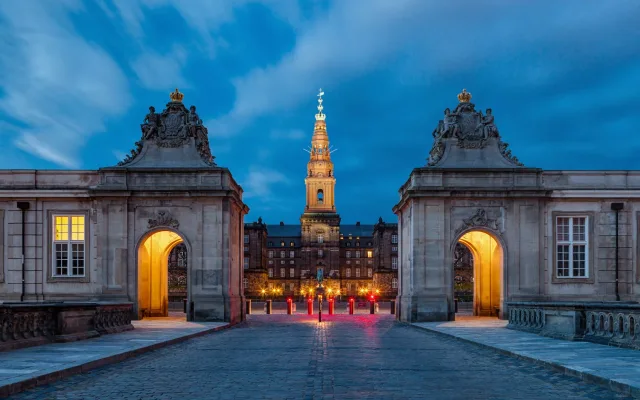
- Christiansborg Palace — home to the Danish parliament (Folketing), as well as surviving royal reception halls and the ruins of earlier fortifications.
- Freetown Christiania — a self-proclaimed autonomous neighbourhood established in 1971 on a former military site, known for its alternative culture and street art.
- Strøget — one of the longest pedestrian streets in Europe (about 1.1 km), stretching from City Hall Square to Kongens Nytorv.
- Church of Our Saviour (Vor Frelsers Kirke) — notable for its external spiral staircase winding up the spire, with panoramic views over the city.
History and culture
The settlement by the harbour — købmandshavn, meaning "merchants' harbour" — grew from a fishing village fortified in the 12th century by Bishop Absalon. The city flourished under King Christian IV (late 16th–early 17th century), during whose reign Rosenborg Castle, the Christianshavn district and the Round Tower were built. Today Copenhagen is a centre of design and architecture: works by studios such as BIG, the Design Museum, the Louisiana Museum of Modern Art (north of the city), and examples of mid-20th-century functionalism and classic furniture design that can be spotted in virtually every café.
Food and drink
Danish cuisine revolves around local produce, fish and rye bread. Smørrebrød — open-faced sandwiches on dense rye bread topped with herring, prawns, roast beef or egg — is an essential try. Street-food hot dogs (pølser) from roadside stands are hugely popular, as is wienerbrød (the original "Danish pastry"). Food halls such as Torvehallerne and Reffen are great spots for a relaxed lunch. Copenhagen is an expensive city: plan your budget in advance, though chain cafés and markets make it possible to eat well without spending a fortune.
Practical information
- Getting there: Copenhagen Airport (Kastrup) is connected to the city centre by metro and train, with a journey time of around 15 minutes.
- Getting around: the metro runs around the clock and operates on a unified zone system; the Copenhagen Card is a convenient option. The best way to explore is by hire bike.
- How long to allow: four days is a comfortable amount of time to cover the centre, visit the main museums and take a day trip or two.
- Weather: the climate is mild and maritime; the best time to visit is May through September.
Day trips
- Kronborg Castle in Helsingør — a Renaissance fortress on the shores of the Øresund, known as "Hamlet's Castle" and a UNESCO World Heritage Site, roughly 45–50 km north of the city.
- Malmö, Sweden — the train crosses the Øresund Bridge in about 35–40 minutes, making a half-day trip to the neighbouring country very straightforward.
- Roskilde — the old royal capital, with its royal burial cathedral and the Viking Ship Museum.