Description
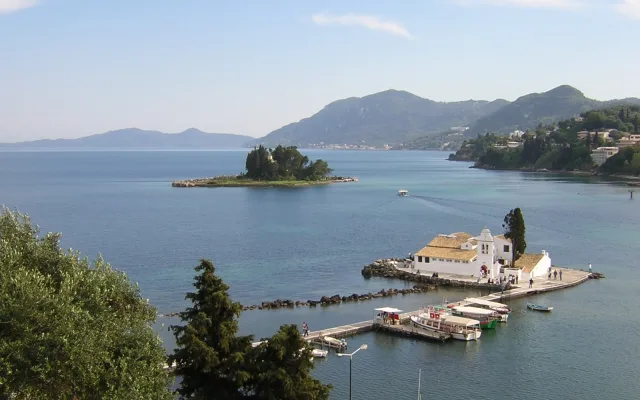
An emerald Ionian island of Venetian forts, olive groves, turquoise bays, and a refined Greco-Italian cuisine.
Wiki
Corfu (Greek: Kerkyra) is the northernmost and one of the greenest islands of the Ionian Sea, lying off the coast of Epirus and just a short distance from the Albanian shore. Four centuries of Venetian rule and its position on the boundary between the Western and Greek worlds made the island a genuinely distinctive cultural crossroads, where Italian refinement blended with Hellenic tradition.
Geography and general character
The island stretches roughly 60 km from north to south and has a population of around 110,000. The north is mountainous, dominated by the Pantokrator massif (906 m) — Corfu's highest point, from whose summit the coasts of Italy and Albania are visible on a clear day. The south is flatter and more open, with long sandy beaches. The western coastline is carved into rocky coves of turquoise water, and the whole island is draped in olive groves — some 4.5 million trees, many of them planted by Venetians who paid peasants for every tree they grew. It is the olives that give Corfu its famous emerald hue.
History
Kerkyra was a Greek colony as early as the 8th century BC and is mentioned in Homer as the land of the Phaeacians. The island's present character was shaped by the Republic of Venice, which held it from the late 14th to the 18th century; during that time Corfu became a powerful fortress that withstood four Ottoman sieges, making it the only part of Greece that was never under Turkish rule. After Venice fell the island passed to the French, then to a British protectorate (1815–1864) that brought roads, running water, Greece's first university, and a distinctive stock of civic buildings. In 1864 the Ionian Islands were united with the Kingdom of Greece.
The Old Town (Kerkyra)
The historic centre is a UNESCO World Heritage Site, recognised as a rare example of a fortified Mediterranean town. Its narrow lanes — kandounia — lined with tall Venetian houses, hanging laundry, and sudden open squares recall Venice and Naples.
- Old Fortress (Palaio Frourio) — 15th–16th-century Venetian fortifications on a rocky promontory separated from the town by an artificial moat, the Contrafossa.
- New Fortress (Neo Frourio) — 16th century, offering the best views over the harbour and terracotta rooftops.
- Liston — a French-style arcaded street modelled on the Rue de Rivoli in Paris; the main spot for coffee and evening strolls.
- Spianada — a vast esplanade between the Liston and the Old Fortress, one of the largest squares in the Balkans.
- Palace of Saints Michael and George — a British residence built in 1819, now home to the Museum of Asian Art.
- Church of Saint Spyridon — patron saint of the island; its tall campanile with a red dome is the main landmark of the centre.
Surroundings and coastline
- Achilleion — a neoclassical palace built for Austrian Empress Elisabeth (Sisi) in the village of Gastouri, dedicated to Achilles, with a sculpture garden and sea views.
- Paleokastritsa — a picturesque bay with several coves and a 13th-century clifftop monastery.
- Pontikonisi ("Mouse Island") — a tiny islet with a chapel near Kanoni, one of the island's enduring symbols.
- Sidari, with its Canal d'Amour (Kanali tou Erota) — a narrow passage cut through soft sandstone cliffs on the north coast.
- The north-east (Kassiopi, Kalami, Agni) — quiet bays where the Durrell family lived in the 1930s; Gerald Durrell described the island in his trilogy My Family and Other Animals.
Cuisine
Corfiot cooking differs noticeably from mainland Greek food in its use of spices and Italian influences:
- pastitsada — braised beef or cockerel in a spiced tomato sauce served with thick pasta;
- sofrito — veal in a white wine, garlic and parsley sauce;
- bourdeto — fish in a sharp sauce of red pepper and tomato;
- tsitsibira — a local ginger lemonade, a legacy of the British period;
- kumquat — a dwarf citrus used to make liqueurs, preserves, and sweets.
Local olive oil and regional wines are also highly regarded.
Practical information
Around four days is a good amount of time to explore the island: one day for the Old Town and fortresses, one for the Achilleion and the southern coast, one for Paleokastritsa and the western coves, and one for the north-east and Pantokrator. The best time to visit is May to October; July and August are the hottest and most crowded months. Corfu is easy to reach by air into Kerkyra Airport or by ferry from Igoumenitsa and from several Italian ports. KTEL buses cover the main routes, but for remote coves and mountain villages a hire car or scooter is the more practical option.