Description
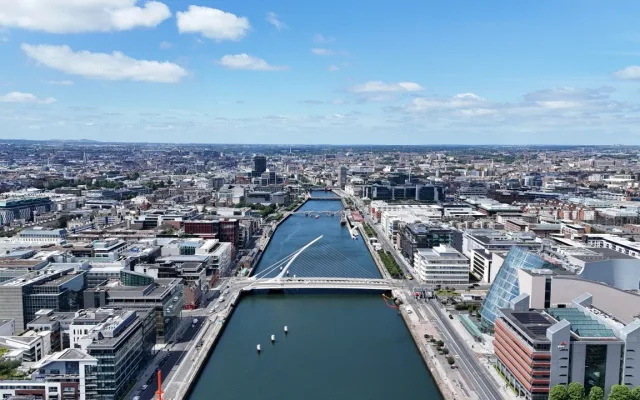
Dublin is the capital of Ireland, known for its ancient castle and historic Trinity College, home to the Book of Kells. The city also has a lively pub scene centred on the Temple Bar quarter.
Wiki
Dublin (Irish: Baile Átha Cliath) stands on the east coast of the island where the River Liffey meets Dublin Bay on the Irish Sea. Founded by Vikings in the 9th century as a trading port, it is today the political, economic and cultural capital of Ireland, home to a large share of the country's population and the European offices of many of the world's major technology companies.
A little history
The first settlement on the site grew up around a "black pool" (Dubh Linn) that gave the city its name. Under the Normans in the 12th century Dublin became an outpost of the English Crown, and later the second city of the British Empire. The Georgian era of the 18th century left behind elegant red-brick townhouses with brightly painted doors, broad squares and graceful bridges. The 20th century was shaped by the struggle for independence: the Easter Rising of 1916, the War of Independence, and the proclamation of the Free State in 1922. These events are still felt in the city's place names and monuments.
What to see
The four headline sights run as follows. The Trinity College library holds the Book of Kells, a ninth-century illuminated gospel. The Guinness Storehouse is a seven-storey brewery museum with a panoramic bar at the top, where the pint is included in the ticket. Dublin Castle retains little of the Norman fortress beyond the Record Tower; the rest is Georgian state rooms. St Patrick's Cathedral is the largest church in Ireland, and Jonathan Swift was its dean for twenty years. Beyond those, there is plenty more:
- Christ Church Cathedral — the older of the city's two medieval cathedrals, with an impressive crypt and 12th-century stonework.
- National Museum of Ireland — an archaeological collection featuring bog bodies, Bronze Age gold and Celtic artefacts; entry is free.
- National Gallery of Ireland — paintings from the medieval period to modernism, including works by Caravaggio and Irish artist Jack B. Yeats.
- O'Connell Street and the Ha'penny Bridge — the city's main ceremonial thoroughfare and the elegant pedestrian footbridge that has become a symbol of the Liffey.
- Phoenix Park — one of the largest urban parks in Europe, home to free-roaming deer, Dublin Zoo and the official residence of the President of Ireland.
- Grafton Street — a pedestrianised shopping street with buskers, leading down to St Stephen's Green.
Neighbourhoods and atmosphere
The historic centre is compact and easy to explore on foot. The south bank of the Liffey concentrates the main museums, the university and the Georgian quarters around Merrion Square, where the former homes of writers are preserved. The Temple Bar quarter, with its cobbled lanes, is known for pubs and live music. To the west lies the Liberties — historically the centre of brewing and craft trades, and now changing rapidly. Coastal suburbs such as Howth and Dún Laoghaire offer sea views, seafood restaurants and cliff walks.
A literary capital
Dublin holds the UNESCO City of Literature designation. Joyce, Beckett, Wilde, Yeats, Shaw and Swift were all born here. Visitors can walk the route of Leopold Bloom from Ulysses, and every year on 16 June the city marks Bloomsday. The Museum of Literature Ireland (MoLI) and the Dublin Writers Museum are both worth a visit, as are the old pubs where lines of classic literature were written.
Food and drink
Dublin's table includes soda bread, Galway oysters, smoked salmon and the hearty "full Irish" breakfast of bacon, sausages, eggs and black pudding. Alongside Guinness, Irish whiskey is taken seriously — the old Jameson distillery and the Teeling Whiskey distillery both offer tours. Traditional music sessions (trad sessions) take place in pubs most evenings: they are a genuine part of the city's culture rather than a tourist attraction.
Getting around and practical tips
Dublin Airport is connected to the city centre by Aircoach and Dublin Express coaches as well as regular city bus routes. Within the city the Luas tram, the coastal DART suburban rail line and buses cover most areas; the Leap Card is the most convenient way to pay for all of them. The currency is the euro. The weather is mild but changeable year-round and rain is frequent, so a waterproof jacket is useful in any season.
Over three days, a sensible rhythm is to spend the first on the historic core — Trinity College, the castle, the cathedrals and Temple Bar; the second on the museums, the Guinness Storehouse and Kilmainham Gaol; and the third on a trip to the coast or westward into the country, towards the Cliffs of Moher and Galway. This pace allows visitors to experience both the city and the landscapes that surround it.