Description
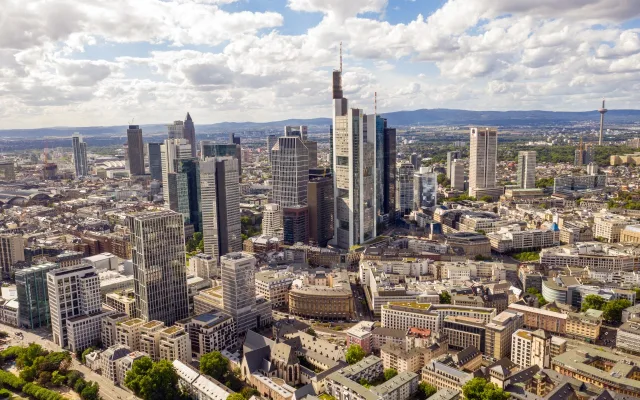
Germany's financial capital, with skyscrapers rising along the Main River, the historic Römerberg square, and famous apple wine served in traditional Sachsenhausen taverns.
Wiki
Europe's financial capital and the continent's busiest airport — around 760,000 people live in the city proper, with 2.8 million in the greater metropolitan area. Headquarters of the European Central Bank, Deutsche Bank, and Commerzbank. "Mainhattan" is Germany's only city with a true skyscraper skyline. Birthplace of Goethe (1749). Around 80% of the city was destroyed in World War II and rebuilt in a mixed style: restored medieval buildings on Römerberg alongside modern towers. Frankfurt is Europe's main transit hub — most visitors pass through on a connection, but one or two days here are well worth it.
Top sights
- Römerberg — the main medieval square, with restored half-timbered houses dating from the 15th century (90% destroyed in 1944, rebuilt 1981–1986).
- Römer — the medieval town hall, built in 1405 and Frankfurt's most recognisable landmark.
- Frankfurt Cathedral (Frankfurter Dom) — coronation church of the Holy Roman Emperors (1356–1792).
- Goethe House (Goethe-Haus) — reconstructed birthplace of Johann Wolfgang von Goethe (1749), now a museum.
- Alte Oper — the old opera house, restored in 1981.
- Museum Embankment (Museumsufer) — 14 museums along the south bank of the Main, including the Städel (fine art), Liebieghaus (sculpture), and Architekturmuseum.
- Städel Museum — Frankfurt's premier art gallery, with an internationally ranked collection.
- Eiserner Steg — a pedestrian bridge across the Main dating from 1869, one of Frankfurt's classic views.
- Mainhattan — the skyscraper district: Commerzbank Tower (259 m), Messeturm (256 m), Trianon, Westend Tower.
- Main Tower — 200 m tall and the only Frankfurt skyscraper with a public observation deck.
- Palmengarten — Frankfurt's main botanical garden (founded 1871), covering 30 hectares.
- Senckenberg Natural History Museum — Germany's largest natural history museum, with an impressive dinosaur collection.
- Apfelwein-Wirtschaften — traditional taverns serving apple wine (Hesse's signature drink), concentrated in the Sachsenhausen neighbourhood.
Food and prices
Frankfurt and Hessian cooking centres on: Frankfurter Würstchen (the classic frankfurter sausage), Grüne Soße (a cold green sauce made with seven herbs, served over boiled eggs — the defining local speciality), Handkäse mit Musik (marinated sour-milk cheese), and Apfelwein (apple wine — the city's emblematic drink). Lunch at a café runs 14–22 EUR (about $16–25), dinner at a restaurant 30–65 EUR ($35–75). A glass of Apfelwein costs 3–5 EUR ($3.50–6). A litre of petrol is around 1.80 EUR ($2.20), an RMV public-transport ticket 3.50 EUR ($4.30) per journey, and a taxi 12–25 EUR ($14–29). Prices are as of 2026.
Getting there and around
Frankfurt Airport (FRA) is Germany's largest and one of Europe's busiest, serving as Lufthansa's main hub. The S-Bahn lines S8 and S9 connect the airport to the city centre in 12 minutes for 5.40 EUR ($6.70); a taxi costs 30–40 EUR ($37–49). Within the city, the RMV network covers U-Bahn, S-Bahn, trams, and buses. From Berlin, ICE trains take around 4 hours (40–130 EUR / $49–159). From Paris, the TGV takes about 3.5 hours.
When to go
May through September brings mild to warm weather (12–25 °C). July and August are the hottest months (22–30 °C). December sees one of Germany's best Christmas markets. The Frankfurter Buchmesse (book fair) takes place in October and is the world's largest. Winter (December–March) averages 0–5 °C.