Description
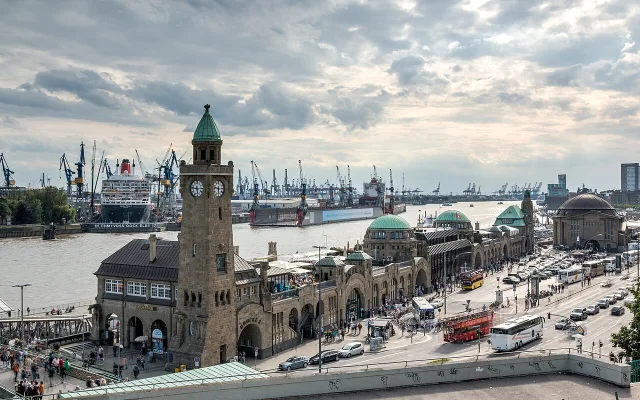
Hamburg is a port city with a fish market, the historic Speicherstadt warehouse district and the famous Reeperbahn.
Wiki
Hamburg is the second-largest city in Germany and its main maritime gateway, a free Hanseatic city on the river Elbe. Merchant scale, harbour romance and a rebellious spirit are woven together here: red-brick warehouses on piles stand next to an ultra-modern concert hall, and quiet canals next to the noisiest night-time street in the country.
General information
Hamburg has the status of a city-state and answers directly to the federation, like Berlin and Bremen. Its full official name — the Free and Hanseatic City of Hamburg — recalls centuries of commercial independence. Lying about a hundred kilometres from the North Sea, the city is connected to it by the navigable mouth of the Elbe, and that is what turned it into the largest port in Germany and one of the leading ports in Europe. Hamburg counts as one of the wealthiest cities in the country and is traditionally associated with media, insurance, logistics and trade. There are more canals here than in Venice and Amsterdam combined, and several thousand bridges, which makes Hamburg the European record-holder for their number.
What to see
- The Speicherstadt — the largest complex of warehouses on piles in the world, built of red brick in neo-Gothic style at the end of the 19th century. It is inscribed on the UNESCO World Heritage list. Today it houses museums, coffee shops and offices, and in the evening the lighting turns the narrow Fleete canals into an almost fairy-tale landscape.
- The Elbphilharmonie — a concert hall built on the base of a historic warehouse and crowned with a wave-shaped glass roof. It opened in 2017 and instantly became the new symbol of Hamburg. The Plaza viewing level, some 37 metres up, gives a full circle of views over the port.
- The Fischmarkt in Altona works on Sunday mornings from very early. Traders call out to customers, selling fish, fruit, flowers and souvenirs, while live music plays in the old auction hall — the place draws early-rising tourists and revellers who have not yet gone home from the night before.
- The Landungsbrücken — the floating piers from which harbour cruises and ferries depart. From here there is a view of the docks, the shipyards and the old sailing ship Rickmer Rickmers, now a museum.
- The Reeperbahn — the main artery of the St Pauli quarter, "the most sinful mile" in Germany. In the early 1960s the Beatles, then still unknown, played in the local clubs, and the district has remained a centre of musical and theatrical life ever since.
Districts
The historic core is wrapped around two artificial lakes — the Inner and Outer Alster — along whose shores locals like to walk and exercise. The town hall square, with the monumental Rathaus, is the ceremonial centre of the city. Bohemian Schanzenviertel is known for graffiti, bars and subculture, while bourgeois Blankenese in the west is known for its narrow staircases and villas above the Elbe. The new harbour district of HafenCity is being built up with modern architecture on the site of the former docks.
History
The city began with the fortress of Hammaburg, laid down in the 9th century. In the Middle Ages Hamburg joined the Hanseatic League and grew rich on maritime trade, achieving effective independence. The Great Fire of 1842 destroyed a large part of the centre, after which the city was rebuilt. The 20th century brought heavy trials: severe destruction during the Second World War and the catastrophic flood of 1962. Post-war reconstruction restored Hamburg's role as a major trading and industrial centre.
Food
The local cooking is inseparable from the sea and the northern character. It is worth trying Matjes, tender lightly salted herring, fish sandwiches in a bread roll, and Labskaus, a filling sailors' dish of salt beef, potato and beetroot. Among the traditional dishes are eel in green sauce and a rich fish soup. For dessert the Franzbrötchen is popular — a buttery cinnamon pastry and a local emblem. The coffee shops and fish stalls in the port offer a bite at any hour.
Practicalities
Around three days is the right length for a first visit: the first is given to the centre, the Alster and the Speicherstadt, the second to the port and St Pauli, the third to museums or a trip out to Blankenese. City transport is united in the HVV system: the underground (U-Bahn), city rail (S-Bahn), buses and ferries all run on a single ticket, and the ferry routes along the Elbe are a convenient and inexpensive alternative to sightseeing cruises. The ICE high-speed train reaches Berlin in under two hours, and there are good connections with other large German cities. The weather is changeable and windy all year round, so an umbrella and a waterproof jacket are useful in any season.
A rough guide to costs: lunch in a cafe is €12-18 (about $14-21), dinner with a beer €25-40 ($29-46), and a day ticket for the HVV network around €8.70 ($10). Going up to the Elbphilharmonie Plaza is free with an online booking. Prices are as of 2026.