Description
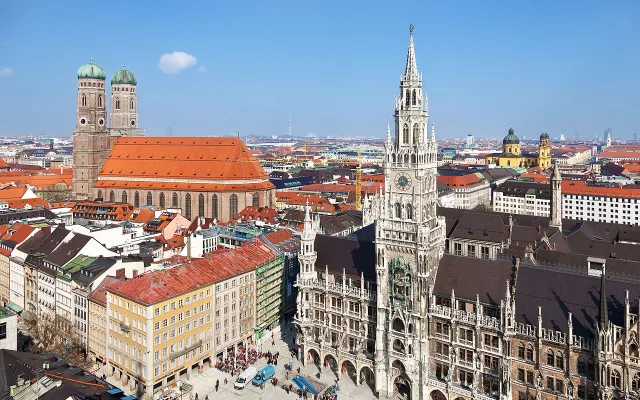
Munich is the capital of Bavaria, known for the Oktoberfest, for the English Garden and for Neuschwanstein castle nearby.
Wiki
Munich (München) is the capital of the federal state of Bavaria and the third-largest city in Germany after Berlin and Hamburg. Set on the river Isar at the foot of the Alps, it is considered one of the most prosperous and comfortable cities in the country, combining centuries-old Bavarian traditions — brewing, lederhosen and dirndls, brass bands — with the role of a major centre of science, engineering and art.
A little history
The city was founded in 1158 and grew up around a settlement of Benedictine monks — hence the name, which goes back to the word for monks (Mönche), and hence the little monk on the city coat of arms. From the 13th century until 1918 Munich was ruled by the Wittelsbach dynasty, under whom it became a glittering residence of the electors and kings of Bavaria. It was the Wittelsbachs who left the city its palaces, galleries and parks. The 20th century brought dramatic chapters: Munich was the cradle of the Nazi movement, suffered badly from bombing in the Second World War, and in 1972 hosted the Summer Olympic Games, for which the famous Olympic Park and the stadium with its "tent" roof were built.
Main sights
- Marienplatz — the heart of the Old Town, with its column to the Virgin Mary. The neo-Gothic New Town Hall rises here, and its glockenspiel plays out scenes from the city's history every day on the chiming of the clock.
- The Frauenkirche — the cathedral of Our Lady, with two onion-domed towers that have become a symbol of the city; its silhouette is visible from many points.
- The English Garden — one of the largest city parks in the world, bigger than Central Park in New York. Surfers ride a standing wave on the Eisbach stream, and open-air beer gardens work by the Chinese Tower.
- Nymphenburg Palace — the lavish baroque summer residence of the Bavarian rulers, surrounded by an enormous park with pavilions, canals and orangeries.
- The Residenz — the Wittelsbachs' town palace, with sumptuous interiors, a treasury and the Cuvilliés court theatre.
- The Deutsches Museum — the largest museum of natural science and technology in the world: aviation, shipping, mining, physics and astronomy.
- The Viktualienmarkt — the historic food market with delicacies, spices and a pleasant beer garden in the middle of the stalls.
The Kunstareal museum quarter deserves a mention of its own, with its three Pinakotheken gathering masterpieces from the Middle Ages to contemporary art.
Districts and atmosphere
The Old Town (Altstadt) concentrates the main monuments, surrounded by quarters with plenty of character. Schwabing is known for its bohemian past, its cafes and its closeness to the English Garden. Isarvorstadt, with the Glockenbachviertel, is a fashionable, lively district of bars and small shops. Haidhausen, on the other side of the Isar, is called the "French quarter" for the atmosphere of its narrow streets.
Neuschwanstein castle and around
About two hours to the south-west of the city, in the Alpine foothills, stands the fairy-tale castle of Neuschwanstein — the embodiment of the romantic fantasies of King Ludwig II and the model for the castle in the Disney films. Nearby are the yellow castle of Hohenschwangau, where the king spent his childhood, and the picturesque Alpsee lake. In summer long queues form at the ticket offices, so tickets are worth booking ahead and arriving early. From Munich itself it is also easy to reach the Bavarian lakes — the Starnberger See and the Tegernsee — and the ski resorts of the Alps.
Oktoberfest
The famous beer festival takes place on the Theresienwiese meadow from late September to the first days of October and draws millions of visitors from around the world. In the huge brewery tents, beer is served in litre steins ("Mass") and the tables carry the signature Bavarian dishes to the sound of folk music. Entry to the festival is free, but tables in the popular tents are booked many months ahead. For the rest of the year the atmosphere of the feast is kept alive by the traditional beer halls, from the historic Hofbräuhaus to the many gardens under the chestnut trees.
Bavarian food
The local cooking is filling and full of character. It is worth trying Weisswurst, the white veal sausages eaten before noon with a pretzel and sweet mustard. Also popular are Schweinshaxe (roast pork knuckle), Wiener schnitzel, pot roasts and Obatzda, a piquant cheese spread. All of it is traditionally accompanied by pale or wheat beer from the local breweries.
Practicalities
Around three days is a comfortable length for a first visit: the first for the historic centre and the museums, the second for the parks, Nymphenburg Palace and the beer gardens, the third for a trip out to the castles or the Alpine lakes. Munich is easy to move around: a well-developed network of underground (U-Bahn), city rail (S-Bahn), trams and buses covers the whole metropolis, and express trains run from Franz Josef Strauss airport to the centre. The best time to visit is late spring and summer, when the outdoor terraces are working, and the Oktoberfest season in early autumn.
Photos