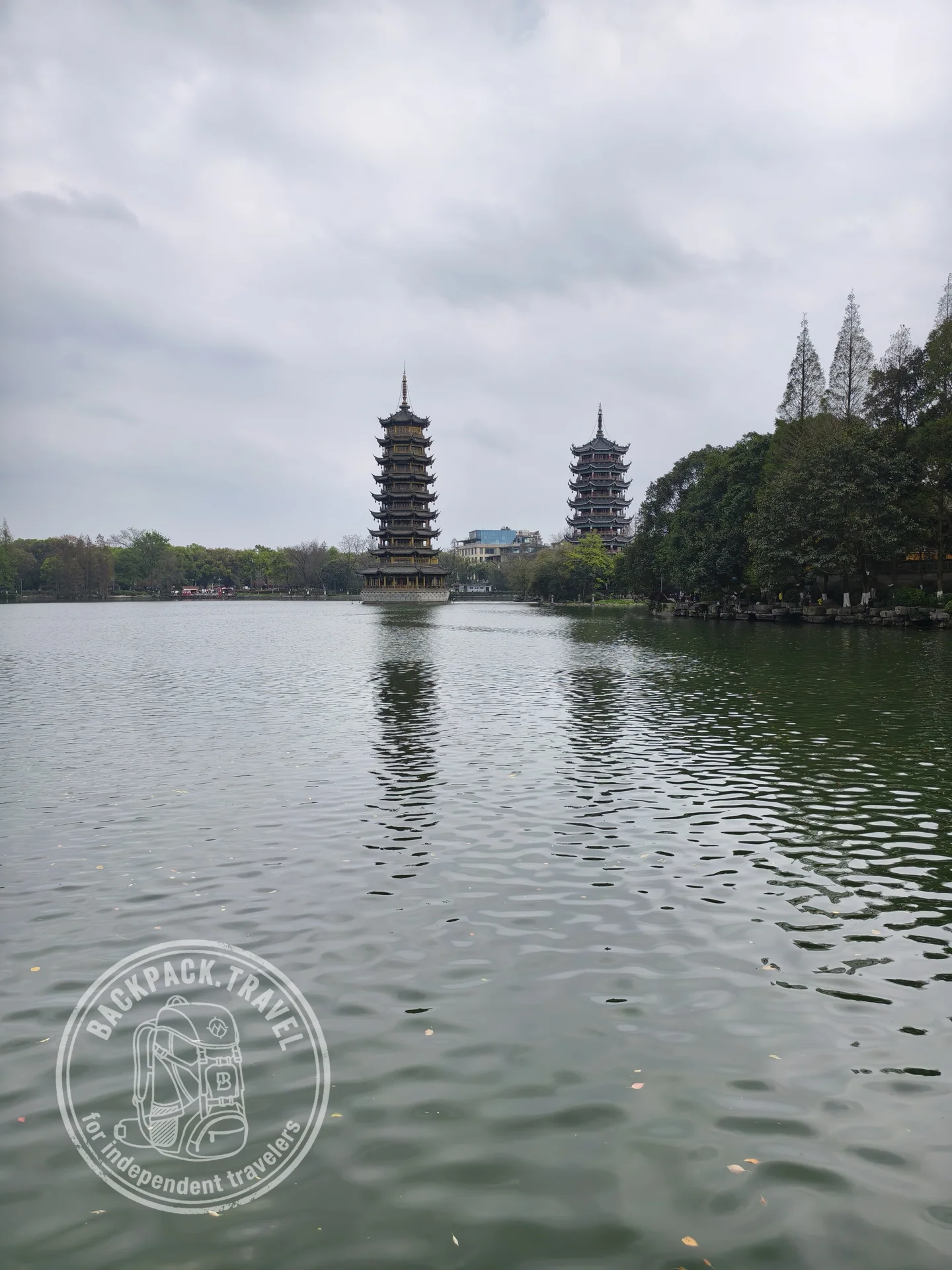
Description
Karst peaks along the Li River — the landscape from the banknote, the town of Yangshuo and the Longji rice terraces.
Wiki
Guilin is a city in the north-east of the Guangxi Zhuang Autonomous Region of China, and the emblem of the classic Chinese landscape. Strange limestone peaks rising straight out of green plains along the Li River have inspired poets and painters for centuries, and today they are the main reason travellers come here from all over the world.
Background and history
The city's name means "forest of cassia trees", or osmanthus: in autumn their flowering fills the streets with a sweet scent. The urban area holds around a million people. The settlement goes back more than two thousand years: under the Qin dynasty the Lingqu Canal was cut here, joining the Yangtze and Pearl river basins and turning Guilin into an important node on the route from north to south.
The landscape was formed by karst — the dissolution of soft limestone by water over millions of years. It is this view of peaks above the river that appears on the 20 yuan note, which fixed Guilin's status as a national emblem. The city itself is more often treated as a starting point, and the climax of a trip is the run down the river to the town of Yangshuo.
What to see
- The Li River cruise. The great experience of the region: an unhurried 83 km, four to five hours, from Guilin down to Yangshuo. Wooded hills, bamboo groves, fishermen on rafts and buffalo standing in the shallows pass along the banks. The most scenic stretch is exactly the one on the banknote.
- Yangshuo. The end of the route is a lively town surrounded by rice fields and karst hills. Pedestrianised West Street mixes souvenir shops, cafés and nightlife; the surroundings are popular for cycling, rafting on the Yulong River and cookery classes.
- Reed Flute Cave (Ludi Yan). A large karst cavern of stalactites and stalagmites, dramatically lit in colour and reflected in an underground lake.
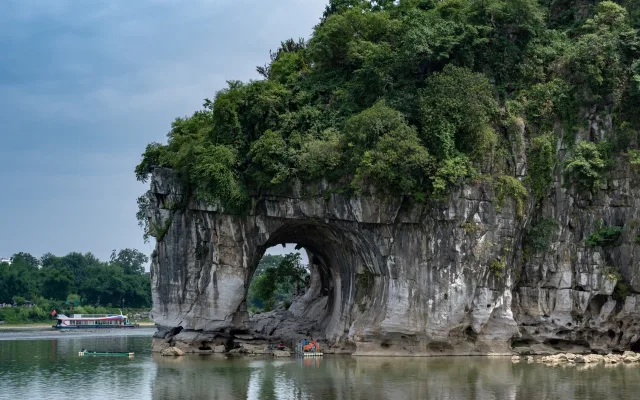
- Elephant Trunk Hill (Xiangbishan). A rock at the confluence of the rivers whose arch resembles an elephant dipping its trunk into the water. Guilin's unofficial symbol and its most recognisable shape.
- The Longji rice terraces, the "dragon's backbone". About two hours to the north lie cascades of fields roughly seven hundred years old. They are worked by the Yao and Zhuang peoples; the best views come when the terraces are flooded in spring and at the golden harvest in autumn.
- Seven Star Park. The largest green space in the city, with pagodas, grottoes and stone peaks named after the constellation of the Plough.
To that list add the peaks of Fubo Hill and Duxiu, and the evening light shows staged on the water near Yangshuo, where the stage is the river and the mountains themselves.
Food
The local cooking belongs to the Guangxi tradition and is fresh with a light heat. The city's signature is Guilin rice noodles (Guilin mifen): thin rice vermicelli in a fragrant broth with pickled vegetables and crunchy toppings, eaten at any hour of the day. Other dishes include beer fish, the speciality of Yangshuo, chicken cooked inside a bamboo stem, river fish and snails. A meal in a simple place is cheap; dinner in a restaurant with several dishes costs noticeably more.
Getting there and around
Guilin Liangjiang International Airport (KWL) is about 30 km from the centre, served by the major Chinese carriers and several low-cost airlines, including flights from Kuala Lumpur. Shuttle buses and taxis run into town. Guilin is on the high-speed rail network: the trip from Shanghai takes around nine hours, and there are fast services from Guangzhou and Nanning.
There is no metro — buses work the streets, along with taxis and ride-hailing apps. Yangshuo is easily reached by train, about an hour, or by bus; the Longji terraces are about two hours away by scheduled bus.
When to go, and advice
Spring and autumn are the best seasons, when the air is mild and the greenery at its richest; the river is usually high enough then for a comfortable cruise. Summer is humid and hot with heavy rain, though that is when the landscape is most vivid. Winter is cool and misty, which lends the views a certain mystery but reduces the chance of clear skies.
Three days is a sensible allowance for the region: the first for Guilin itself with its hills and caves, the second for the Li River cruise and an evening in Yangshuo, the third for a trip to the Longji terraces. That rhythm takes in the urban, the natural and the ethnographic sides of this corner of southern China.