Description
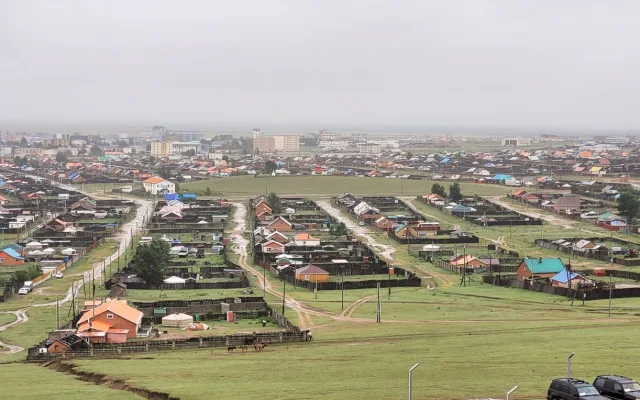
The ancient capital of the Mongol Empire — the Karakorum site and Erdene Zuu monastery in the Orkhon valley.
Wiki
Kharkhorin is a small town of 13,000 people in the Orkhon valley in central Mongolia, 360 km west of Ulaanbaatar. What you come to see is not the town but what lies beneath and beside it: Karakorum, capital of the Mongol Empire, stood here, and just off the modern streets rise the walls of Erdene Zuu, the oldest surviving Buddhist monastery in the country. For most routes through central Mongolia, Kharkhorin is the gateway to the Orkhon valley, a UNESCO World Heritage site.
History
Karakorum was founded by Genghis Khan in 1220, but it was his son Ögedei who made it a real capital, walling it in 1235. Under Ögedei and Möngke the largest land empire in history — stretching from China to Hungary — was governed from here. Buddhist temples, mosques and a Christian church all operated in the city at once, and the Flemish friar William of Rubruck, who visited in 1254, left a detailed account of the khan's court and its silver fountain-tree. In the 1260s Kublai moved the capital to Khanbaliq, present-day Beijing, and Karakorum quickly lost its importance. In 1380 the city was destroyed by the armies of China's Ming dynasty, and two centuries later its stones went into building a monastery.
What to see
- The Karakorum site — the archaeological zone where the imperial capital stood. Almost nothing survives above ground: the clearest trace is the stone tortoises on their plinths, which marked the boundaries of the city; two of the four remain.
- Erdene Zuu Monastery — the oldest surviving Buddhist monastery in Mongolia, begun in 1585 and built partly from the stones of ruined Karakorum. Its square perimeter wall is punctuated by 108 white stupas; inside stand temples in the Tibetan-Chinese style, some working as a museum, some as a living religious community.
- The Karakorum Museum — a modern museum opposite the monastery, with finds from the imperial period and a model of the city; it makes sense to visit before walking the site.
Around Kharkhorin
- The Orkhon valley — a UNESCO property of about 122,000 hectares: steppe pasture, monasteries, eighth-century Turkic runic monuments and the ruins of the Uyghur capital Karabalgasun.
- The Orkhon waterfall (Ulaan Tsutgalan) — a fall of about 20 metres in a basalt canyon roughly 90 km to the south-west, and the main natural draw of the region.
- Tövkhön Khiid — a small seventeenth-century cave monastery on a wooded mountain, founded by Zanabazar, the first spiritual head of Mongolian Buddhism and a great sculptor. The last stretch is on foot up a steep path.
- Shankh Khiid — a monastery of 1647 about 25 km away, one of the oldest in the country.
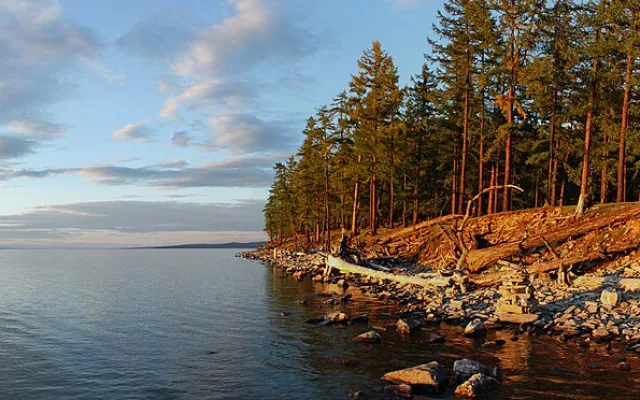
- Khorgo-Terkhiin Tsagaan Nuur — a national park roughly five hours' drive away: the extinct Khorgo volcano with its crater, and the large Terkhiin Tsagaan lake, dammed by an ancient lava flow.
- Ger camps around the town are the standard form of accommodation in the region and the easiest way to spend time with herders.
Food and prices
The cooking is Mongolian and very meaty: buuz (steamed dumplings), khuushuur (fried meat pasties), tsuivan (noodles with meat and vegetables), khorkhog (mutton cooked with heated stones inside a metal churn), airag, the soured mare's milk, and suutei tsai, salted milk tea.
Lunch in a café comes to about 18,000–32,000 tugrik ($5–9), dinner at a tourist camp 36,000–90,000 tugrik ($10–25). A night in a ger camp with full board costs 108,000–290,000 tugrik ($30–80) per person, and a litre of petrol around 3,600 tugrik ($1). Prices are as of 2026.
Getting there
There are no scheduled flights to Kharkhorin, so every route starts in Ulaanbaatar. The service bus takes about eight hours and costs 54,000–72,000 tugrik ($15–20), with part of the road unsurfaced. A tourist shuttle or a seat on a tour does it in six or seven hours for 215,000–360,000 tugrik ($60–100). A taxi from the capital for the whole journey runs to 290,000–540,000 tugrik ($80–150). The standard Mongolian option is a four-wheel drive with a driver at 290,000–435,000 tugrik ($80–120) a day: without one, the waterfall, Tövkhön and the volcano are essentially out of reach.
When to go
The real season is June to September, when daytime temperatures hold at 15–25°C. The town sits at about 1,470 metres, so nights are cool even in July. The event of the year is Naadam on 11–13 July, with wrestling, archery and horse racing; Kharkhorin marks it on a smaller and more intimate scale than the capital. From November to March temperatures run from −20 to −40°C, the roads are hard going, and most camps and museums are closed.