
Description
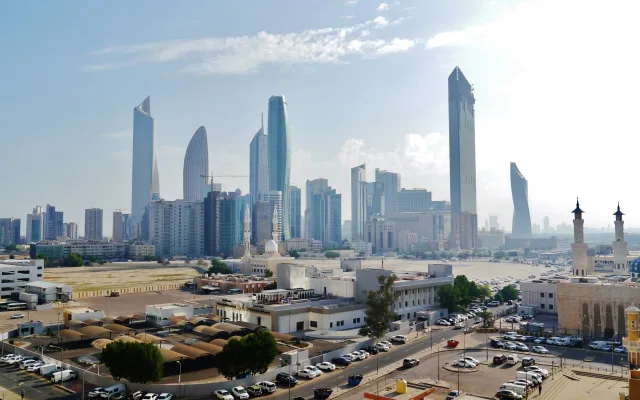
The capital of Kuwait — the Kuwait Towers, the Grand Mosque, Al-Mubarakiya souk and the corniche along the Arabian Gulf.
Wiki
Kuwait City is the capital and the only genuinely large city in the country. Around 60,000 people live within the city limits proper, but the Greater Kuwait City conurbation runs for tens of kilometres along the coast and holds almost the entire population of Kuwait. A century ago this was a walled port of pearl divers and traders with India; the oil found at the Burgan field in 1938 turned it within a single generation into a city of glass towers and eight-lane highways. There are far fewer tourists here than in Dubai, and that is precisely the appeal: Arabia has not been lacquered for the guidebook.
What to see
- The Kuwait Towers. The country's symbol: three concrete needles of 1979, the tallest 187 metres, with an observation deck and a revolving restaurant in the upper sphere.
- The Grand Mosque (Masjid Al-Kabir). The largest in Kuwait, holding some 11,000 worshippers. Free guided tours for non-Muslims explain the rituals; women are lent an abaya at the door.
- Al-Mubarakiya souk. The oldest market in the city and the best place to eat: spices, dates, gold, textiles, fish rows and dozens of tiny eating houses where Kuwaitis themselves have lunch.
- The Kuwait National Museum. Archaeology from Failaka Island, ethnography and a planetarium; the same complex houses the Dar al-Athar al-Islamiyyah Islamic collection. Much of the collection was carried off and destroyed during the Iraqi invasion of 1990, and the museum took decades to rebuild.
- The Tareq Rajab Museum. A private collection of Islamic art, jewellery and calligraphy, one of the finest in the region; a separate calligraphy museum operates alongside it.
- Sadu House. An old merchant house on the waterfront where Bedouin sadu weaving is demonstrated and the weavers' work is sold.
- Dickson House. The home of the British political agent Harold Dickson, built around 1870 and now a museum of pre-oil Kuwait.
- The Sheikh Jaber Al-Ahmad Cultural Centre. A vast 2016 complex with an opera house and concert halls, the largest cultural centre in the Middle East.
- Liberation Tower. A 372-metre telecommunications tower. Construction was interrupted by the Iraqi invasion and the tower was finished after liberation, in 1993 — hence the name.
- The Avenues mall. One of the largest shopping centres in the Middle East; in the Kuwaiti heat malls function as town squares, which is less of a joke than it sounds.
- The corniche. The seafront along Arabian Gulf Street runs for tens of kilometres past beaches, parks and the fish market. In the evening the whole city walks here.
- Failaka Island. About 20 km offshore, reached by ferry from Salmiya. The Hellenistic town of Ikaros, founded after Alexander the Great's campaigns, has been excavated here, while the modern village still stands abandoned from the war of 1990–91.
Getting there and around
Kuwait International Airport (KWI) is the base of the national carrier Kuwait Airways and of the low-cost Jazeera Airways; Emirates, Qatar Airways, Turkish Airlines and flydubai also serve it. From Dubai the flight is about two hours. A taxi from the airport into the centre costs 4–6 KWD ($12–20).
There is almost no public transport useful to a visitor: buses run, but the city is designed around the car. Careem and Uber both operate; if you flag a street taxi, agree the fare first. Hiring a car makes sense if you plan trips out of town — petrol costs almost nothing.
Most visitors get a visa online or on arrival, but the rules depend on nationality and change regularly, so check them before you book.
Food and prices
The cooking is Arabian with Indian and Persian traces. The essential list: machboos, rice with lamb, chicken or fish and a spice mix built on dried loomi lime; mutabbaq samak, fried zubaidi fish on rice; gers ogaily, a saffron cake with cardamom; balaleet, sweet vermicelli with omelette for breakfast; and tea with cardamom and saffron. Alcohol is banned outright, including in luggage.
Lunch in a simple place costs 2.5–4.5 KWD ($8–15), dinner in a restaurant 8–15 KWD ($25–50). A litre of petrol is about 0.1 KWD ($0.30), a taxi across town 1.5–4.5 KWD ($5–15), car hire 9–15 KWD a day ($30–50). Prices are as of 2026.
When to go
November to March, at 15–25°C by day, is the only genuinely comfortable window. Summer from May to September brings 40–50°C, and July and August make Kuwait City one of the hottest inhabited places on earth: life in those months retreats into air-conditioned malls and onto the streets after dark. In February and March the desert briefly flowers after the rains, and Kuwaitis decamp en masse to desert camps.
Ramadan needs separate planning: cafés are shut during daylight, eating and drinking in public is not allowed, but after iftar the city comes alive deep into the night.
Common mistakes
- Coming in summer "for a couple of days to look around". At 40°C a walking programme is impossible, and the whole point of the city is the street and the seafront.
- Expecting to see it on foot. Distances between the towers, the museums and the souk are much longer than the map suggests, and pavements are far from continuous.
- Arriving on a Friday morning. Almost everything, the souk included, is shut before midday.
- Trying to bring in alcohol. The ban is absolute and the penalties are serious.
- Dressing too lightly. There is no formal dress code for visitors, but Kuwait is more conservative than the UAE: keep shoulders and knees covered, especially away from the malls.