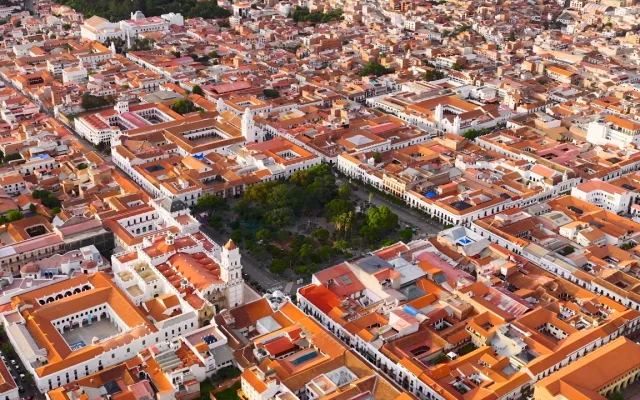
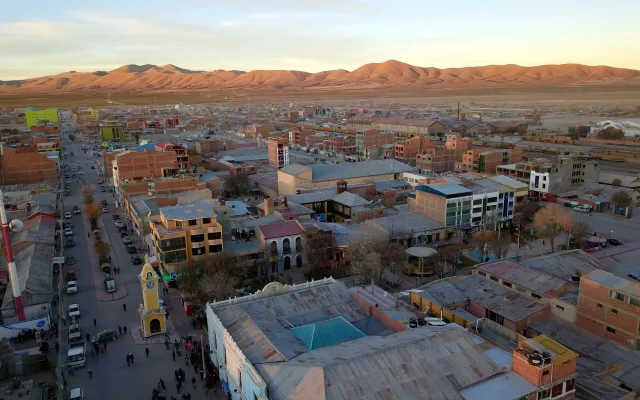
Description
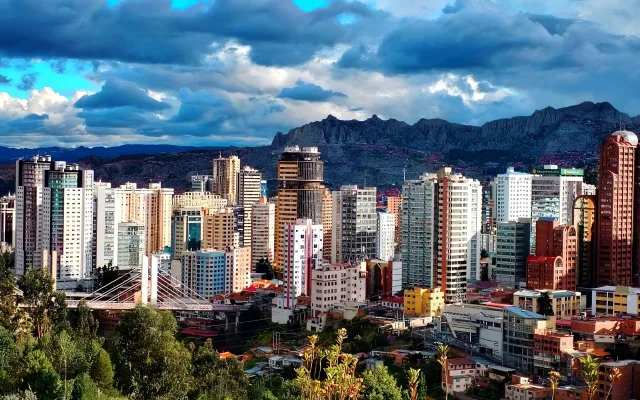
La Paz — Bolivia's seat of government, perched at 3,600 metres above sea level. The city is home to an urban cable car network, the Witches' Market, and the notorious mountain road known as the Death Road, popular with downhill cyclists.
Wiki
La Paz is the highest seat of government in the world and one of the most extraordinary cities in South America. Spread across a deep canyon at elevations ranging from 3,200 to 4,100 metres, it stuns visitors with the contrast of snow-capped peaks, red-brick hillsides and busy streets that seem to hang over the void.
Overview and Geography
Although Sucre is Bolivia's constitutional capital, La Paz is where the government, parliament and presidential residence are located, making it the country's effective capital. The city itself has a population of around 800,000, and together with the adjacent city of El Alto — which sits on the edge of the plateau — the metropolitan figure comes to roughly two million.
The city's dramatic terrain shapes every aspect of life in La Paz: wealthier neighbourhoods descend into the warmer, sheltered lower valley (the Zona Sur district), while the poorest and most windswept areas climb toward the rim of the Altiplano. The altitude means thin air, and newcomers should take it easy during their first days and watch out for altitude sickness — known locally as soroche.
Getting Around: Mi Teleférico
The defining symbol of modern La Paz is the urban cable car network Mi Teleférico, launched in 2014 and now the longest urban cable car system in the world. Ten colour-coded lines connect the canyon floor to the plateau of El Alto, bridging elevation changes that are simply beyond the reach of ground transport. Riding the gondolas is not just a practical way to get between neighbourhoods — it is also the best vantage point in the city: terracotta rooftops unfold below, while the 6,000-metre peak of Illimani gleams on the horizon.
What to See
- Plaza Murillo — the heart of the historic centre, flanked by the National Congress building, the presidential palace and the cathedral. The ideal starting point for a walking tour of the old city.
- Mercado de las Brujas (Witches' Market) — a vivid corner of the city where Aymara healers sell medicinal herbs, amulets, figurines and dried llama foetuses, which are traditionally buried in the foundations of new buildings as an offering to Pachamama, the earth goddess.
- Calle Jaén — a narrow cobbled street that has kept its colonial character, with brightly painted facades and a cluster of small museums.
- Iglesia de San Francisco — a church dating from the 16th to 18th centuries, a striking example of Mestizo Baroque whose facade is carved with indigenous motifs: birds, plants and masks.
- Valle de la Luna (Valley of the Moon) — a surreal landscape of clay spires sculpted by erosion, just a few kilometres from the city centre.
- Mirador Killi Killi — a lookout point with a 360-degree panorama of the city set within its bowl of mountains.
Surroundings
- Chacaltaya (5,421 m) — a mountain that once hosted the world's highest ski resort; after the glacier disappeared skiing ended, but the ascent rewards visitors with views over the La Paz valley and Lake Titicaca.
- Tiwanaku — a UNESCO World Heritage archaeological site roughly 70 km away, the centre of a pre-Inca civilisation featuring monolithic statues and the famous Gateway of the Sun.
- The Death Road (Camino de los Yungas) — a legendary mountain track now reinvented as a cyclist's adventure: a descent of dozens of kilometres drops from the cold highlands into the warm tropical Yungas.
- Lake Titicaca and Copacabana — the world's highest navigable lake, sacred to Andean peoples, with a pilgrimage town and the Island of the Sun nearby.
Food
Local cuisine is hearty and well suited to the cold climate. Must-tries include salteñas — juicy pastries filled with meat and broth — spicy pique a lo macho of beef and potato, corn flatbreads, and dishes made from quinoa and the dozens of potato varieties native to the Andes. Street markets offer fresh juices and fruit brought up from the warmer valleys below.
Practical Tips
Three days is an ideal amount of time to settle in: spend the first on acclimatisation and a gentle walk around the centre, the second on the teleférico and the markets, and the third on a day trip to Tiwanaku, the Valley of the Moon or Lake Titicaca. At this altitude temperatures swing sharply throughout the day, so layers and sun protection are essential. Cash in bolivianos is more practical than cards, especially at markets and in taxis.