Description
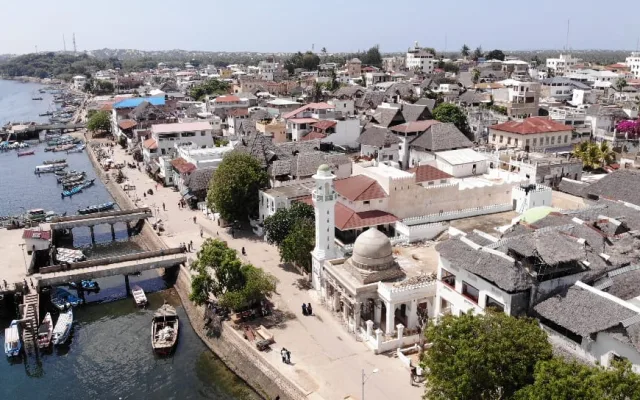
Lamu is a UNESCO-listed town in Kenya, known for its Swahili architecture, its donkeys and dhows, and a culture shaped by the Indian Ocean.
Wiki
Lamu is the oldest continuously inhabited Swahili town in East Africa, spread across the island of the same name off the northern coast of Kenya, some 250 km from Mombasa. There is almost none of the usual modern apparatus here: the streets are too narrow for cars, so donkeys carry the loads, and the link with the mainland rests on wooden sailing boats. Around 25,000 people continue a way of life formed centuries ago, and it is precisely this intactness that made the Old Town a UNESCO World Heritage Site.
History and culture
The settlement arose in the 14th century at the crossing of the sea routes that linked Arabia, Persia, India and the African coast. Ivory, tortoiseshell, mangrove timber, spices and slaves passed through the port of Lamu, and with the goods came Islam, the Arabic language and artistic traditions. Swahili culture, a fusion of African, Arab and Asian influences, is reflected in the language, the music, the poetry and the crafts.
The town lived under the Portuguese, the Omani sultans of Zanzibar and then the British protectorate, and kept its own rhythm throughout. Lamu was long a centre of Islamic learning: madrasas operated here, manuscripts were copied and poetry was composed in Swahili. The island's school of carpentry became famous for its carved wooden doors — heavy leaves with geometric and floral ornament, which became the signature of the whole coast and a model for craftsmen across the region.
Architecture and the look of the town
Historic Lamu is built of coral limestone and mangrove wood. Houses of one to three storeys press against each other, forming a shaded maze of lanes, inner courtyards and blank facades turned to the street. Inside are cool rooms, wall niches, carved beams and those doors, and on the roofs are open terraces that escape the heat.
The key points of the old town:
- Lamu Old Town — the only Swahili town on the UNESCO list to have kept its 18th- and 19th-century layout and buildings almost unchanged.
- Lamu Museum — an ethnographic collection in a fort of the early 19th century: displays on Swahili culture, seafaring and daily life.
- The Lamu Siwa — a ceremonial brass horn, one of the museum's emblems and a fixture of civic celebrations.
- Lamu Fort — the massive stone stronghold in the centre, with market life boiling around it.
- Restored merchants' houses — some 19th-century mansions are open to visitors and show the inner workings of a traditional dwelling.
Around the island
Three kilometres to the south lies Shela, a quiet village of whitewashed houses where long sand beaches meet high dunes; it is an easy walk along the shore. From there stretches a band of pale sand many kilometres long, one of the emptiest on the Kenyan coast.
Opposite is the island of Manda, with archaeological traces of ancient Swahili settlements. Further north the archipelago continues into secluded bays and coral reefs that draw snorkellers and divers. An essential part of the experience is a trip on a dhow, the traditional Arab sailing boat: sunset sailings and fishing remain a living trade rather than a performance for guests.
Festivals
The great event of the year is Maulidi, the Muslim festival of the Prophet's birth. The dates follow the lunar calendar, and in those days pilgrims and visitors converge on Lamu: the streets fill with processions, the singing of religious hymns, competitions and a fair. The programme often includes donkey and dhow races, which turns the festival into a vivid display of local colour.
Food
The table in Lamu is Swahili, built on seafood, coconut and spice. Try pilau and biryani — fragrant rice with spices and meat — mishkaki skewers, and fresh fish and seafood from the ocean. For something sweet there is kashata, a dense confection of coconut or peanut with sugar, and to drink, strong sweet spiced tea and fresh tropical juice. Many dishes are made with coconut milk, which gives them their soft, recognisable flavour.
Practical information
Three days is a comfortable length to see the old town without hurrying, walk to Shela, go out to sea on a dhow and catch the rhythm of the island. People usually arrive by air at the airport on Manda island, from where a boat takes you across to the town — there is simply no road access to the historic part.
Lamu is a conservative Muslim town, so dress modestly, especially away from the beaches, and respect local customs and prayer times. Comfortable closed shoes help in the narrow sandy lanes, and cash is essential, as card payment is far from universal. The best time to come is the dry seasons, when the sea is calm and good for sailing.