Lucerne
SwitzerlandDescription
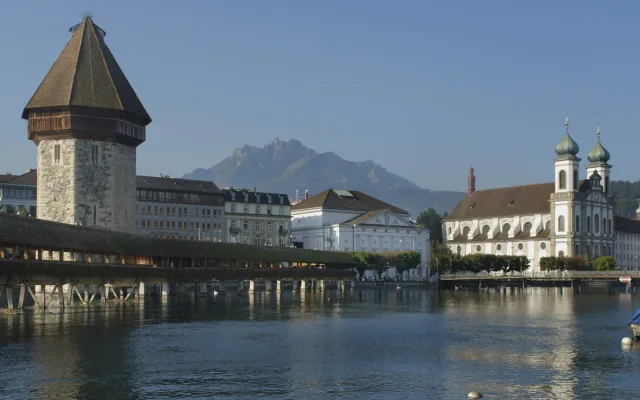
A scenic city at the foot of the Alps, with the wooden Kapellbrücke, a crystal-clear lake, and views of snow-capped peaks.
Wiki
The main tourist city of Central Switzerland and one of the most postcard-perfect Alpine scenes in the world — around 80,000 residents on the shore of Lake Lucerne (Vierwaldstättersee) at the foot of the mountains. The city where Richard Wagner lived and composed by the lake; the birthplace of "Swiss tourism" in the 19th century, written about with great enthusiasm by Mark Twain and Victor Hugo. One hour from Zurich by train.
Main Sights
- Kapellbrücke — a wooden bridge from 1333 across the Reuss River, symbol of Switzerland. Painted panels decorate the interior of the roof (most were lost in a fire in 1993 and have since been restored).
- Wasserturm — a 13th-century water tower standing in the middle of the Kapellbrücke.
- Lion Monument (Löwendenkmal) — a 6-metre dying lion carved in rock, in memory of the Swiss Guards killed in Paris in 1792.
- Lucerne Festival — Switzerland's largest classical music festival, August–September.
- Swiss Museum of Transport (Verkehrshaus) — the country's largest transport museum, covering trains, cars and aviation.
- Mount Pilatus (2,132 m) — the golden round trip: cogwheel railway (the world's steepest rack railway, 48% gradient) — cable car — gondola.
- Mount Rigi (1,798 m) — "Queen of the Mountains"; Europe's oldest rack railway (1871), with a classic sunset from Rigi Kulm.
- Bürgenstock — a cliff-face lift and the Hammetschwand Elevator (the highest outdoor elevator in Europe, 152 m).
- Lake Lucerne (Vierwaldstättersee) — scenic cruises aboard historic paddle steamers.
- Altstadt (Old Town) — pedestrian zone with ornately painted building facades.
Food and Prices
The cuisine is Swiss: fondue, raclette, rösti, Zürcher Geschnetzeltes (veal in a cream and mushroom sauce) and Lucerne Speck. Lunch at a café costs 23–33 CHF (about $28–40); dinner at a restaurant 56–103 CHF ($69–127). A glass of Swiss wine (Chasselas or Pinot Noir) is 7–9 CHF ($8–12). A litre of petrol runs around 1.8 CHF ($2.20). The Pilatus golden round trip is 80 CHF ($99), the Rigi round trip likewise 80 CHF ($99), and a city public-transport ticket costs 4 CHF ($5). Prices are as of 2026.
Getting Around
The nearest airport is Zurich (ZRH), one hour by train (30 CHF / about $37). The city centre is compact and easy to walk; lake steamers offer a scenic alternative. The Swiss Travel Pass (from 232 CHF / $287 for 3 days) is excellent value if you plan to use the mountain railways and cable cars. Lucerne is also a popular base for day trips to Interlaken, Bern and Zurich.
When to Go
May–September (12–23°C) is ideal for almost everything. The Lucerne Festival (classical music) runs from late August into September. December brings a Christmas market and an ice rink on Schwanenplatz. Winter (December–March) is ski season in Engelberg-Titlis, an hour away. The Fasnacht carnival runs for six days before Lent.