Zurich
SwitzerlandDescription
The financial capital of Europe — the lake, the old Lindenhof and shopping on Bahnhofstrasse.
Wiki
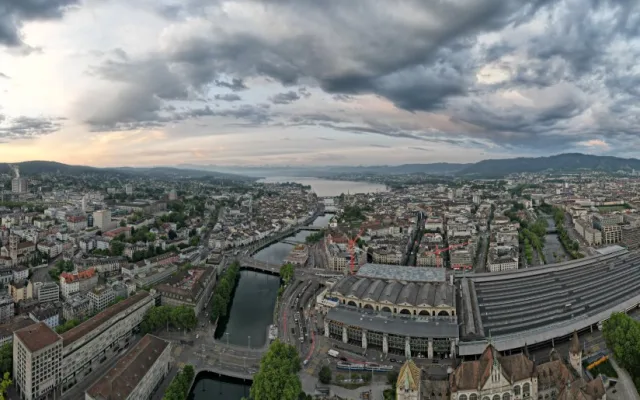
Zurich is the largest city in Switzerland and its main economic gateway, spread at the northern end of Lake Zurich where the river Limmat flows out of it. Formally it is not the capital — the country's administrative centre is Bern — but it is this city that sets the financial and business rhythm of the Alpine republic, and it regularly tops international rankings for quality of urban life.
General character
The population of Zurich itself is about 430,000, and more than a million including the wider urban area. It is the administrative centre of the canton of the same name and the heart of German-speaking Switzerland, where the local Swiss dialect (Zuridutsch) is spoken in daily life while standard German is used in writing. The city is a convenient starting point for travel around the country: Lucerne, Bern, Basel and the foothills of the Alps are a couple of hours away by train.
History
A settlement existed on the site of modern Zurich as far back as the Roman era — the customs post of Turicum controlled the trade route along the Limmat. The medieval city grew around the Lindenhof hill, where traces of Roman and Carolingian fortifications survive. In the 16th century Zurich became one of the centres of the Reformation: the preacher Huldrych Zwingli, who served at the Grossmunster, turned it into a hub of the Protestant movement, and that long shaped the austere, businesslike character of its citizens. The industrial rise of the 19th century and the city's status as a banking centre in the 20th made it what it is today.
What to see
- The Old Town (Altstadt) — a labyrinth of cobbled lanes on both banks of the Limmat. Niederdorf on the right bank is lively with cafes and bars, while the left-bank part with the Lindenhof hill is quieter and holds the panorama over the tiled roofs.
- The Grossmunster — the 12th-century Romanesque cathedral with its twin towers, the symbol of the city; one of the towers gives a view over the centre.
- The Fraumunster — the church on the left bank, famous for its stained glass by Marc Chagall and Augusto Giacometti.
- St Peter's Church — holder of the largest clock face in Europe.
- Bahnhofstrasse — the shop-window artery about a kilometre and a half long, running from the main station down to the lake; one of the most prestigious shopping streets in the world, with boutiques, banks and watch houses.
- The Kunsthaus — the largest art collection in Switzerland: works by Monet, Picasso and Munch and an extensive holding of Giacometti sculpture.
- The National Museum (Landesmuseum) — in a castle-like building by the station, devoted to the history and culture of the country.
- Lake Zurich (Zurichsee) — the sheet of water right by the centre, where open-air bathing places (Badi) work in summer and pleasure steamers leave from the piers.
Districts and surroundings
Beyond the historic core it is worth looking into Zuri-West, a former industrial quarter where factory halls have been converted into galleries, bars and creative spaces (the symbol of the district is the Im Viadukt arcade). Uetliberg is the city's "home mountain" at 871 m, reached by suburban train; the Alps are visible from the lookout tower. In the suburb of Kilchberg stands the Lindt & Sprungli chocolate factory, with a museum telling the history of cocoa.
Food
The local cooking is filling and dairy-rich. The signature dishes are cheese and meat fondue, potato rosti and the city's own Zurcher Geschnetzeltes: sliced veal in a creamy mushroom sauce, traditionally served with rosti. Among sweet things, the Luxemburgerli almond biscuits are popular, and of course the local chocolate. Prices are high even by European standards: a modest lunch costs from about 18 CHF (around $22), dinner for two some 65 CHF ($80), and a cup of coffee about 4.50 CHF ($5.50). Prices are as of 2026.
Transport
The city transport network is considered exemplary: trams, buses and S-Bahn suburban trains work on a single tariff (a one-zone ticket is about 4.40 CHF, roughly $5.40), the intervals are short and the timetable exact. The international airport is within the city limits — the train to the main station takes about 10 minutes. The ZurichCARD is convenient for visitors, giving free travel and discounts at museums.
Practical advice
About three days is the right length for a first visit: enough for the Old Town, a couple of museums, a trip on the lake and an excursion to Uetliberg or Kilchberg. Plan the budget in advance — Zurich is expensive, and at moderate spending you should allow roughly 150–250 CHF (about $185–310) per person per day. The best time to travel is May to September, when the lake baths are open and the terraces are working; in winter the city is quieter, but atmospheric in the weeks before Christmas. The currency is the Swiss franc, and cards are accepted almost everywhere. Most residents speak English fluently, which makes communication easy.
Photos