
Description
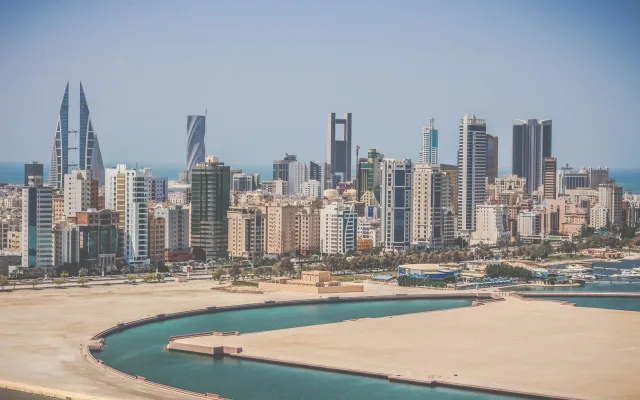
Capital of Bahrain — the UNESCO fort of Dilmun, the Bab Al Bahrain souq and the Pearling Trail on Muharraq.
Wiki
The capital of Bahrain sits on the north-eastern edge of the archipelago's main island: a compact city where the glass towers of the financial district stand alongside the ruins of a five-thousand-year-old civilisation. For an independent traveller Manama is convenient because everything essential fits into a couple of days, and the island itself is small — less than an hour by car from one end to the other.
Why come and what is actually worth seeing
- Qal'at al-Bahrain, the Bahrain Fort — the compulsory stop. A UNESCO site, this was the capital of Dilmun, with foundations going back to 2300 BC. Helpfully there is a small site museum nearby that makes sense of the excavation layers. Come towards sunset — the light over the fort and the bay is at its best.
- The Bahrain National Museum — start here if you want to understand the island's history before walking the fort. Dilmun artefacts, reconstructions of the pearl-diving trade, burial mounds.
- Bab Al Bahrain and the Manama souq — a gateway arch of 1949 and the entrance to the old market, where gold, spices, fabric and pearls are sold. Bahrain is the historic centre of the natural pearl trade, and it is worth knowing that the sale of cultured pearls is banned in the country, which is why local stock is prized. Haggle, especially over gold and souvenirs.
- Al-Fateh Mosque — the largest in the country, open to non-Muslims, free to enter, with an abaya handed out at the door. One of the few mosques in the Gulf that lets visitors inside.
- The Tree of Life — a 400-year-old ghaf tree standing alone in the desert about 40 km from the centre. The tree itself is modest; people go for the fact of it and for the desert landscape. It is awkward to reach without a car, so treat it as part of a drive around the island.
- The Bahrain Pearling Trail on Muharraq, the neighbouring island across the causeway — a UNESCO route through the houses of the pearl merchants. It combines well with Arad Fort and the old quarters.
The Bahrain International Circuit is mainly of interest to those coming for the Grand Prix in March or April. Riffa Fort makes a decent viewpoint, but that is already in the "if there is time" category.
Getting there and around
The airport is on Muharraq island, a short hop across the causeway into central Manama, fifteen to twenty minutes by taxi. There is no urban rail. Taxis and ride-hailing apps are the main way of getting about; public buses exist but are awkward for a visitor.
The practical advice: hire a car for a day or two. The island is tiny, the traffic is calm by Gulf standards, and reaching the Tree of Life, the fort and Muharraq under your own steam is otherwise expensive and tedious. An international driving permit is usually required.
Where to stay and for how long
Two days covers the city and the nearest points. Useful bases:
- Juffair — plenty of hotels and serviced apartments, restaurants and bars, close to the centre. Lively in the evening.
- The financial and Diplomatic Area — nearer the museum, the fort and the business district, and quieter.
- The old centre by Bab Al Bahrain, if you want to live in the middle of the market.
When to go
November to March is best: warm but bearable. Summer, June to September, is draining — over 40°C with high humidity makes daytime walking hard work. Bear in mind that the rhythm of the city changes during the Grand Prix and Ramadan, and room rates rise.
Money, food, prices
The currency is the Bahraini dinar, one of the strongest in the world, so the numbers on price tags are deceptively small. Bahrain is noticeably cheaper than Dubai overall, but dearer than, say, Egypt.
For food, look for machboos (meat or fish with spiced rice), shawarma and mezze in the Lebanese places, and fresh fish. Cheap and filling means the simple Indian and Filipino cafés, of which there are many thanks to the large expatriate communities. Expensive means hotel restaurants and the waterfronts.
Things to know
- Bahrain is the most liberal of the Gulf states: alcohol is sold legally, the dress code is softer and there is a real nightlife. On Thursdays and Fridays the city fills up as Saudis drive over the 25 km King Fahd Causeway — hotels and restaurants fill and prices can jump.
- All the same, respect local norms: dress modestly at mosques and in the market, and behave with restraint in public.
- Safety is high and street crime is almost unknown. The main risk is the heat; carry water.
- A typical mistake is to plan a beach holiday: good public beaches are few, and most of the coast belongs to hotels and clubs that charge for access.