Description
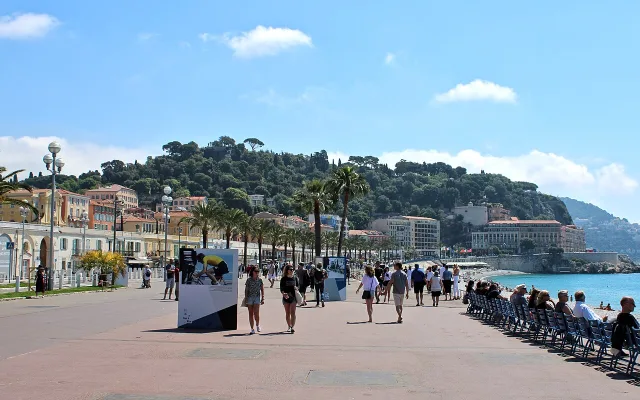
The pearl of the Cote d'Azur, with the Promenade des Anglais, the old town and the Cours Saleya market.
Wiki
Nice is the largest city on the French Riviera and the unofficial capital of the Cote d'Azur, spread like an amphitheatre between the foothills of the Maritime Alps and the turquoise Baie des Anges. A mild Mediterranean climate, almost three hundred days of sunshine a year, avenues of palm trees and a distinctive Italian-Provencal atmosphere have made it one of the most alluring resorts in Europe.
History and character
Founded by Greeks from Massalia around the 4th century BC under the name Nikaia (after Nike, the goddess of victory), Nice spent centuries under the Duchy of Savoy and only became part of France in 1860. That double inheritance is felt everywhere: in the cooking, in the Nissart dialect, in the ochre-red facades and baroque churches that recall Genoa or Turin more than the typical French south. From the middle of the 19th century the city became a fashionable place to spend the winter for the British and Russian aristocracy — hence the lavish villas, the grand hotels and the Orthodox Cathedral of St Nicholas, one of the most beautiful outside Russia.
Main sights
- The Promenade des Anglais — the emblem of Nice, a seven-kilometre esplanade along the sea laid out in the 19th century with money from the British community. Famous blue-and-white chairs, a cycle path, pebble beaches and the facade of the Hotel Negresco.
- The Old Town (Vieille Ville) — a maze of narrow lanes with washing strung across them, baroque churches and Place Rossetti. The heart of the quarter is the market on Cours Saleya, where mornings (except Monday, given over to antiques) bring flowers, spices, olives, cheeses and Provencal delicacies.
- Castle Hill (Colline du Chateau) — almost nothing survives of the fortress itself, but the climb is rewarded with the finest panorama of the city, the port and the bay; at the top there is a park, a waterfall and an old cemetery.
- Museums — Nice was home to great artists. The Matisse Museum stands in the olive grove of Cimiez, the Marc Chagall National Museum holds his biblical cycle, and MAMAC, the museum of modern art, shows work by Yves Klein and Niki de Saint Phalle.
- Place Massena and the Promenade du Paillon — the ceremonial centre, with red-ochre arcades, chequerboard paving and a green corridor running down to the sea.
Day trips
Nice is an ideal base for exploring the coast: local trains and buses link it to every jewel in the region.
- Monaco — the tiny principality half an hour away: the Monte Carlo casino, the Oceanographic Museum, the Grimaldi palace and the Formula 1 circuit.
- Eze — an "eagle's nest", a medieval village on the top of a crag with an exotic garden and a breathtaking view over the Mediterranean.
- Cannes, Antibes, Menton — the film festival town, a seaside fortress with a Picasso museum, and the "pearl of France" right on the Italian border, buried in lemon groves.
Nissart cooking
The local food is a treasure in its own right. Be sure to try socca, a thin chickpea-flour pancake baked in a wood-fired oven. Street-food classics include pan bagnat, a substantial sandwich of tuna and vegetables, and pissaladiere, an onion tart with anchovies. A real salade nicoise is made without cooked vegetables — tuna, egg, olives and fresh tomatoes. For dessert, candied fruit and citrus treats from neighbouring Menton.
Practicalities
Cote d'Azur International Airport is the second busiest in France, and tram line 2 runs from it into the centre. The city itself is easy to cover on foot and by tram; for trips along the coast there is an extensive network of TER regional trains. The best time for a beach holiday is June to September, when the sea is warm and the sun generous. Anyone who prefers walking and sightseeing without the crush should choose April–May or October: the weather stays warm and comfortable, while prices and crowds are noticeably lower. Three days are enough to catch the unhurried rhythm of the city, walk the promenade, get lost in the old quarters and make one or two trips out to neighbouring villages.