Description
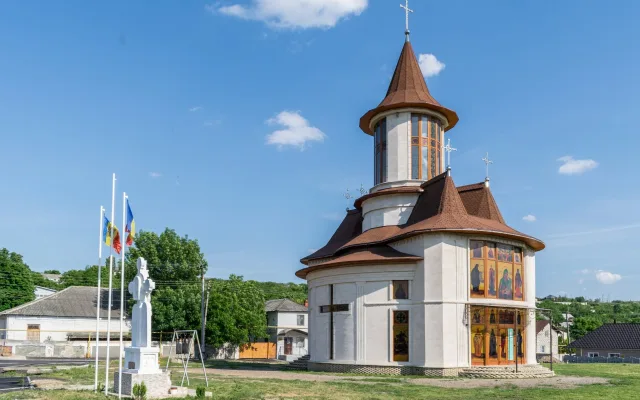
Old Orhei is a cave monastery cut into a limestone cliff above a loop of the river Raut, alongside the ruins of a Golden Horde town, 55 km from Chisinau.
Wiki
Old Orhei (Orheiul Vechi) is the reason to get out of Chișinău: a rock monastery that monks cut straight into the limestone cliff above a loop of the river Răut. The town of Orhei itself is somewhere you pass through; everything of interest is 15 km beyond it, in a reserve where a narrow tongue of land between the river's meanders holds the monastery, the ruins of a Golden Horde town and what is probably the most recognisable landscape in Moldova.
What there is actually to see
Do not confuse the town with the site: modern Orhei is a stop on the highway, while the destination is the archaeological and ethnographic reserve by the villages of Butuceni and Trebujeni.
- The cave monastery of the Dormition is the main thing. You enter through a narrow passage and a wooden door in the rock; inside are a church and monks' cells hewn out of the stone. The community appeared here in the thirteenth century, emptied in the eighteenth, and monastic life resumed only at the end of the twentieth. From the "window" in the cliff face the whole meander of the Răut opens up — the most photographed view in Moldova. On top of the rock stands a church with a bell tower, reached by a path; that is also the easiest way down to the cave entrance.
- Shehr al-Jedid — the foundations of a fourteenth-century Golden Horde town: the remains of baths and fortifications, the outlines of streets. You need to look at it understanding that this is archaeology rather than restored walls — but the scale and the layers of history (Getae and Dacians, the Golden Horde, the Principality of Moldavia) are legible on the spot.
- The landscape. The Răut canyon, the sheer limestone slopes, the fields on top — here you simply walk and breathe. Allow time for the ridge walk between Butuceni and the monastery.
- The ethnographic museum and the village of Butuceni — whitewashed houses, shadoof wells, village life. A good counterpoint to the monastery and a convenient place to eat.
Getting there
Rutiere (minibuses) run from Chișinău's North bus station to the town of Orhei in about an hour. But they go to the town, not to the reserve, and from there it is another 15 km or so along a country road where public transport is sparse and awkward.
The realistic options for an independent traveller:
- A hire car or a taxi for the day is the most practical approach, giving freedom and the chance to call in at neighbouring monasteries. The drive from Chișinău takes an hour to an hour and a half.
- A transfer or an organised trip from Chișinău makes sense if you have no car and only one day: the logistics are handled for you, at the cost of flexibility.
- A rutieră to Orhei plus a taxi to the site is a workable budget compromise; agree with the driver in advance that he will collect you, because there is nowhere to flag a car down out there.
How much time to allow
Half a day is enough for the reserve itself: the climb to the monastery, the caves, the views, the ridge walk and the town ruins. As a day trip from Chișinău it fits comfortably into daylight hours.
If you would rather not rush and want to catch sunset over the canyon — the light here is best in the evening — stay overnight in a guest house in Butuceni. That is a different proposition altogether: a quiet village, home cooking, morning mist over the river and no crowds. It is often the overnight stay that turns a tick-box stop into something memorable.
When to go
May to June and September to October are ideal: green or gold on the slopes and mild temperatures. Summer can be hot and busy at weekends. Winter is beautiful, but the paths and climbs are slippery and village facilities run at half strength. Come on a weekday — at weekends pilgrims and groups converge on the monastery.
Practicalities and money
- Dress for the monastery. This is a working community: cover shoulders and knees, women should have a headscarf, and scarves are often laid out at the entrance. Wear comfortable shoes with grip; the climbs are stony.
- Prices. By Moldovan standards everything is inexpensive. Admission to the museum and the monastery is nominal, and lunch in a Butuceni guest house with home-made wine costs noticeably less than a restaurant in Chișinău. Cash (lei) is essential: village businesses rarely take cards.
- Food. Order local — mămăligă with brânză and crackling, plăcinte, zeamă (chicken soup), sarmale and home-made wine. Guest houses feed people generously and simply.
- Water and supplies. There are hardly any shops at the site, so bring water and something to eat, especially in summer.
Common mistakes
- Going to the town of Orhei expecting the sight to be there: what you want is the reserve beyond the village of Butuceni.
- Relying on public transport all the way to the site — the last few kilometres are the problem, so plan the return in advance.
- Planning to "do it quickly in an hour" — the views and the paths call for a walk, and hurrying kills the point.
- Turning up in shorts and a vest top and not getting into the caves.
If you have time left
With a car the site combines well with others: Țipova, an even more dramatic cave monastery on a cliff above the Dniester, about 60 km away, and Căpriana, one of Moldova's oldest monasteries, documented since 1429. But each of these is a separate excursion in its own right — allow a full day for them rather than treating them as stops on the way.