Description
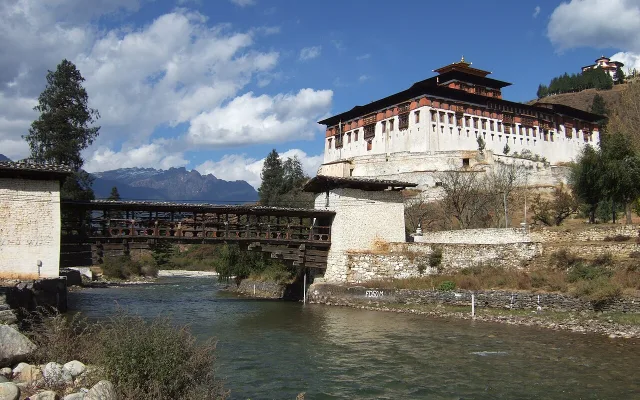
Bhutan's gateway town and its only international airport — the Tiger's Nest monastery, Paro Dzong and the valley views.
Wiki
Paro is the gateway to Bhutan: the country's only international airport is here, and almost every journey through the kingdom starts and ends in this valley. The town itself is small, around 12,000 people, spread across a wide valley at 2,280 metres.
How entry to Bhutan works
Bhutan admits foreign visitors on an unusual model: besides a visa you pay a daily Sustainable Development Fee, set since 2022 at $100 per night for most visitors, with reductions for children and separate terms for Indian nationals. You cannot travel the country independently — the itinerary is arranged through a licensed operator, and a guide and driver accompany you. Accommodation, meals and transport are normally already covered by the tour, so on-the-spot spending comes down to souvenirs and tips.
Main sights
- Taktsang, the Tiger's Nest — the symbol of Bhutan and the reason most people come. The monastery clings to a sheer cliff at 3,120 metres, roughly 800 metres above the valley floor. Tradition holds that Padmasambhava flew here on the back of a tigress and meditated in the cave around which the monastery later grew. The climb up and back takes four to five hours; the path is well trodden but steep, and the altitude tells.
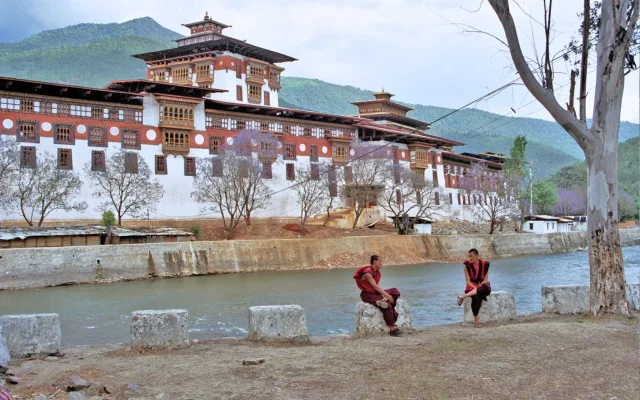
- Paro Dzong (Rinpung Dzong) — the 15th-century fortress monastery above the river, the principal building in town and the setting for the spring tshechu.
- Ta Dzong — the round watchtower on the hill above the dzong, now housing the National Museum of Bhutan.
- Kyichu Lhakhang — one of the oldest temples in the country. Tradition dates it to the 7th century and counts it among the 108 temples the Tibetan king Songtsen Gampo is said to have raised in a single day.
- Drukgyel Dzong — a fortress of 1649 built to mark a victory over a Tibetan army; it burned in 1951 and stood as a ruin for decades, and is now being rebuilt.
- Chele La pass (3,988 m) — the highest motorable point in Bhutan, with a view of Jomolhari (7,326 m) in clear weather. It is about an hour and a half from Paro.
- The Paro valley — the landscape itself: rice terraces, pine slopes and traditional houses with painted facades and wooden balconies.
What is nearby
- Thimphu — the capital, 50 km away, about an hour by road.
- Punakha — the former winter capital roughly 100 km off, over the Dochu La pass.
Food
The cooking is hot and filling. The base is red rice and ema datshi, chilli stewed in cheese sauce, which Bhutanese consider the national dish. Alongside it come phaksha paa (pork with dried chilli and radish), jasha maroo (chicken in a spicy broth), momos and suja, salted butter tea. Tourist hotels tone the chilli down; if you want the real heat, ask for it.
Transport
Paro airport (PBH) is the country's only international one, served by Drukair and Bhutan Airlines from Delhi, Kathmandu, Bangkok, Singapore and several Indian cities. The runway is hemmed in by mountains, the approach is flown manually on a visual procedure, and only specially certified crews are cleared for it — flights operate in daylight and good visibility only, and weather delays are routine. Leave slack before any onward connection.
It is about an hour from the airport to Thimphu on a paved road, and the transfer is normally part of the tour. Travel within the country is by minibus with a driver and guide.
When to go
March to May and September to November are the best seasons: 12-22°C and clear. Rhododendrons flower in March and April; October and November give the best visibility of the Himalaya. The monsoon from June to August brings cloud and rain, but the valley is at its greenest then. Winter is cold (-5 to +10°C), with clear skies and few visitors.
One reason to time a trip precisely is the tshechu, the monastic festivals with masked dances. Paro Tshechu falls in spring; dates follow the lunar calendar and are announced in advance, and rooms go long before the season.
Common mistakes
- Planning Taktsang for the day you land: the altitude gain straight after a flight is hard going.
- Counting on travelling the country independently without an operator — it is not possible.
- Booking a tight onward connection out of Paro.
- Assuming the $100 a night is the whole cost of the trip: the fee is charged on top of the tour.