Description
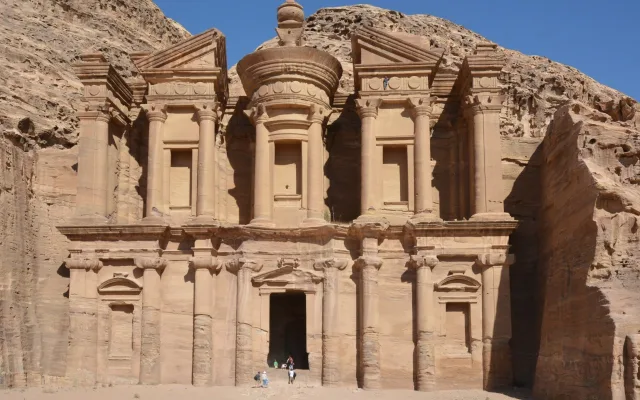
The Nabataean capital carved into rose sandstone — the Siq, the Treasury and the Monastery, a UNESCO World Heritage Site in southern Jordan.
Wiki
Jordan's greatest wonder and one of the New Seven Wonders of the World: the ancient capital of the Nabataean kingdom, established from around the fourth century BC, and a UNESCO World Heritage Site. The nearby town of Wadi Musa, with some 20,000 residents, serves as the base for visitors. A city of temples and tombs cut into the cliffs, Petra was lost to the Western world from the fourteenth century until 1812, when the Swiss traveller Johann Ludwig Burckhardt brought it back to scholarly attention. Many will recognise it as the "Grail temple" from Indiana Jones and the Last Crusade (1989).
The main sights
- The Siq (As-Siq) — the main entrance to Petra: a 1.2 km cleft in the rock, between three and twelve metres wide, with walls rising up to 180 m. The walk takes 20–30 minutes.
- The Treasury (Al-Khazneh) — Petra's signature façade, about 40 m tall, carved into rose sandstone in the first century AD. The Siq's closing shot.
- The Street of Facades — around forty tombs along the main street.
- The theatre — cut into the rock by the Nabataeans and enlarged under the Romans, with room for roughly 8,500 spectators.
- The Royal Tombs — four great tombs in the mountainside; the steps in front of them offer the best views across Petra.
- The Colonnaded Street — the main thoroughfare of the classical city.
- The Great Temple — the largest building in ancient Petra.
- The Monastery (Ad-Deir) — a larger façade than the Treasury, roughly 47 m wide and 48 m high, reached by a climb of about 800 steps (45–60 minutes).
- The High Place of Sacrifice — altars on a mountain summit, another long stair climb, and the widest views over the whole site.
- Petra by Night — the Treasury lit by candles three evenings a week (Monday, Wednesday and Thursday). The ticket is sold separately from daytime entry.
- Little Petra (Siq al-Barid) — a miniature Petra about 8 km away, without the crowds; half an hour of easy walking.
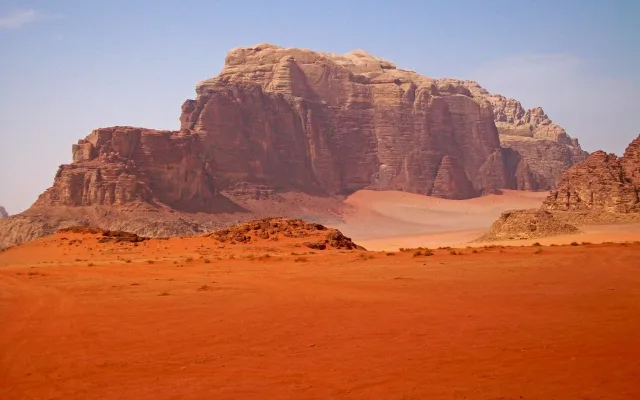
- Wadi Rum — the desert an hour and a half away, usually combined with Petra (it has its own page).
Food and prices
The cooking is Jordanian and Bedouin: mansaf (the national dish, lamb with fermented yoghurt and rice), mezze (hummus, moutabbal, tabbouleh), shrak (paper-thin flatbread) and zarb (lamb baked in a sand pit). Lunch in a Wadi Musa café costs $8–15, dinner in a restaurant $20–40. Entry to Petra is 50 dinars (about $70) for one day, 55 (about $78) for two days and 60 (about $85) for three. The Jordan Pass, which bundles the tourist visa with entry to Petra and many other sites, starts at 70 dinars and normally works out cheaper if you are seeing more of the country. Petrol is about $1.20 a litre. Prices are as of 2026.
Transport
The nearest airports are Aqaba (AQJ), two hours away by road, and Amman (AMM), about three. The JETT bus from Amman takes around four hours and costs roughly 11 dinars (about $16). A taxi from Amman is $90–130. Inside Petra you walk; camels and donkeys are offered, which raises its own ethical questions. Buy the two-day ticket in advance — Petra does not fit into a single day.
When to go
March–May and September–November, at 18–28°C, are ideal. Summer (June–August) brings an extreme 35–40°C, and the Siq turns into a heat trap. Winter (December–February) runs 5–15°C, with the chance of snow and cold nights. The gate opens at 6 am, and early morning gives the best light on the Treasury.