Rotorua
New ZealandDescription
Geyser country and Maori culture — Wai-O-Tapu, Te Puia and natural hot pools.
Wiki
New Zealand's principal geothermal resort and the cultural heart of the Maori — around 60,000 people on the North Island, 230 km from Auckland. The town is built on an active volcanic plateau: geysers, mud pools, thermal baths and sulphur fumaroles, with the smell of sulphur across the whole town. Around 35% of the population is Maori, which offers a rare chance to engage with Polynesian culture: haka, hāngī evenings where food is cooked in the earth, wood carving and ancestral storytelling.
Main sights
- Te Puia — the main geothermal park and the New Zealand Maori Arts and Crafts Institute. The Pohutu geyser erupts once or twice an hour to as much as 30 m, alongside hot springs and a carving workshop.
- Whakarewarewa Living Maori Village — a working Maori village where people have genuinely lived on the thermal springs for more than 200 years, cooking with steam and bathing in natural pools.
- Mitai Maori Village — an evening cultural programme with haka, a hāngī dinner and storytelling.
- Tamaki Maori Village — another cultural village with a show.
- The Polynesian Spa — New Zealand's leading geothermal spa, with 30 thermal pools at different temperatures.
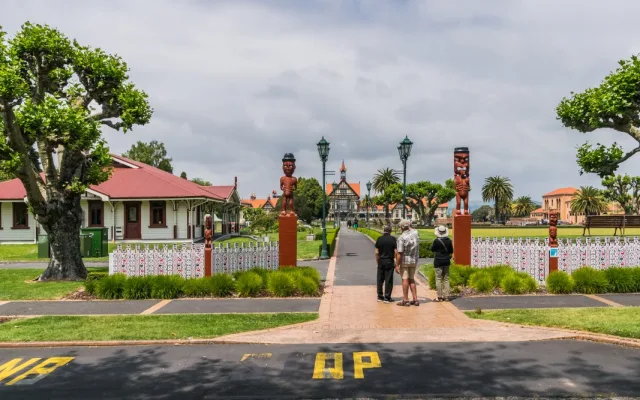
- The Government Gardens — the main park, with its Victorian bathhouse complex.
- Wai-O-Tapu (Sacred Waters) — one of the most vivid geothermal parks in the world, with coloured pools in orange, green and blue, the Champagne Pool, and the Lady Knox Geyser, which performs to schedule at 10:15.
- Waimangu Volcanic Valley — the youngest geothermal system in the world, formed after the Tarawera eruption of 1886, with the Inferno Crater Lake.
- Hells Gate Geothermal Park — boiling mud pools and sulphur steam.
- Skyline Rotorua — the gondola up Mount Ngongotaha, with a luge track and a panorama over the lake.
- Lake Rotorua — the town's lake, with Mokoia Island at its centre and the legend of Hinemoa and Tutanekai.
- The Redwoods (Whakarewarewa Forest) — Californian redwoods planted in 1901, with walking trails and mountain biking.
Food and prices
The cooking is modern New Zealand and Maori: hāngī (food cooked on hot stones in the ground), kūmara (sweet potato), mussels, trout and lamb. Lunch in a café is NZ$18-25 ($11-15), dinner in a restaurant NZ$40-70 ($24-41), and a hāngī dinner with a show NZ$100-130 ($59-77). A litre of petrol is NZ$2 ($1.20), a taxi or Uber NZ$15-25 ($9-15), and the Bay Hopper bus NZ$3 ($1.80). Prices are as of 2026.
Getting there and getting around
Rotorua airport (ROT) is served by Air New Zealand from Auckland and Wellington. From Auckland it is four hours on the InterCity bus (NZ$40-60 / $24-35) or three hours by hire car. Around town, walk or use the Bay Hopper buses, taxis and Uber.
When to go
October to April is 14-25°C and ideal. December to February is peak season, so book hāngī tours a month ahead. Winter (June to August) runs 5-12°C, but the thermal pools are all the better for it. The geysers and geothermal fields work all year.