Description
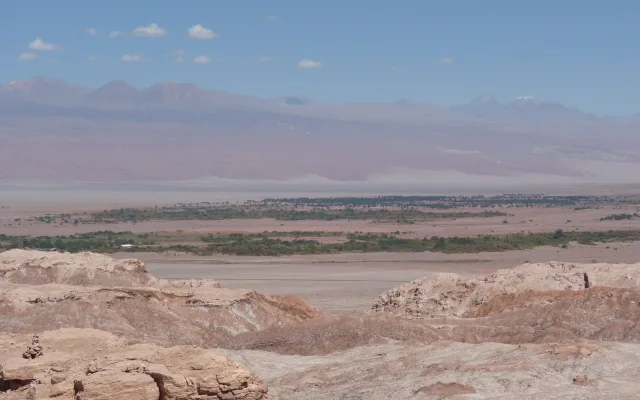
The Atacama Desert — the driest on Earth: El Tatio geysers, Valle de la Luna, flamingo lagoons, and skies free of clouds year-round.
Wiki
The main base for exploring the Atacama Desert — the driest desert on Earth — San Pedro de Atacama is a town of around 11,000 people in northern Chile, at an elevation of 2,408 m. A small adobe-brick town surrounded by otherworldly landscapes: salt flats, active volcanoes, geysers at 4,300 m, pink flamingo lagoons at 4,000 m, and the Valley of the Moon. The Atacama has the clearest skies on the planet for astronomy (the world's largest radio telescope, ALMA, is located nearby). The town is also a crossing point into Bolivia (Uyuni) and Argentina.
Top Attractions
- Valle de la Luna (Valley of the Moon) — the region's defining natural landmark, 13 km from San Pedro, with lunar-like landscapes. Sunset here is unmissable.
- Valle de la Muerte / Valle de Marte (Valley of Death / Valley of Mars) — the neighbouring valley, popular for sandboarding on its dunes.
- El Tatio Geysers — the world's third-largest geyser field, at 4,320 m. Best at dawn (departure around 4 am) — the steam is most dramatic in the cold. Tours 50–80 USD.
- Altiplanic Lagoons (Lagunas Altiplánicas) — Miscanti and Miñiques at 4,200 m, vivid blue lakes with flamingos. Half-day tour 60–80 USD.
- Salar de Atacama — Chile's largest salt flat, with the Chaxa and Tebenquiche lagoons and their flamingo colonies.
- Laguna Cejar — a hypersaline lagoon where it is impossible to sink (denser than the Dead Sea).
- Puritama Hot Springs (Aguas Termales de Puritama) — natural thermal pools set inside a canyon.
- ALMA (Atacama Large Millimeter Array) — the world's largest radio telescope at 5,050 m; free guided visits on Saturdays and Sundays.
- Astronomy Tours — the Atacama sky is among the best on Earth for stargazing. Professional tours with telescopes: 50–80 USD.
- Iglesia San Pedro — a 17th-century church, whitewashed with a timber roof.
- Museo del Padre Le Paige — artefacts of the Atacameño culture.
- Salar de Uyuni (Bolivia) — the world's largest salt flat, reachable on a 3-day tour departing from San Pedro: 200–300 USD.
Food and Prices
The cuisine is Chilean and Atacameño: empanadas, llama (lama), queso de la Atacama, pisco sour. Lunch at a café runs 12–22 USD, dinner at a restaurant 25–50 USD. Tours are the main expense: a typical day tour costs 50–80 USD. A litre of petrol is around 1.20 USD; taxis (scarce) 5–15 USD; bicycle hire 8–15 USD per day. Prices are as of 2026.
Getting There and Around
El Loa Airport (CJC) in Calama, 100 km away, is served by LATAM, Sky, and JetSMART from Santiago (2 hours, 80–150 USD). Shuttle from Calama to San Pedro: 12–18 USD; taxi: 40–60 USD. Long-distance bus from Santiago takes 22–24 hours (40–70 USD). Cross-border tours to Bolivia — San Pedro to Uyuni, 3 days (200–300 USD) — are popular.
When to Go
March–November is the dry season (the Atacama is the world's driest desert): daytime temperatures 5–25 °C, nights cold (down to 0 °C). December–February is the Altiplano's summer rainy season — rainfall is light but possible. The altitude of 2,408 m should be taken seriously: avoid alcohol and heavy exertion for the first 24 hours. The El Tatio geysers sit at 4,320 m, where morning temperatures can reach −10 °C even in summer.