Description
Chile's modern capital with views of the snow-capped Andes, the Bellavista quarter, the La Vega Central market and good pisco sour bars.
Wiki
Chile's capital and largest city, home to around 6.8 million people in a valley between the Andes and the Coastal Range. It is the main financial centre of South America and has the highest standard of living in Latin America. From Santiago it is easy to reach the Maipo and Casablanca wine valleys (1 hour), ski resorts (1.5 hours), the beaches of Viña del Mar (1.5 hours), and Aconcagua (6,962 m, the highest peak in the Americas, across the border in Argentina) in around 2 hours.
Main sights
- Plaza de Armas — the country's main square, with the Cathedral (1748), the presidential Casa Colorada palace, and the National History Museum.
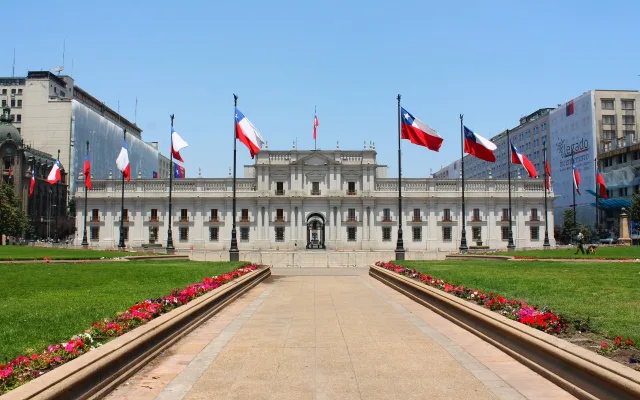
- Palacio de La Moneda — the presidential palace, bombed in 1973 during Pinochet's coup. Changing of the guard takes place four times a week.
- Cerro San Cristóbal — a hill in the heart of Santiago rising about 300 m above the streets (880 m above sea level), served by a funicular and cable car, topped by a 22 m statue of the Virgin Mary.
- Cerro Santa Lucía — a small hill in the city centre, once a fort, now a park.
- Barrio Bellavista — the bohemian neighbourhood at the foot of San Cristóbal, home to Pablo Neruda's house La Chascona, and the city's main clubs and bars.
- La Chascona (Pablo Neruda's House) — one of three houses belonging to the Nobel Prize-winning poet (the others are at Isla Negra on the coast and in Valparaíso).
- Museo Nacional de Bellas Artes — the country's main fine arts museum.
- Museo de la Memoria y los Derechos Humanos — a powerful museum documenting the Pinochet dictatorship of 1973–1990.
- Mercado Central — the city's main seafood market, housed in a striking iron-and-glass building from 1872.
- Costanera Center — Latin America's largest shopping mall, anchored by the Sky Costanera tower (300 m), the tallest skyscraper on the continent.
- Maipo Valley wineries — Chile's leading wineries (Concha y Toro, Santa Rita, Viña Cousiño Macul) are 30 minutes from the centre.
- Casablanca Valley vineyards — known for white wines (Chardonnay, Sauvignon Blanc), about an hour away.
- Cajón del Maipo — a mountain canyon an hour to the east, with rafting and hot springs.
- Valle Nevado and Portillo — ski resorts 1.5–2 hours from the city.
Food and prices
Chilean cuisine centres on empanadas (the staple street food), pastel de choclo, cazuela, curanto, and asado, alongside ceviche and a strong wine culture. Lunch at a café runs $10–18, dinner at a restaurant $25–50. A pisco sour costs $5–8, a bottle of Carménère $12–25. Metro fare (7 lines) is around $1, a city taxi or Uber $5–15. Petrol costs around $1.20 per litre. Prices are as of 2026.
Getting around
Arturo Merino Benítez International Airport (SCL) is the main hub for the Southern Cone. The Centropuerto airport bus costs around $2.50; a taxi or Uber runs $25–35. Within the city, Santiago operates the largest metro network in South America (260 km), supplemented by taxis, Uber, and Cabify. Buses to Viña del Mar and Valparaíso take 1.5 hours ($10–15).
When to go
March–May and September–November are the best months, with temperatures of 12–25 °C. December–February (southern summer) brings 18–32 °C, though many locals head to the coast. Winter (June–August) sees 5–15 °C and is ideal for skiing in the Andes, though smog can be a serious problem in Santiago during these months. Key events: the Wine Festival (March) and Fiestas Patrias (18 September).