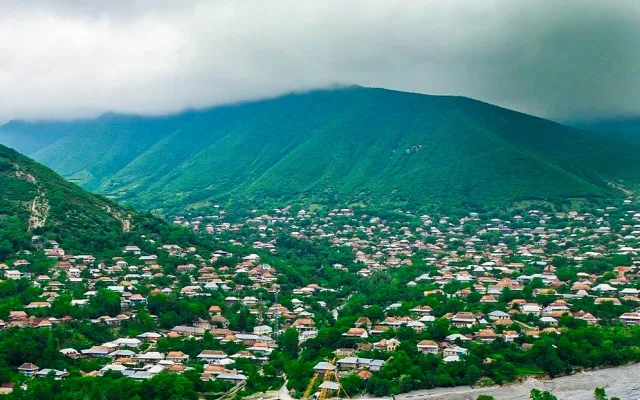
Sheki
AzerbaijanDescription
Sheki is a historic town in Azerbaijan, known for the Palace of the Sheki Khans, its silk-making tradition and medieval caravanserais.
Wiki
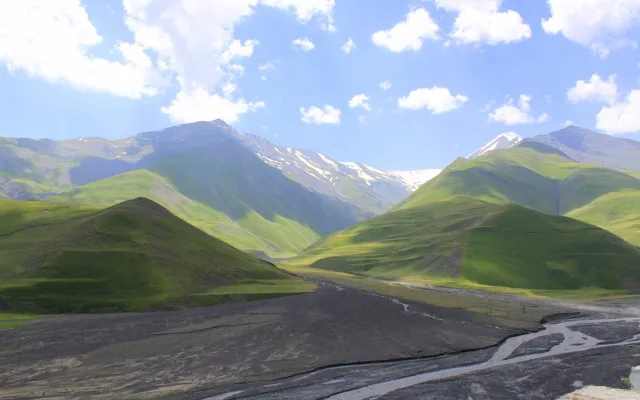
The main historic town of north-western Azerbaijan and one of the best-preserved places in the Caucasus — around 65,000 people in the Greater Caucasus mountains at an altitude of 700 m, 320 km from Baku. A UNESCO World Heritage Site since 2019: the Historic Centre of Sheki along with the Palace of the Sheki Khans. This was the capital of the Sheki Khanate (1743-1819), the principal silk centre of the Silk Road in the Caucasus, and the home of a unique craft called shebeke — wooden lattices holding coloured glass, assembled without a single nail or drop of glue.
Main sights
- The Palace of the Sheki Khans (Şəki Xan sarayı) — a UNESCO site and the town's great monument (1797). The finest shebeke building in the world: 5,000 pieces of coloured glass, no nails, no glue. Six rooms painted by hand inside.
- The Sheki Caravanserai (Yuxarı Karvansaray) — 18th century, restored and now a hotel. One of the best-preserved caravanserais on the Silk Road.
- The Albanian Church of Kish (Müqəddəs Yelisey kilsəsi) — the oldest Christian church in the Caucasus (1st century AD; by tradition founded by the Apostle Elisha). The village of Kish is 5 km away.
- The Shekikhanov House — a restored merchant's house with shebeke windows.
- Yukhari Bazar — the old market quarter.
- Gelersen-Gorersen ("Come and See") — an 18th-century fortress in the mountains 6 km out; a two- to three-hour trek.
- The Khan Mosque — the town's main 18th-century mosque.
- The Sheki Fortress Museum — artefacts from the khanate period.
- Ilisu — a village on the border with Dagestan, with a seven-tier fortress and a waterfall.
- The Altyaghach reserve — for trekking in the mountains.
- A 17th-century defensive tower — a surviving Caucasian Albanian watchtower.
Food and prices
The cooking is Sheki's own: piti (the local speciality — mutton soup in clay pots, cooked for eight hours), khan plov, gyzartma, Sheki halva (the pride of the town, in seven varieties) and nut-based sweets. Lunch in a teahouse is $5-9, dinner in a restaurant $12-25. A litre of petrol costs $0.70, a taxi across town $2-5, a minibus from Baku $8-12.
Getting there
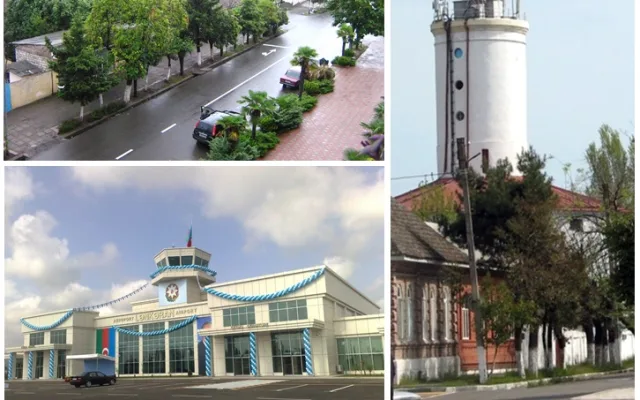
Sheki has a small airport with very few flights. It is easier to fly into Baku (GYD) and continue by minibus, 5-6 hours ($8-12), or by taxi hired for the day ($80-130). In town you walk or take taxis. Most nationalities need an ASAN eVisa for Azerbaijan, usually issued within three days — check the current rules for your own passport before you travel.
When to go
April-May and September-October, at 18-25°C, are ideal. Summer (July-August) is 25-30°C, cooler than Baku. Winter (December-March) is cold, −5 to +5°C, often with snow — and Sheki under snow is something special. Main events: the Halva Festival in July and the Silk Road Festival.