Description
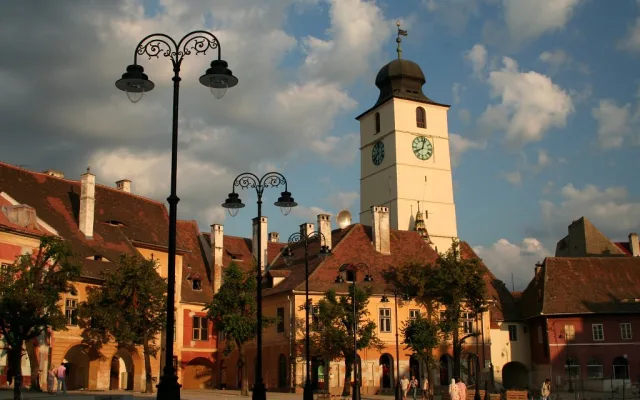
The city many travellers call the finest in Transylvania: colourful houses with attic "eyes", fortress towers, and one of Europe's biggest theatre festivals.
Wiki
One of the best-preserved medieval cities in Eastern Europe and the cultural capital of Transylvania — a city of around 145,000 people in Romania. Former European Capital of Culture 2007. Founded by Saxon settlers in the 12th century as Hermannstadt — one of the seven "Saxon cities" of Transylvania. The Germanic heritage is still very much alive: bilingual street signs, a Lutheran cathedral, and the iconic "eye" houses (dormer windows that look like watchful eyes). The area around the city holds the greatest concentration of fortified churches in Europe.
Top sights
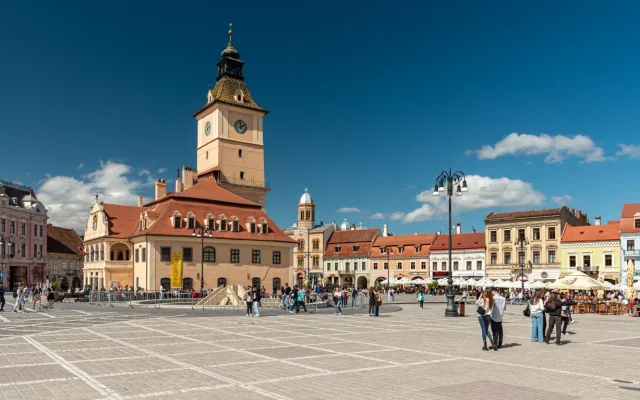
- Grand Square (Piața Mare) — the main square, lined with Baroque and Gothic townhouses, the town hall, and the Brukenthal Palace.
- Small Square (Piața Mică) — the adjacent smaller square, the city's favourite spot for an outdoor coffee.
- Passage of Stairs (Pasajul Scărilor) — a covered medieval stairway of the 13th–14th centuries linking the upper and lower towns.
- Liars' Bridge (Podul Minciunilor) — Romania's first cast-iron bridge (1859), sharing the same legend.
- Lutheran Cathedral of Saint Mary — the main Lutheran church, with a 73-metre tower.
- Orthodox Cathedral of the Holy Trinity — the main Orthodox church, built in a Neo-Byzantine style in 1906.
- Brukenthal Museum — Romania's oldest museum (1817), housing the art collections of Baron Samuel von Brukenthal.
- The "Eye" Houses — Sibiu's most distinctive quirk: dormer windows set into the rooflines that seem to peer down at passers-by.
- Lower Town (Orașul de Jos) — the old craftsmen's quarter with well-preserved medieval buildings.
- ASTRA Open-Air Museum — the largest open-air museum in South-East Europe, with around 400 historic structures spread over almost 100 hectares.
- Bran Castle — the famous "Dracula's Castle", 130 km away and Romania's most visited tourist site.
- Sighișoara — another UNESCO-listed Saxon city 90 km away, birthplace of Vlad the Impaler (Dracula).
- The fortified Saxon churches — Biertan, Viscri, Valea Viilor, Câlnic and dozens of others from the 13th–16th centuries, within 50–80 km of the city.
Food and prices
The local cooking is Saxon-Transylvanian: gulaș, sarmale (stuffed cabbage rolls), mămăligă cu brânză (polenta with cheese), cozonac (sweet bread), ciorbă (sour soup), and papanași (fried doughnuts). The influence of German and Hungarian cuisine is strong throughout. A lunch at a local restaurant runs 35–68 RON (about $8–15), dinner for two at a sit-down restaurant 80–160 RON ($18–35). A glass of Recaș or Murfatlar wine costs 14–23 RON ($3–5). A litre of petrol is around 7 RON ($1.50), a city taxi ride 18–45 RON ($4–10), and a public transport ticket 3 RON ($0.70). Prices are as of 2026.
Getting there and around
Sibiu International Airport (SBZ) is served by Wizz Air, Lufthansa, and a handful of other carriers with limited routes. From Bucharest (OTP) there is a 1-hour flight or a 5.5-hour train (68–136 RON / about $15–30). From Budapest the journey takes around 11 hours by train or 7 hours by bus (136–205 RON / $30–45). The city centre is compact and very walkable; local buses cover the wider urban area.
When to go
May to September brings temperatures of 12–25 °C. September and October are particularly beautiful in the autumn colours. Key events: the Sibiu International Theatre Festival in June (one of the largest in Europe) and the Astra Film Festival in October. December brings a Christmas market that regularly ranks among the top three in Europe.