Sidi Bou Said
Description
The blue-and-white village on a cliff above the sea, next to Carthage — famous doorways and mint tea with pine nuts.
Wiki
Sidi Bou Said is the most photogenic village in Tunisia and one of the most recognisable spots in North Africa: some five thousand people on a cliff above the Mediterranean, 20 km from the centre of the capital. Every house here is white, and every door, window, shutter and grille is blue. The convention took hold in the early 20th century at the instigation of the French baron and musicologist Rodolphe d'Erlanger, who settled in the village. European painters came here to work; Paul Klee visited in 1914.
What to see
- The main street — a paved climb between white walls with blue doors and grilles, bougainvillea, shops selling ceramics and birdcages, and cats on the steps. This is what people come for.
- Café des Nattes — the oldest café in the village at the top of the stairway, named for the reed mats on its floor. It carries a literary reputation: mid-century French writers came here.
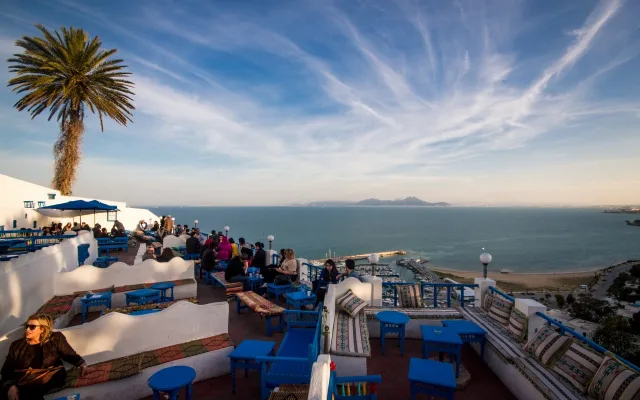
- Café Sidi Chabaane — a terraced café on the cliff with the best view of the harbour. Mint tea with pine nuts is the local classic.
- Dar el-Annabi — a traditional 18th-century Tunisian house open as a museum, with its patio, ceramics and original furniture and fittings.
- Ennejma Ezzahra — d'Erlanger's villa above the sea, now the Centre for Arab and Mediterranean Music, with its garden, interiors and collection of instruments.
- Dar Zarrouk — a restaurant with a large terrace over the drop; people come for the view and the sunset rather than the food.
- The marina below the cliff — fish restaurants and pleasure boats.
What is nearby
- Carthage — a UNESCO site 5 km away. The Phoenician city was founded here in the 9th century BC, destroyed by Rome in 146 BC and rebuilt by the Romans; Roman Carthage lasted until the Arab conquest in the 7th century AD. The things to see are the Baths of Antoninus on the shore, the Byrsa hill with its museum, the Punic quarter and the tophet.
- Tunis — the capital 20 km away: the UNESCO-listed medina and the Bardo Museum, holding one of the largest collections of Roman mosaic in the world.
- La Marsa — the neighbouring seaside suburb, more local and less polished.
- Gammarth — the beach area a few kilometres to the north.
Food and prices
The cooking is Tunisian: brik (a crisp pastry parcel with egg and tuna), couscous, mechouia (a salad of roasted peppers and tomatoes), Tunisian tajine, which is closer to a baked omelette than to the Moroccan dish, and makroud, date pastries. The thing to drink is mint tea with pine nuts. Lunch at a café comes to 35-64 dinars ($12-22), dinner at a restaurant by the sea to 73-146 dinars ($25-50), and a coffee to 6-12 dinars ($2-4). Prices here run noticeably above the Tunisian average: this is a shop-window village.
Transport
Tunis-Carthage international airport (TUN) is 25 km away, and a taxi from it costs 20-29 dinars ($7-10). From the capital the easiest way is the TGM suburban line (Tunis-La Goulette-La Marsa) to Sidi Bou Said station: about half an hour and under 3 dinars (under $1). A fixed-rate taxi from Tunis is 15-23 dinars ($5-8). The village itself is walkable, but the climb up from the station is steep.
When to go
April to October, 18-30°C. May, June and September are the optimum: warm, with the sea up to temperature and fewer visitors than at the height of summer. In summer the village fills with cruise groups and the main street loses half its charm — come before ten in the morning or towards evening. Winter is mild (12-18°C) but wet, and some cafés are shut. In July and August the International Carthage Festival is held in the ancient theatre at Carthage.
Updated