Description
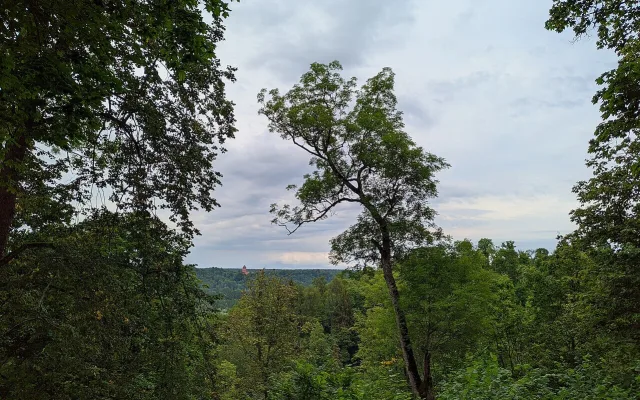
Latvia's Switzerland in the Gauja valley — three castles, a bobsled run, and Turaida park.
Wiki
Sigulda is a small town in northern Latvia, spread across the picturesque slopes of the ancient Gauja river valley, roughly 50 km from Riga. Its landscape of forested hills, sandstone cliffs, and caves has long earned it the nickname "the Switzerland of Latvia."
History
The first settlements in this area predate the arrival of the German crusaders by a long stretch: the Finnic Livonian people lived here, leaving behind hill forts and legends. In the early 13th century, during the Livonian Crusade, the territory became a battleground. On opposite banks of the Gauja, two rival fortresses rose: a castle of the Livonian Brothers of the Sword on one side, and the stronghold of the Archbishop of Riga on the other. The town has been known by the German name Segewold since the 13th century, from which the Latvian Sigulda grew.
Over the following centuries the land passed through the hands of the Livonian Order, the Polish-Lithuanian Commonwealth, Sweden, and the Russian Empire. The real turning point came in the late 19th century, when the Riga–Valka railway was routed through Sigulda. The scenic countryside quickly became a popular summer-retreat and resort destination for Riga residents, a role that only grew after Latvia gained independence.
Three Castles
Sigulda's defining feature is a trio of castles separated by the river valley.
- Sigulda Medieval Castle — the ruins of the Livonian Brothers of the Sword fortress, dating from the early 13th century. The surviving walls and towers have been partly restored, and viewing platforms offer sweeping views over the valley.
- Sigulda New Castle — a 19th-century neo-Gothic manor house built beside the old ruins. It has housed various institutions over the years and forms the architectural centrepiece of the castle ensemble.
- Turaida Castle — arguably the most recognisable landmark of the region. The red-brick Archbishop's fortress, founded in 1214, has been restored and converted into a museum. From the top of its tall round tower, the panorama of the Gauja valley stretches out in every direction.
Turaida and the Park
The Turaida Museum Reserve is an expansive complex combining the castle, an old wooden church, ethnographic outbuildings, and the celebrated Song Park with Dainu Hill, adorned with sculptures inspired by Latvian folklore. The site also holds the grave of the Rose of Turaida — Maija, the heroine of a tragic 17th-century legend of loyalty and love that has become one of Latvia's most cherished tales.
The Gauja Valley and Nature
Sigulda is the heart of Gauja National Park, the oldest in the country. The steep riverbanks are formed from reddish Devonian sandstone, carved by water and time into grottos and exposed faces. The most famous is Gutmanis Cave, the largest in the Baltic states, whose walls are covered in inscriptions left by visitors over the centuries. A spring nearby is the subject of many local beliefs.
Hiking trails, wooden stairways, and viewpoints wind through the valley. A cable car crosses the river and ravines — the gondola glides unhurriedly above the valley, offering breathtaking views that are especially dramatic in the golden autumn.
Active Pursuits
Sigulda is also popular with sports enthusiasts. The luge and bobsled track — one of the few in the world built during the Soviet era and still used for international bobsled, luge, and skeleton competitions — operates here. In winter the surrounding area becomes a skiing destination; warmer months bring cycling routes, bungee jumping, and wind tunnel flights.
Food and Drink
Local gastronomy follows Latvian tradition: rye bread, grey peas with bacon, smoked fish, game dishes, and wild mushrooms. A particular pride of the area is Sigulda walking sticks — carved wooden canes that have become a folk souvenir and informal symbol of the town. At local markets you'll find honey, herbal teas, and crafts from local artisans.
Practical Information
The easiest way to reach Sigulda from Riga is by commuter train or scheduled bus — the journey takes about an hour, making it a comfortable day trip. Covering the main highlights — the three castles, Gutmanis Cave, and the Turaida Reserve — is very doable in a single full day, though an extra night is well worth it if you want to explore the national park at a leisurely pace.
The best time to visit is late spring, summer, or autumn, when the Gauja valley is at its most scenic. The more distant sights are linked by walking trails, or you can use the cable car. Comfortable footwear is a good idea given the hilly terrain.