Description
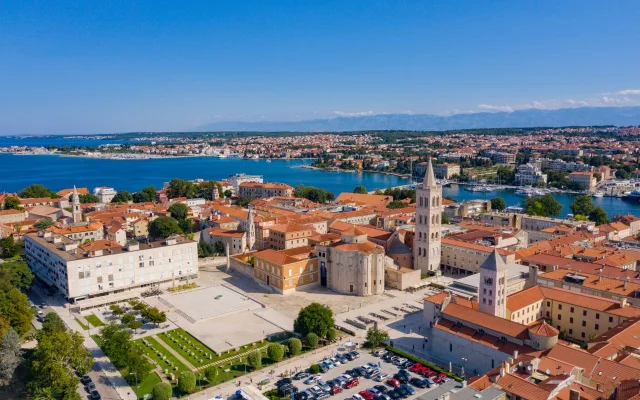
A Dalmatian city with the Sea Organ — an avant-garde instrument played by the waves of the Adriatic — and a historic old town on a peninsula.
Wiki
Zadar is a Dalmatian city on a peninsula where Roman ruins stand alongside two art installations that "play" the sea and the sun. It is often skipped on the way to Split or Dubrovnik, which is a mistake: two days is enough to cover everything on foot at a relaxed pace, and the city is a convenient base for day trips to the islands and Plitvice.
Why visit and how long to stay
Zadar is well suited to independent travellers: a compact old town on a peninsula, lively waterfronts without Dubrovnik's crowds, and a fully functional transport hub — airport, bus station and ferry port. Two days is the right amount of time: one for the historic centre and sunset at the Sea Organ, the second for a trip to the islands or Plitvice Lakes.
What is genuinely worth seeing
- The Sea Organ and Greeting to the Sun — go at sunset, not during the day. The organ plays on its own, driven by the waves, and the solar circle puts on a light-and-sound display in the evening. Sit on the steps with a bottle of wine — this is the city's main evening ritual, and it is free.
- The Roman Forum and the Church of St Donatus — they stand side by side and can be seen in a single visit. The round ninth-century basilica was built literally on the ancient stones of the forum; the acoustics inside are excellent and concerts are held there in summer.
- Zadar Cathedral (St Anastasia's) — you can climb the bell tower for views over the terracotta rooftops and the Adriatic; the climb is inexpensive and worth it.
- Narodni trg (People's Square) with its Venetian loggia — the hub of evening life, and a useful landmark for meeting people and getting your bearings.
The peninsula itself can be walked in a couple of hours. Do not try to "see everything" — the value of Zadar lies in wandering slowly along its marble streets and finding your way back to the water.
Day trips from the city
- Kornati National Park — an archipelago of islands reached by day boat tours that include swimming and lunch on board. A full day out; it is better to book through local agencies at the port than through online middlemen.
- Plitvice Lakes — about 1.5 hours by car or bus. A day trip is perfectly feasible, but leave early: by midday the cascades fill up with tour groups. In high season, book tickets in advance.
- Ugljan Island — the ferry from the port takes about twenty minutes; a good half-day option with no great expense, quieter and cheaper than the Kornati trip.
Getting there and getting around
Zadar Airport (ZAD) is served by low-cost carriers including Ryanair and easyJet. An airport bus (around 5 EUR / about $6) runs to the centre timed to arrivals — the simplest option; taxis are considerably more expensive. The bus station and ferry port are within walking distance of the old town, making onward connections along the coast and to the islands straightforward.
A car is unnecessary in the city and can be a nuisance: the peninsula is pedestrianised and parking is paid. Rent a car only if you plan to visit Plitvice or travel freely around Dalmatia — in that case it makes sense to pick it up at the airport.
Where to stay
The best location is in the old town on the peninsula or just behind it. The advantages: everything is walkable and sunsets are right on your doorstep. The drawbacks: it can be noisy on summer evenings and prices are higher. If you prefer quiet and a lower budget, the Borik/Puntamika area slightly to the north has city-bus connections to the centre and its own beaches.
Food and prices
The cuisine is Dalmatian: pašticada (beef braised in wine), fresh fish and grilled scampi. A local speciality is maraschino liqueur, invented in Zadar from the marasca cherry; it makes a good edible souvenir. In practical terms, lunch at a konoba is noticeably cheaper than dinner at a waterfront restaurant, and a glass of local Plavac Mali wine costs very little. The straightforward way to save money is to move a couple of streets back from the waterfront where locals eat, and to order the catch of the day rather than imported fish. Prices are as of 2026.
The central market is a good place to pick up fruit, cheese and cured meat for a ferry crossing or a picnic by the sea.
When to go
The ideal time is late May, June and September: warm, the sea is swimmable, but without the July–August crowds and peak prices. In the height of summer it is hot and busy, though ferry and excursion services run at full frequency. In winter the city is quiet, and some sea routes and venues are closed.
Things to bear in mind
- Zadar is safe; the usual city awareness around pickpockets in the sunset crowds is all that is needed.
- The marble paving of the old town becomes slippery after rain and in open-soled shoes — wear soles with a good grip.
- There is nowhere to swim in the centre itself; beaches are in the Borik area or on the islands, so plan for that separately.
- A common mistake is to stop for half a day "just for the organ." Stay for at least one sunset and one day trip — without those, the point of the city is lost.