 Города и дороги
Description
A village on the Volkhov with a stone fortress and pre-Mongol churches - Rurik's first capital stood here, and this is where the chronicled history of Rus begins. Half a day covers it.
Wiki
Staraya Ladoga is not a town but a village in the Volkhovsky district of Leningrad Region, with around two thousand inhabitants. People come here for one thing: the written history of Rus begins here earlier than in Novgorod or Kyiv. Dendrochronology dates the lowest layers of the settlement to 753 — there is practically nothing older in Russia.
What was here
Ladoga stood on the Volkhov stretch of the route "from the Varangians to the Greeks", at the point where the sea ended and the rapids began. Hence the Scandinavian finds, the hoards of Arab silver and the craft layers of the 8th and 9th centuries.
Its title of "the first capital of Rus" rests on a single chronicle version: the Hypatian Codex says that Rurik, invited in 862, settled precisely in Ladoga and only two years later moved on towards Novgorod. The Laurentian Codex knows nothing of this episode. The argument is not settled, but in 2003 the village officially celebrated its 1,250th anniversary as "the ancient capital of northern Rus".
The fortress
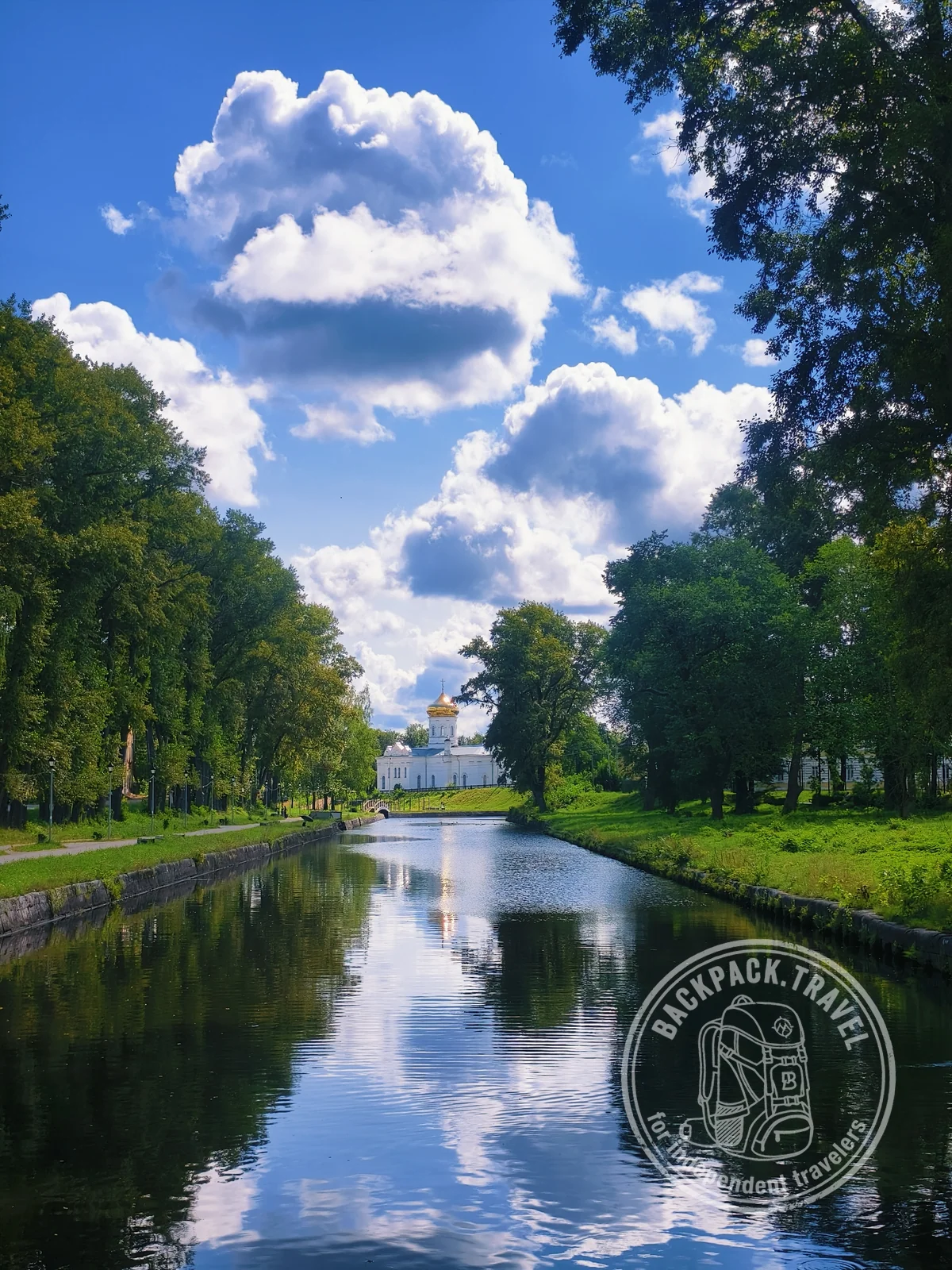
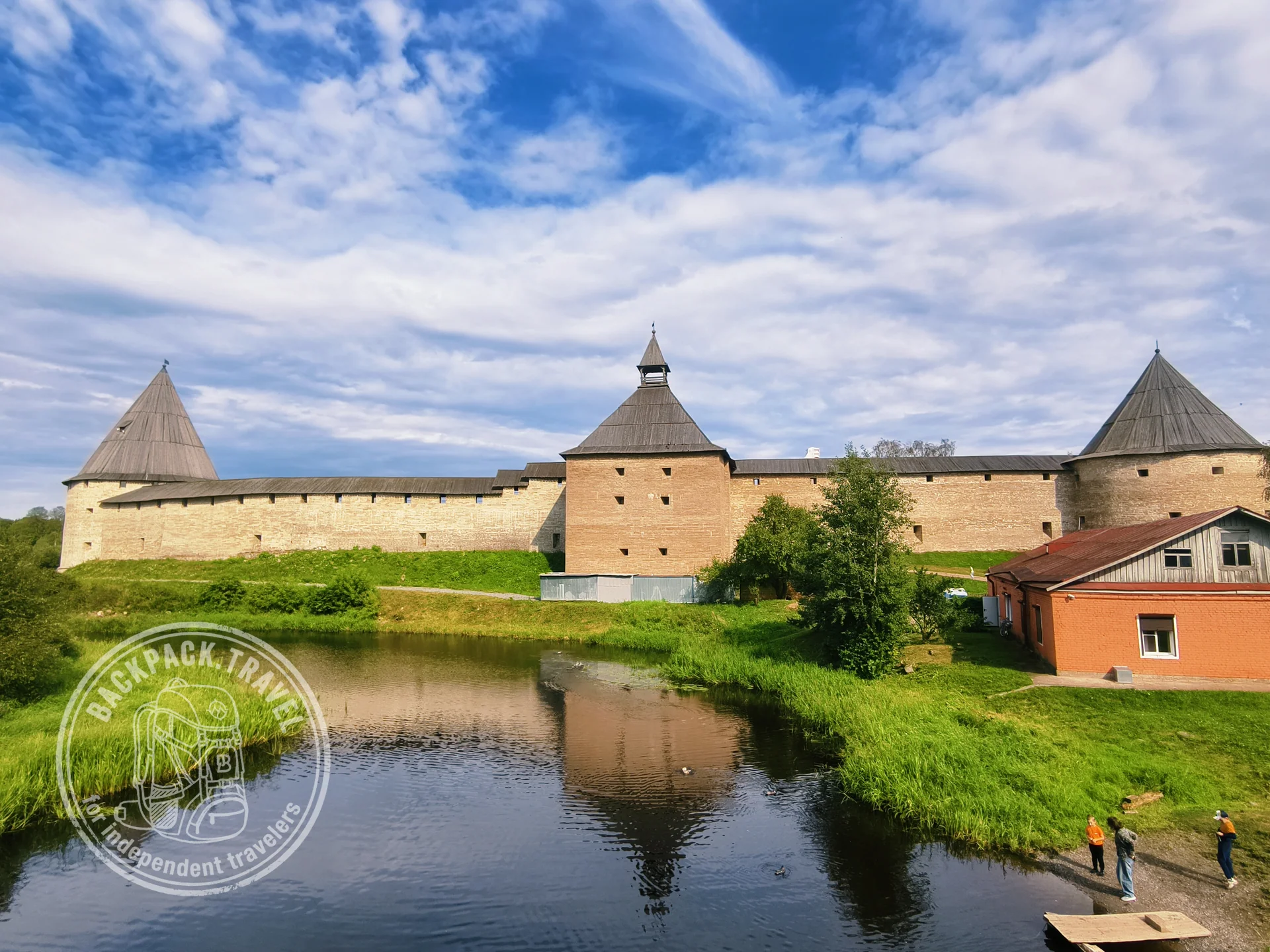
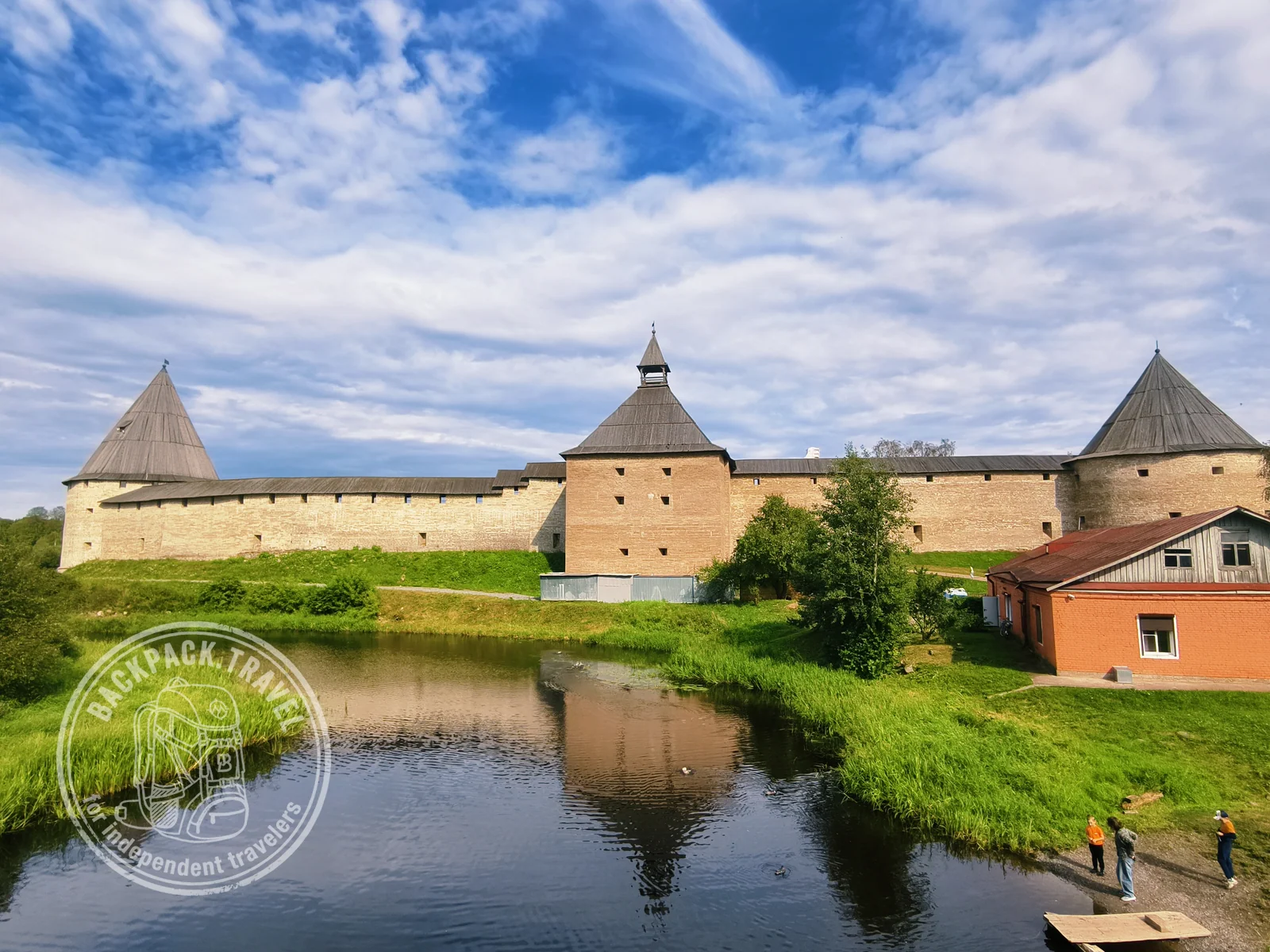
The stone fortress on the headland where the Ladozhka flows into the Volkhov appeared in about 1114–1116. What you see today mostly dates from the rebuilding of the late 16th century: walls up to seven metres thick and five towers.
In the 1960s and 1970s the Klimentovskaya and Vorotnaya (Gate) towers were raised from the ruins along with the stretch of wall between them — this is the classic shot of Staraya Ladoga. Since 2008 the Strelochnaya and Raskatnaya towers have been reconstructed. The rest is ramparts, fragments of masonry and traces of the Earthen Town to the south.
Two churches stand inside:
- The Church of St George — from the second half of the 12th century, a pre-Mongol building. It is what people come here for: inside are fragments of 12th-century frescoes painted with the involvement of a Byzantine master. The main one is "The Miracle of St George and the Dragon": the dragon is being led on a leash, with no blood and no lance, which is rare for this subject. The church is only open in the warm season, roughly from May to September, and only in dry weather — the frescoes cannot cope with damp. Allow for the risk of being turned away.
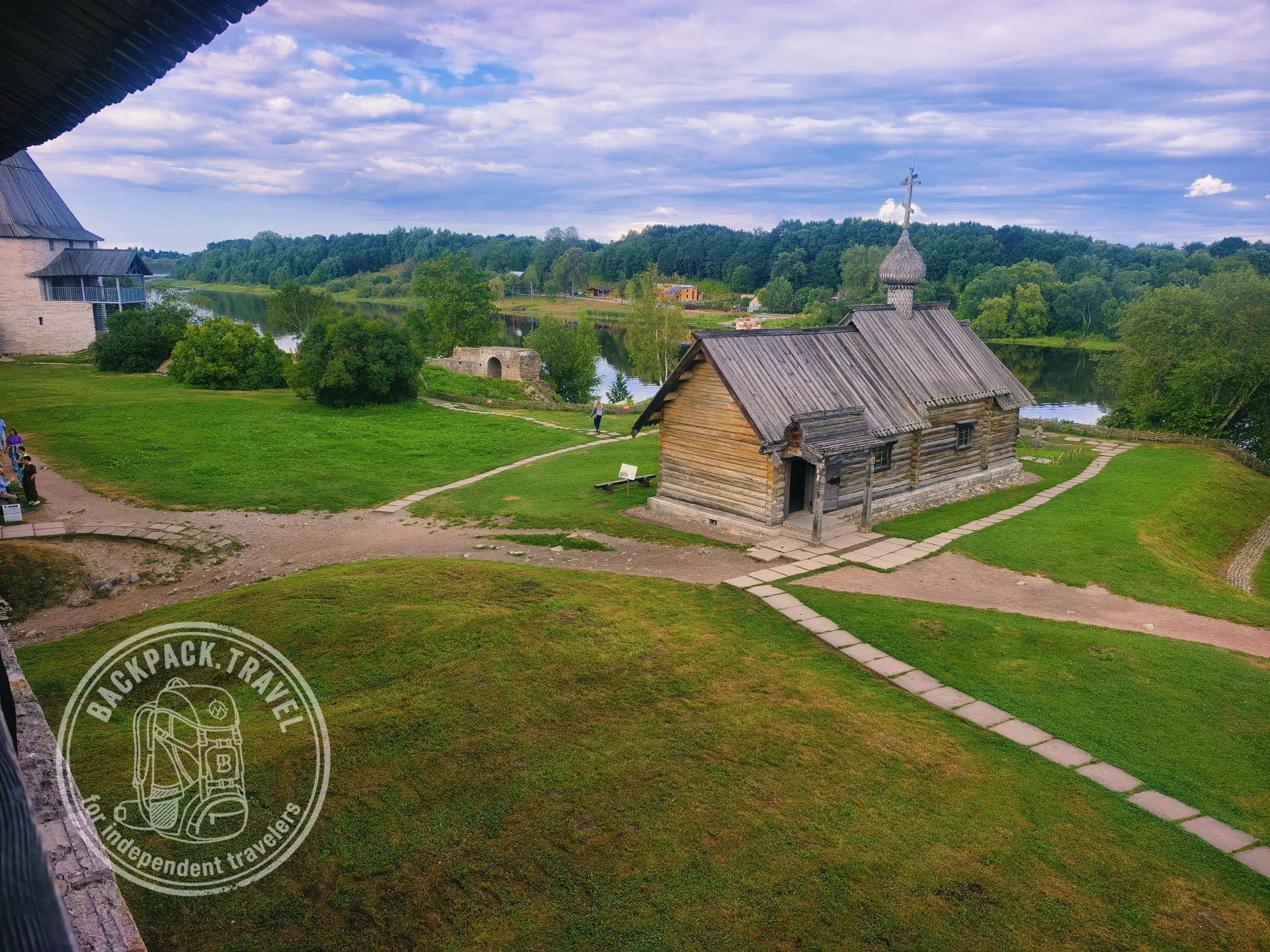
- The Church of St Demetrius of Thessaloniki — wooden, "warm", for winter use. The present one was put up in 1901 following the pattern of its predecessor; a church on this spot is recorded from 1646. It is mainly open in the cold season, when St George's is closed.
The barrows and "the grave of Oleg the Seer"
On the northern edge of the village, on the high bank of the Volkhov, lies the Sopki site: a group of mounds, the largest about ten metres high and known as Oleg's Grave. Tradition has it that Oleg died in Ladoga itself from a snake bite. The excavation of 1820 did not bear the legend out: it turned up burnt bones and a little iron. It is worth walking there for the view — the best panorama of the Volkhov and the fortress is from the top.
Between the fortress and the barrows are Varyazhskaya (Varangian) Street, described as one of the oldest streets in Russia, and the Dormition Convent with its pre-Mongol 12th-century cathedral; Peter I's first wife Yevdokia Lopukhina was exiled here. South of the fortress is the St Nicholas Monastery.
How much time to allow
It is about 120–130 km from St Petersburg and 12 from the town of Volkhov.
- 2–3 hours — the fortress, both churches inside it, the embankment.
- Half a day — plus the barrows, Varyazhskaya Street and one of the monasteries. The sensible format.
- A full day from St Petersburg — with the journey both ways.
By car it is around two hours along the Murmansk highway. Without a car: the train to Volkhovstroy-1 station (some 2–2.5 hours), then a bus for another fifteen minutes or so. Individual monuments keep their own opening hours — check before you set out.
It makes sense to combine the village with Novaya Ladoga and Tikhvin; on the way to Petrozavodsk or Vologda it fits into the route with barely a detour. It is not connected to the Moscow–St Petersburg motorway: this is a separate trip out and back from St Petersburg.
Who won't take to it
If you are expecting a town, there isn't one. This is a village with a single street, a couple of cafés and very modest facilities; there is nothing to do in the evening and no reason to stay the night. The fortress is compact and half reconstructed: next to Pskov or Izborsk it loses out on both size and authenticity. The frescoes are fragments rather than a complete scheme, and they are hard to make sense of without explanation. The point of the trip is almost entirely historical: you are standing at the spot where what later came to be called Rus began. If that motivation leaves you cold, there are more rewarding ways to spend half a day.