 Города и дороги
Description
A small town on the Volga with the white-stone Holy Dormition Monastery below the hill and an old hillfort on the high bank opposite. Once the favorite town of Ivan the Terrible, now a quiet district center.
Wiki
Staritsa is a district town in Tver Region with about six and a half thousand residents, standing on the Volga where the river cuts through high limestone banks. The main argument for coming is the relief: the town is laid out across two steep slopes, and from almost anywhere you can see the other half of it. The second argument is the white stone that was quarried here for eight centuries.
A short history
The fortress was founded in 1297 by the Tver prince Mikhail Yaroslavich. From 1505 to 1566 Staritsa was the seat of the appanage Principality of Staritsa, under Andrei Ivanovich, the youngest son of Ivan III, and then under his son Vladimir Andreevich. Both ended badly: Andrei died in confinement in 1537, and Vladimir was executed by Ivan the Terrible.
Ivan himself treated the town differently, calling it his "beloved town", and in 1579–1581, at the height of the Livonian War, he effectively kept his headquarters here, receiving the papal legate Antonio Possevino. In October 1941 the town was taken by the Germans, and it was liberated on 1 January 1942.
The Holy Dormition Monastery
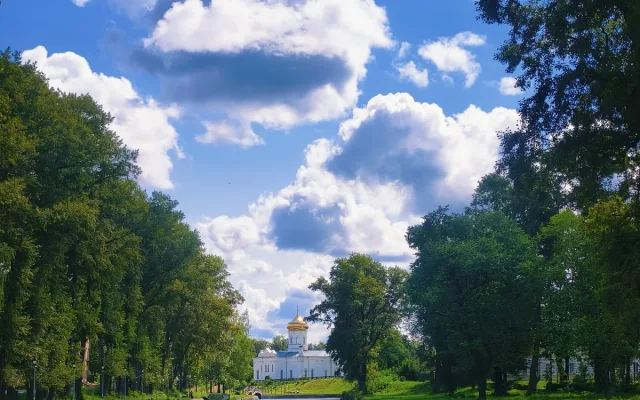
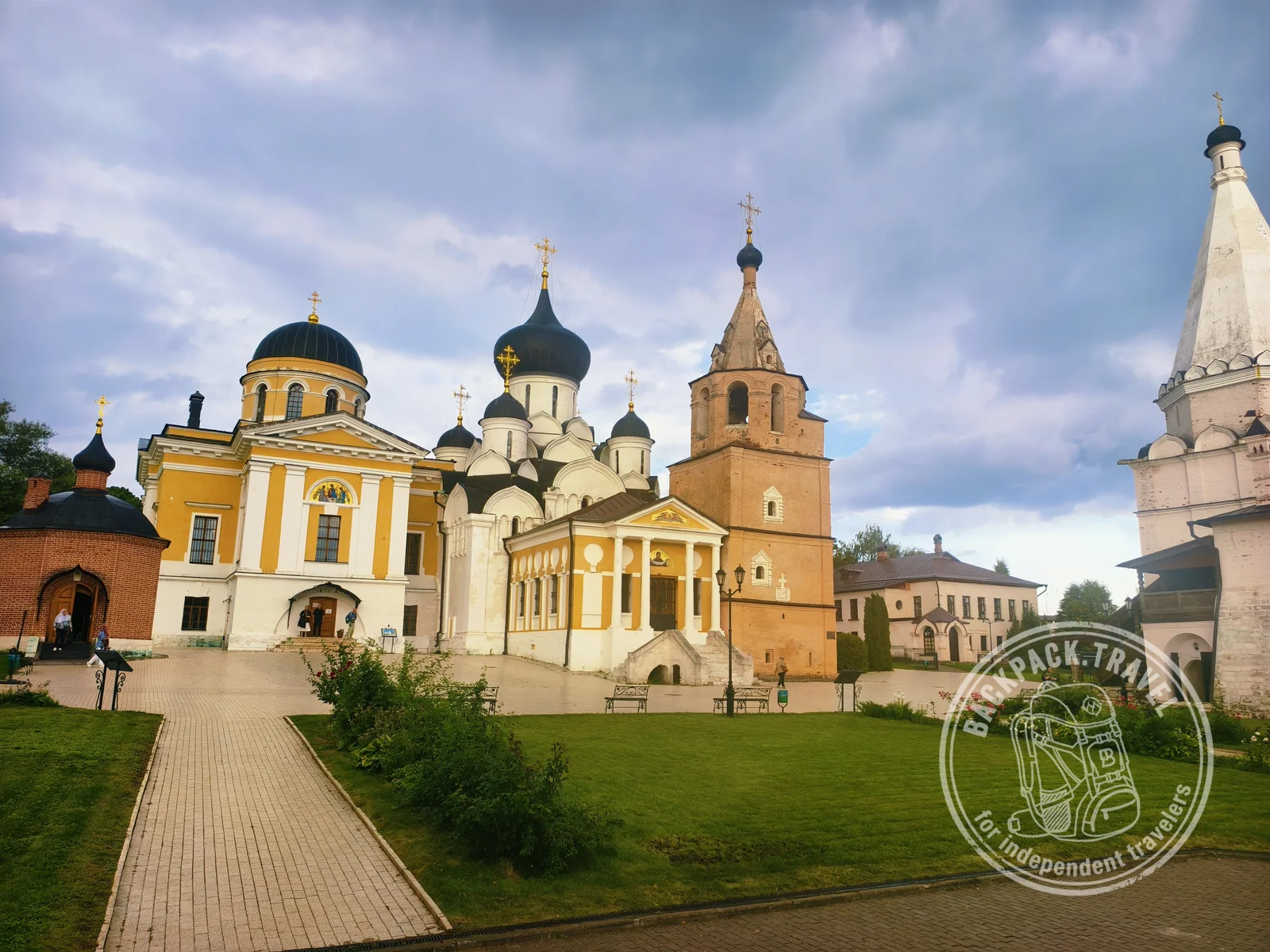
It stands on the low left bank right at the water's edge, and it is the main reason people come here.
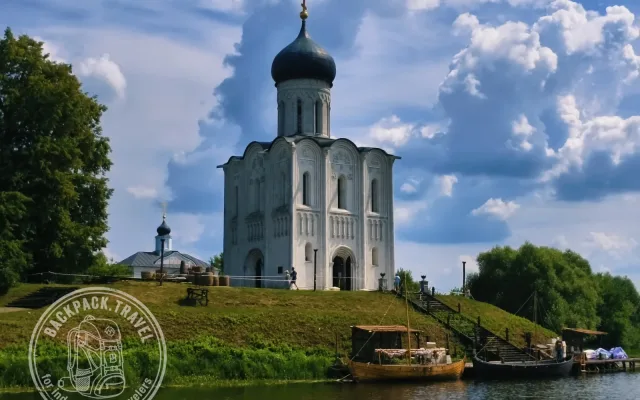
- The Dormition Cathedral — built in the 1530s of dressed white stone, with five domes and rows of kokoshnik gables. It was raised by Prince Andrei of Staritsa and is the oldest and most valuable building in town.
- The Presentation Church with its refectory hall — 1570, commissioned by Ivan the Terrible, with a tented roof.
- The bell tower of the 1680s, holding the tomb of Patriarch Job, and the neoclassical Glebov mausoleum of the 1790s.
Patriarch Job, the first Patriarch of Moscow, took his monastic vows here and served as archimandrite, and in 1605, having refused to swear allegiance to the False Dmitry, he was exiled back here and died in 1607.
The ensemble was restored through the 2000s and 2010s and looks emphatically new, which some visitors find sterile.
The hillfort and the right bank
Across the Volga, on the high right bank, is the hillfort with earthen ramparts of the 13th and 14th centuries. The fortress itself is gone, but the panorama makes up for it, with the monastery visible in full.
Here stands the Cathedral of Boris and Gleb, which should not be confused with the old five-tented one of 1558–1561: that church lost its domes under Patriarch Nikon and was dismantled as unsafe in 1803. The present one was built in 1808–1816 by the local architect Matvei Chernyatin, and the design is linked to Nikolai Lvov. Beside it is the bell tower with the Church of the Saviour, built in 1817–1827 and the most prominent vertical in town; services resumed only in 2018, and the restoration is still going on.
At the foot of the hillfort is the Pyatnitskaya Church (formally the Church of the Nativity of the Mother of God, 1750, with rotunda chapels added in 1825). Its condition is poor, so it is worth looking at from outside, for the silhouette. Next to it stand the white-stone smithies of the 18th century.
The quarries
The "Staritsa white stone", also known as Staritsa marble, was quarried here from roughly the 13th century until 1928. Dozens of adits are left along the banks of the Volga, and the passages run for tens of kilometers; the most visited system is Seltso, not far from town.
This is not an equipped show cave: it is dark and damp, there are sections prone to collapse, and nothing is marked. Going in makes sense only with a guide and a spare light, and otherwise you should limit yourself to the grottoes at the entrance.
How much time to allow
The basic minimum is three or four hours for the monastery, the hillfort and the views from both banks. A full day is needed if you add the Pyatnitskaya Church, the embankment and the entrance to the quarries. Staying overnight is worth it for those going underground seriously, or those using Staritsa as a base for the manor houses nearby.
From Tver it is about 75 kilometers by road and a little over an hour by bus, and from Moscow it is some 230–240 kilometers. The timetable is sparse, so a car gives you noticeably more freedom.
It makes sense to build the town into the chain of Tver, Torzhok, Staritsa and Rzhev: all four lie on the arc between the M-11 and M-9 highways, and Staritsa is the most scenic point on it. Nearby are the Upper Volga estates associated with Pushkin, Bernovo and Malinniki.
Who won't enjoy it
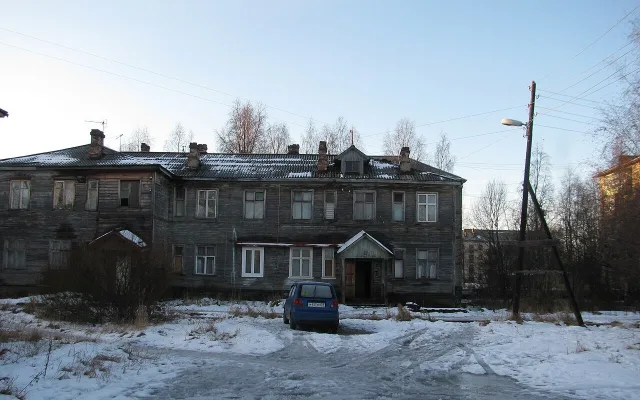
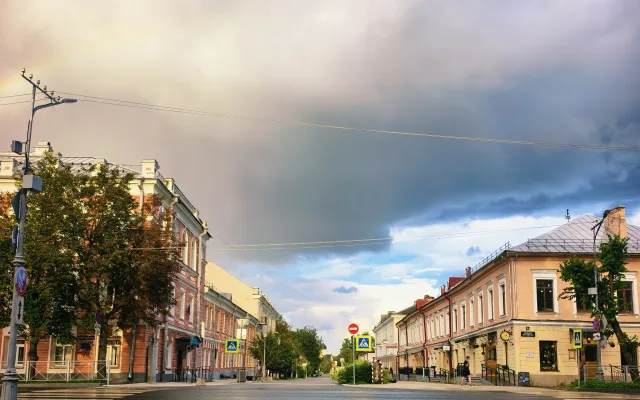
There is almost no urban fabric in Staritsa: the cafés can be counted on one hand, there is no evening life, and a large part of the historic buildings are either in ruins or wrapped in siding. The museum side is weak, and without preparation half of what you see will remain simply "old walls". Getting between the two banks means walking across the bridge and then uphill. If what you want is a cozy restored town with a promenade street, this is the wrong address: Staritsa wins on relief and white stone rather than on comfort.
Updated