Description
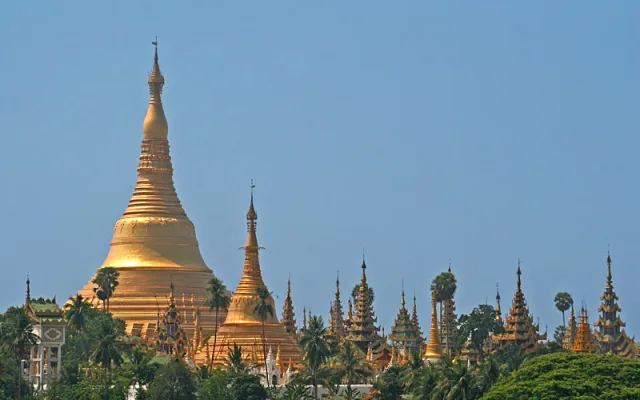
Yangon is Myanmar's largest city: the Shwedagon Pagoda, the colonial downtown of old Rangoon, Bogyoke Aung San Market and the circular railway.
Wiki
Yangon is Myanmar's largest city and its main gateway: about five million people, a port in the Irrawaddy delta, and the biggest concentration of British colonial architecture in South East Asia. It stopped being the national capital in 2005, when the government moved to the newly built Naypyidaw, but it remained the economic and cultural centre. Its earlier name was Rangoon, used from 1853, when the British rebuilt the city on a regular grid, until the change of name in 1989.
Since 2021 Myanmar has been in a state of internal armed conflict. Many governments advise against travel to the country, some regions are inaccessible, and flights, communications and banking services all work erratically. Check current advisories and conditions on the ground before you go.
Shwedagon
The country's foremost shrine and one of the most important Buddhist monuments anywhere stands on Singuttara Hill north of the centre. The 99-metre stupa is clad in gold plates and gold leaf — commonly estimated at around 27 tonnes, though figures differ widely between sources — and the finial is crowned with a diamond of roughly 76 carats. Tradition holds that the reliquary contains eight hairs of Gautama Buddha and that the pagoda has stood here for more than two and a half thousand years; archaeologists date the present structure to somewhere between the sixth and tenth centuries, with many later rebuildings. The platform is ringed by dozens of smaller stupas, pavilions and planetary posts — shrines corresponding to the day of the week on which a person was born. Come towards sunset, when the gold changes colour; shoes come off at the foot of the stairways.
The colonial downtown
Between the Yangon River and the railway station an almost complete quarter of British building from the 1880s to the 1940s survives. Here stand the red-brick High Court with its clock tower, City Hall, which grafts Burmese tiered roofs onto a European block, the former Secretariat, where General Aung San was assassinated in 1947, the trading houses and banks of Pansodan Street, and the Strand, the legendary hotel of 1901 that remembers Somerset Maugham and Rudyard Kipling. Many of the buildings are decaying, but it is exactly this mix of shabbiness and scale that makes a walk downtown memorable. At the heart of the quarter stands Sule Pagoda, a small golden stupa around which the British laid a traffic circle; tradition makes it, too, more than two and a half thousand years old.
Pagodas, lakes and parks
- Chaukhtatgyi — a hall sheltering a 66-metre reclining Buddha, one of the largest in the world; the soles of its feet are painted with 108 auspicious signs.
- Kandawgyi Lake — a lake in the middle of the city with a boardwalk around the shore and the Karaweik, a concrete replica of a royal barge that houses a restaurant.
- Inya Lake — considerably larger than Kandawgyi, and a favourite place for city residents and students to walk.
- Maha Bandula Park — the garden in front of City Hall, with the Independence Monument obelisk.
- People's Park, at the foot of Shwedagon, is the city's most spacious park.
- Aung San Suu Kyi's house on the shore of Inya — the compound where she spent about fifteen of the twenty-one years between 1989 and 2010 under house arrest. There is no entry, but the house is visible from the street.
- Botataung — a riverside pagoda rebuilt after the bombing of 1943; inside the stupa is a mirrored maze of passages.
Markets and street life
Bogyoke Aung San Market, built in 1926 and still known to older residents as Scott's Market, occupies several covered lanes: pearls, jade, lacquerware, longyi — the Burmese sarongs worn by men and women alike — and antiques of varying authenticity. Bargaining is expected. A quite different experience is the Yangon Circular Railway: the train works its way around the city and its suburbs on a 46-kilometre loop with 39 stops, taking roughly three hours, the ticket costs almost nothing, and baskets of vegetables and live poultry are loaded into the carriages alongside the passengers. Services have been interrupted at times since 2021, so check the timetable at the station.
Food and prices
Burmese cooking sits between Indian and Chinese and resembles neither. The morning begins with mohinga, a fish soup with rice noodles regarded as the national dish. Also worth trying are lahpet thoke, a salad of fermented tea leaves with nuts and garlic; Shan noodles; mont di, the Rakhine noodle dish in fish broth; the oily Burmese curries served with a whole spread of side dishes; and biryani in the Muslim quarters. Street food concentrates around 19th Street in Chinatown.
Lunch in a local eatery costs $4–8, dinner in a restaurant $10–25. A taxi across the centre is $3–10, a cycle rickshaw $1–3. Cash matters more than cards: international payment systems barely function in the country and cash machines are unreliable. Prices are as of 2026; in kyat they shift quickly with inflation.
Getting there and when to go
Yangon International Airport is about 15 kilometres from the centre, and a taxi in costs $8–15. Many foreign airlines stopped flying to Myanmar after 2021 and the choice of flights is limited; most people arrive via Bangkok, Kuala Lumpur or Singapore. Visas are issued online, but entry rules change and need to be checked immediately before travelling.
Neighbouring Bago (Pegu), 80 kilometres to the north-east, is worth a day trip for the 55-metre Shwethalyaung reclining Buddha and the tall Shwemawdaw Pagoda. Closer at hand is the potters' town of Twante, reached by ferry across the river to Dala and then by road, about an hour each way.
The best season runs from November to February: dry, and 22–32°C. March to May brings punishing heat of up to 40°C, and from June to October the rains arrive in short heavy downpours. The main festivals are Thingyan, the water new year in April, and Thadingyut, the festival of lights in October. To repeat: check your own foreign ministry's advisories and the situation in the country before you travel.