Description
A mud-brick desert city of wind towers and vaulted lanes, with a working Zoroastrian fire temple, the Towers of Silence and rooftop tea houses at sunset.
Wiki
Yazd sits between Iran's two great deserts, and you feel it in everything: in the colour of the walls, in the silence of the lanes, in the way the city hides from the sun. For an independent traveller it is one of the most coherent stops in the country — the old town can be walked at leisure, and the atmosphere is stronger here than in sprawling Isfahan or hectic Tehran.
Why come, and what is really worth seeing
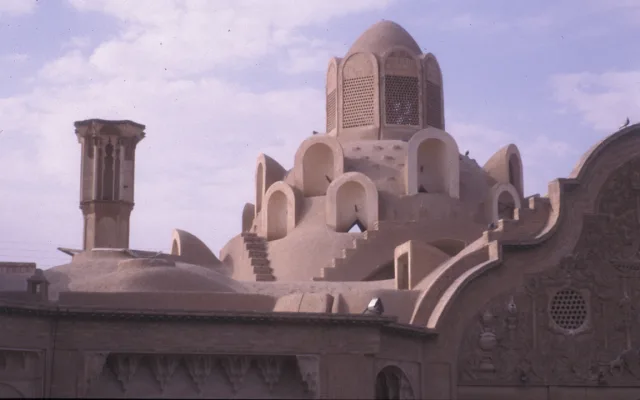
The great thing about Yazd is not any single monument but the mud-brick labyrinth itself. Set aside an evening to wander the old town with no map and no destination: vaulted passageways, blank walls, the occasional door with two different knockers (one for men and one for women — they sounded different). The badgirs, those wind-catching towers, work as natural air conditioning, funnelling airflow down into the houses; the principle makes most sense once you get up onto any accessible roof.
The essential minimum:
- The Atashkadeh (Fire Temple) — the flame is visible behind glass and the visit is quick; the value is in seeing a working centre of Zoroastrianism rather than a grand spectacle.
- The Towers of Silence on the edge of town — go towards evening, when the view opens out over the desert and the city; the service buildings at the foot of the hills survive.
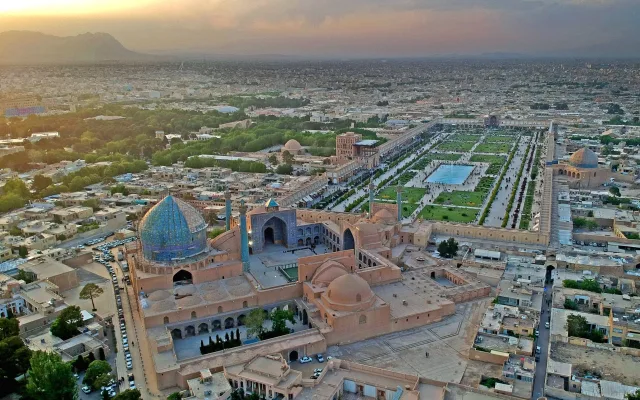
- The Friday Mosque — come close to sunset, when the tiles on the minarets catch the light.
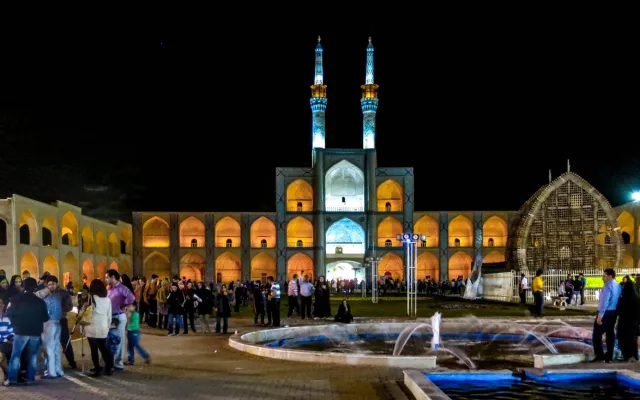
- Amir Chakhmaq — floodlit in the evening; by day the façade is much less striking.
- The Dowlatabad Garden, with the tallest wind tower of them all — a quiet place with a water channel, welcome in the heat.
The rooftop cafés around Amir Chakhmaq and in the old town are a ritual of their own: tea at sunset over a field of domes costs very little and beats any observation deck.
How many days, and how to shape them
Two days is enough. The first for the old town on foot, the fire temple, the mosque and a roof at sunset. The second for the Towers of Silence and a trip out of town: Chak Chak, the Zoroastrian shrine in the mountains, or a night at the Zeinodin caravanserai about 60 km away. Either is easier as a half-day trip with a driver — there is almost no public transport out there, and stringing the stops together yourself costs you the day.
Getting there and getting around
Yazd lies on the line between Isfahan, Shiraz and Kerman, so it slots naturally into the classic central Iran route. There is an airport with domestic flights, a railway station and a bus terminal; long-distance trains and buses are the usual way to arrive.
Inside the city you do not need a car: the historic centre is compact and walkable. For the outlying sights — the Towers of Silence, the gardens — take a taxi through the Snapp app, which works in Yazd and removes the haggling, or agree a half-day rate with a driver.
Where to stay
In the old town, without question, in a traditional courtyard guesthouse built around a pool. This is not just a bed but part of the experience: many of these houses are restored merchant mansions. Book ahead in high season, as the popular ones have few rooms. Staying in the new districts makes no sense — you lose the atmosphere and spend the trip commuting.
When to go
Yazd has a desert climate: the summers are punishing and the winter nights cold. Spring (March–May) and autumn (September–November) are the best windows. If you end up here in summer, switch to the local rhythm: sightseeing early in the morning and after sunset, with the middle of the day spent in the shade of a courtyard. Bear Nowruz in mind too (late March) — beautiful, but crowded and more expensive.
Food and prices
Yazdi cooking is famous for its sweets: gooshfil, crisp pastry soaked in syrup, baklava, bastani sonnati (saffron ice cream with pistachio) and shirini-ye zanjabili, ginger biscuits. They are sold in the confectioners of the old town and cost next to nothing — good to take home. Lunch in a caravanserai restaurant or a hotel courtyard is cheap by Western standards, and so is dinner with a meat dish and a drink.
Where to save: eat where you sleep (courtyard restaurants are often cheaper than the tourist ones), drink tea on the roofs instead of in expensive cafés, and share out-of-town trips with other guests from your guesthouse, which splits the taxi fare.
Practicalities and common mistakes
- Money. Foreign cards do not work in Iran — bring hard currency and change it locally. Plan the budget in advance. One more thing: prices are written in rials but quoted in tomans, which are rials divided by ten; if a figure sounds exactly ten times too low, that is why.
- Navigation. It is easy to get lost in the labyrinth of the old town, and satellite navigation loses itself in the lanes. Do not panic: fix a couple of tall landmarks in your head — minarets, wind towers — and keep steering towards them.
- Clothing. Iran's general dress code applies: women need a headscarf and covered arms and legs; in the heat, choose light fabrics that still cover.
- Pace. The classic mistake is trying to tick off every sight in a day. Yazd opens up slowly; one unplanned evening here is worth more than a sprint down a list.
- Heat. Do not underestimate the desert sun — water, a hat and a midday siesta are necessities, not indulgences.