Description
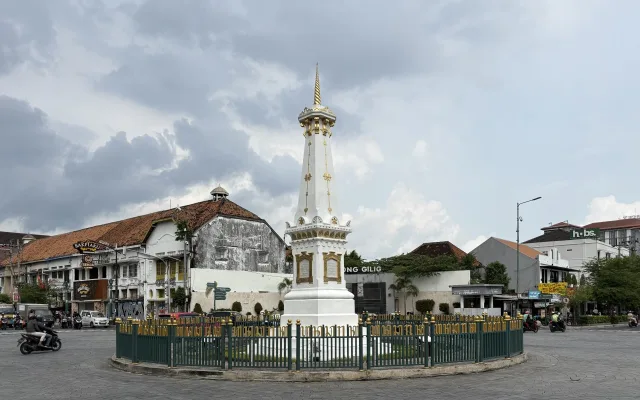
Java's cultural capital — Borobudur, Prambanan, the sultan's kraton, Taman Sari and the batik workshops.
Wiki
Set in the very centre of Java, Yogyakarta — colloquially Jogja or Yogya — is considered the country's spiritual and artistic capital. It is the only territory in Indonesia still governed by a hereditary sultan, and its streets carry the memory of the ancient Javanese kingdoms that produced the greatest temples in Southeast Asia.
Character and status
Administratively the city forms a special region, Daerah Istimewa Yogyakarta, with extended autonomy, headed by the sultan, who is also the governor. About 420,000 people live in the city proper and over a million in the wider urban area. Yogyakarta is a major university town: Gadjah Mada University, the oldest and one of the most prestigious in the country, is here, which gives the place a young, studenty, creative character. Compared with noisy Jakarta the atmosphere is noticeably calmer and more measured.
Borobudur and Prambanan
The main reason to come is two ninth-century monuments on the UNESCO World Heritage list, both in the surroundings of the city.
Borobudur is the largest Buddhist monument on the planet, raised by the Shailendra dynasty. The stepped pyramid embodies the Buddhist model of the cosmos: the pilgrim climbs the terraces from the world of desire towards nirvana. It carries 504 Buddha statues and 2,672 relief panels, and is crowned by bell-shaped stupas with figures inside. Meeting the sunrise on the upper levels is a ritual of its own; since 2022 access to the terraces has been limited and is only possible with a licensed guide.
Prambanan is Indonesia's greatest Hindu ensemble, built by the Sanjaya dynasty at almost the same time as Borobudur. The complex once held some 240 shrines; the central candi towers are dedicated to the divine triad of Shiva, Vishnu and Brahma. Reliefs telling the Ramayana run round the walls of the main temple. In the evenings the famous open-air ballet of the same epic is performed beside the complex, with gamelan accompaniment.
The palace, the water castle and the city quarters
The heart of the old city is the kraton, the working residence of the sultan and a living museum of Javanese court culture. Its pavilions host gamelan orchestras, wayang shadow theatre and traditional dance, and the layout of the palace reflects a philosophy of harmony between people and the cosmos. Nearby is Taman Sari, an eighteenth-century water castle with bathing pools, channels and a system of underground passages, once the pleasure retreat of the sultan's court.
The main artery is Malioboro street, running from the station to the palace. By day it sells batik, leather and silver; by evening the pavements fill with lesehan eating mats. Yogyakarta is one of the world centres of batik, and in many workshops you can watch wax being applied with a canting, and try the technique yourself.
Nature and the surroundings
To the north rises Merapi, one of the most active volcanoes in the world; after the destructive eruption of 2010, jeep tours run over its slopes and through the damaged villages. Adventurous visitors are drawn to Jomblang cave in the karst district of Gunungkidul, where the famous "heavenly beam" of light falls through a 60 m shaft into an underground chamber. On the south coast lies the black-sand beach of Parangtritis, backed by dunes and bound up with the legend of Nyai Roro Kidul, queen of the Southern Sea.
Food
The local cooking is one of the brightest versions of Javanese cuisine. The city's signature dish is gudeg, young jackfruit stewed for hours in coconut milk with palm sugar into something sweet and spiced, served with rice, chicken and hot sambal. Also worth trying are nasi liwet (rice cooked in coconut broth), crisp ayam goreng (fried chicken), and the street sweets: bakpia pastries filled with mung bean, and getuk made from cassava. Street food here is cheap and the portions generous.
Practicalities
Three days is the usual allowance: a day each for Borobudur and Prambanan, and a day for the city itself with the kraton, Taman Sari and Malioboro. Trains connect Yogyakarta conveniently with the rest of Java, and the international airport links it with Jakarta, Bali and a handful of foreign destinations. The climate is equatorial; the dry season, roughly April to October, is the better window for the temples and the volcano. The centre can be covered on foot, by taxi or by the popular becak cycle rickshaws; for longer excursions a car with a driver is easier.