
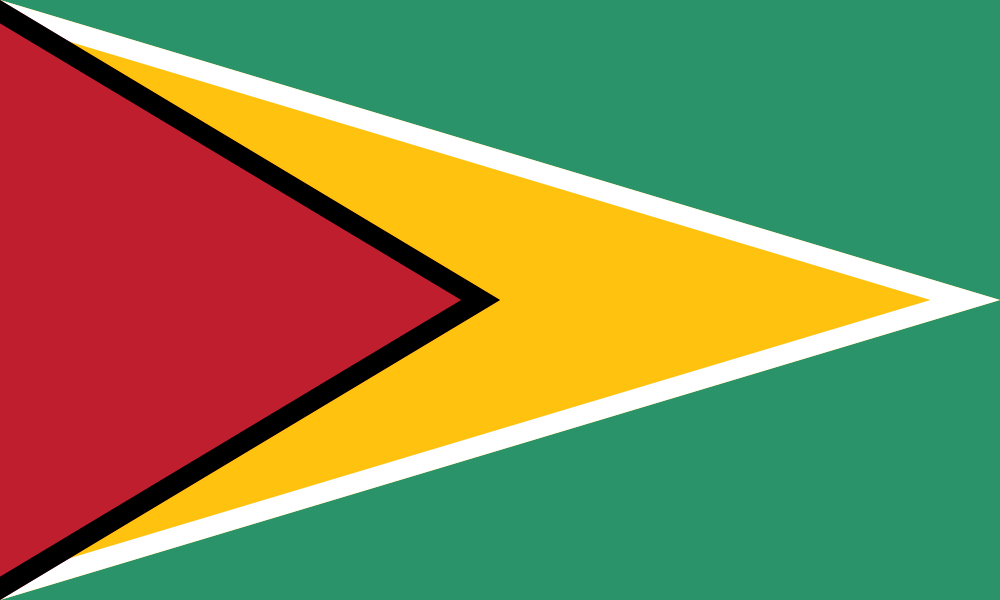
Safety in Guyana
A rating built from four independent indices, plus scams, laws and what to do when something happens
Rating calculated from the indices below
Indices checked on 10.08.2026
Position in global indices
Save these before you fly
The general picture
Georgetown: The capital needs attention, because street crime remains persistently high. Do not walk alone after sunset, even in the central districts; call a trusted taxi instead. Stay alert in market crowds.
Valuables: Leave expensive jewellery at home and do not display electronics in public. Use ATMs inside banks or hotels rather than on the street. Keep the bulk of your cash and your passport in a safe or a money belt.
The interior: Away from the cities the country is far safer in terms of crime, and people are notably welcoming. The risks in the jungle are natural ones: river currents, insects and snakes. Never head into the forest without an experienced local guide.
Wildlife: Jaguars and caimans do not seek out people, but you should watch where you put your feet in the forest. Always tell the lodge staff your route. Listen properly to the briefing before any river trip; the water is deceptive.
Local advice: Guyanese are sociable and will readily tell you which parts of the capital to avoid. If you feel you are attracting unwanted attention, step into the nearest shop. Trust your instincts and turn down offers from strangers.
Health: Drink bottled water only and use mosquito repellent consistently. Malaria is uncommon but prophylaxis and good insurance make for a calmer trip. The sun here is fierce, so sunscreen is not optional, and check your own government's travel advisory before you go.
How tourists get scammed
Guyana is South America's only English-speaking country, with vast tracts of untouched forest and Kaieteur Falls. Tourists are few, and crime in Georgetown is high.
Georgetown. Urban caution is needed at a high level: armed robbery, bag snatching and theft from cars. Stabroek Market and its surroundings are not a place to walk with a camera. Nobody walks at night at all.
Taxis. Only those booked through a hotel or a trusted firm. Street cars must not be taken.
ATMs. Withdraw inside banks in daylight.
Interior tours. Kaieteur, Iwokrama and the Rupununi ranches are the main reason to come. Arranged through operators including light aircraft flights. Check the operator and which segments are included.
Currency exchange. Use banks and licensed bureaux.
The oil boom. The economy is growing fast and Georgetown prices have risen accordingly.
What gets you fined or jailed
Drugs. Guyana is a cocaine transit country and the airport is screened very strictly. Never carry anyone else's belongings or parcels.
Weapons. Illegal firearms are numerous and importing them is prohibited.
Photography. Military installations, police, the presidential palace, the airport and oil infrastructure are off limits.
Drones. Permission is required.
Indigenous territories. Visiting villages in the Rupununi requires community permission, arranged by your operator.
Gold mining. Mining areas in the interior are dangerous and not visited.
Disputed territory. The western part of the country (Essequibo) is the subject of a territorial dispute with Venezuela. The border areas are a higher-risk zone.
Roads. Beyond the coastal strip there are almost none. The road to Lethem through the forest takes days and is impassable in the rains.
Driving on the left.
Health: vaccines, medicines, care
Yellow fever. Vaccination is advised, and a certificate is required from arrivals out of endemic countries and when travelling on to several others.
Malaria. Risk in the interior — the Rupununi, mining areas and forest regions. Georgetown and the coast are largely free of it. Prophylaxis is matched to your route.
Dengue. Present.
Vaccinations. Hepatitis A and B, typhoid and rabies.
Water. Bottled only.
Jungle and savanna. Insects, snakes and jaguars at Iwokrama. Guided only.
Kaieteur. A waterfall with no railings: the cliff edge is open, and tourists have died approaching too closely for a photograph. Distance must be kept.
Healthcare. Georgetown has basic private clinics. The interior has none, and evacuation is by light aircraft and daylight only. Insurance with evacuation cover is essential.
Emergency number is 911.
Police: how to handle them
Guyana ranks low on the Corruption Perceptions Index, and violent crime in Georgetown is among the region's highest.
Do not resist a robbery. Attackers are often armed.
Police. Response is slow and clearance rates are low. English is official.
Reporting theft. Reports are taken and certificates issued.
Geography. The interior — Iwokrama, the Rupununi, Kaieteur — is calm: small communities live there and crime is essentially absent. Georgetown and the coastal strip are another reality.
At night. In Georgetown, by car and only when necessary.
What actually matters. Guyana is a country of outstanding wilderness with a dangerous capital. A trip is built to minimise time in Georgetown and maximise it in the interior.
Emergency number is 911.
What else to check
The rating is built from open international indices and foreign-ministry advisories; links to the primary sources are in the cards above. Conditions change faster than annual reports come out — check current travel advice before you go.