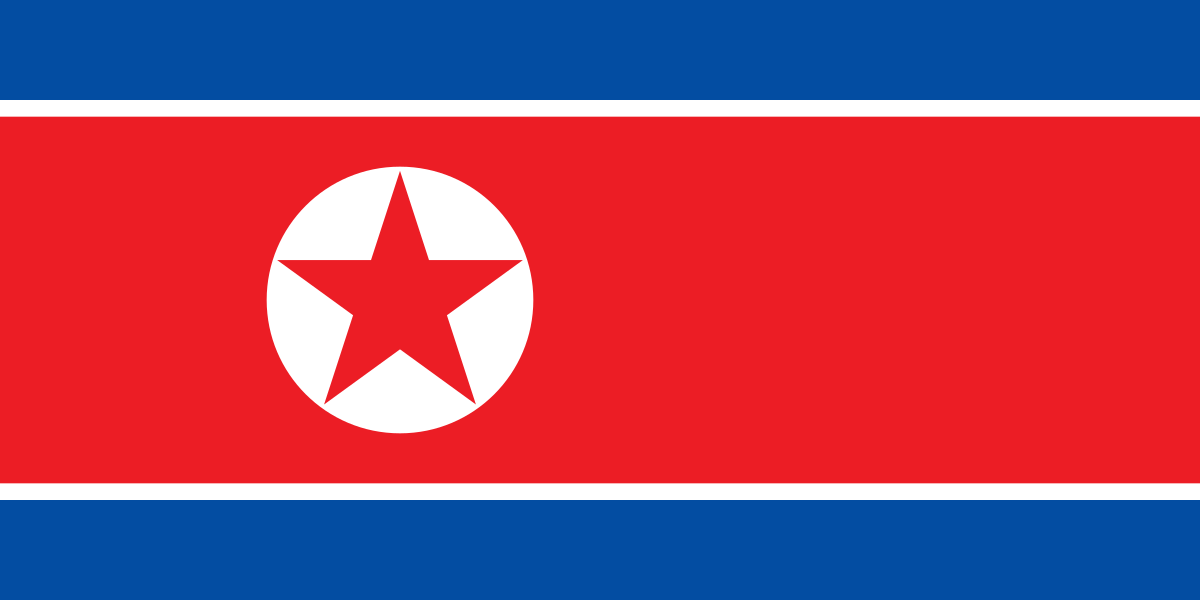
North Korea
KPThe most closed country in the world. Tourism has been almost entirely shut since 2020 and reopens only in narrow, tightly controlled windows. Monumental Pyongyang, the Myohyang and Kumgang mountains, the Demilitarised Zone and the singular ideology of Juche add up to a trip that rearranges your head. Everything is strictly organised: group tours, two guides, an approved itinerary, no independent movement. This is not a holiday but an expedition into a parallel reality.
Where to go #
Pyongyang
The country's showcase and an unavoidable fixture of any itinerary, worth seeing for its monumental style. Wide avenues cut across futuristic residential blocks and life runs to a strict timetable. The grandiose architecture and the total absence of advertising make for a genuinely unusual visual experience.
Kaesong
The ancient capital, reachable in a day from Pyongyang and worth it for the spirit of old Korea. The city sits right on the border with the South and has kept its traditional low-rise streets and a medieval atmosphere. It is a rare chance to see the country as it looked before the concrete towers.
Wonsan
A port city on the east coast, worth a trip for the new beach resorts. This is the country's designated leisure centre, offering fresh seafood and sea air well away from the formality of the capital. It also shows you how the coastal districts actually live.
Nampo
A major port, where the giant sea barrage is the thing to look at. The city is interesting for its industrial scale and for the view it gives of the Yellow Sea coast. This is the country's industrial heart and it has a hard character.
Samjiyon
A highland town near the sacred Mount Paektu, best visited for the northern landscapes. The place is bound up with revolutionary history and startles visitors with its cleanliness and freshly rebuilt architecture. In winter there are good ski slopes here.
What to see #
Mansudae: A vast architectural ensemble built around enormous bronze statues of the leaders. It is the heart of the capital and a fixed point on every programme. Flowers are laid here and visitors are expected to be restrained.
Juche Tower: A tall obelisk on the riverbank, worth going up for the panorama. From the top platform you get the best view of the city's geometrically exact blocks. In the evening the torch at the summit is brightly lit.
The metro: The Pyongyang underground is something you have to see. The stations are finished in marble, mosaic and chandeliers, like subterranean palaces, and it is the deepest metro in the world, doubling as a shelter.
The DMZ: The trip to the border with the South is the most charged experience available in a day. You see the famous blue negotiation huts and feel the tension of a divided people. The soldiers on duty stand absolutely motionless.
Myohyang mountains: A scenic area worth visiting for the International Friendship Exhibition. Thousands of gifts to the leaders from around the world are stored underground in enormous halls, from cars to antiques. The surrounding area is known for clean air and Buddhist temples.
Arch of Triumph: A massive granite structure, taller than the Paris original. It is the ideal spot to take the measure of North Korean monumentality, standing at the foot of Moran Hill.
Mount Paektu: The sacred summit with Heaven Lake in the crater of an extinct volcano. It is worth the journey for extraordinary landscape and a sense of primordial silence at the edge of the world. This is the highest point on the peninsula with a unique ecosystem.
Prices #
Currency: The local won is not officially issued to visitors, and everything you pay for inside the country is settled in foreign currency.
Cash: Bring only new, undamaged euro or US dollar notes with nothing written on them. Old or marked banknotes may simply be refused, and Chinese yuan is also widely accepted.
Change: Change is often handed back in a different currency, commonly Chinese yuan or small dollar bills. Always check the arithmetic on the spot.
Tipping: Guides and drivers are customarily given a small gift or a cash gratuity in hard currency at the end of the programme.
Cards: There are no ATMs in the country that work for foreign nationals and no card payments of any kind, so Visa, Mastercard, Amex, Wise and Revolut are all useless here. Everything you will spend must be carried in as physical cash.
| Item | Price (USD) |
|---|---|
| Visa | 60 |
| Beer in a bar | 2 |
| Packet of cigarettes | 3 |
| Postage stamp | 1 |
| Lift up the tower | 7 |
| Coffee in a hotel | 4 |
| Restaurant meal | 15 |
| Set of postcards | 5 |
| Circus ticket | 20 |
| 0.5l of water | 0.5 |
| Bunch of flowers | 5 |
| Souvenir badge | 3 |
| Hotel massage | 35 |
| Pool session (3 hours) | 5 |
| Propaganda poster | 10 |
| Ginseng root | 50 |
Getting around #
Getting here: Practically every international visitor enters from China. Air Koryo operates the Beijing to Pyongyang flight, which takes under two hours, and there is a slower, cheaper overland option by train from Beijing via Dandong that takes roughly a day. Everything is booked through an accredited tour operator; you cannot simply buy a ticket and turn up.
Getting around: Inside the country you travel in a private minibus or car. A driver and guides are assigned to you for the entire duration of your programme.
The metro: The Pyongyang underground is a museum of marble and murals. Visitors are usually shown several stations, but riding unaccompanied is not permitted.
Taxis: This form of transport is effectively unavailable to foreigners on a free basis. All logistics go through your guide, who orders a car to the door of your hotel.
Roads: Highways between the major cities are in decent condition, though mountain sections can shake you badly. There is no traffic congestion at all, which means the excursion schedule holds precisely.
Domestic flights: Remote northern areas can be reached on the local airline. These are old Soviet-built aircraft, and the flight itself is a historical experience.
Where to stay #
How it works: You cannot book a room yourself through any global platform. The hotel is assigned by the receiving side according to availability and the shape of your tour.
Koryo Hotel: The famous twin towers in central Pyongyang offer a high level of comfort. There is a pool, a sauna, several restaurants and the popular revolving bar on the roof.
Yanggakdo: Set on an island, this hotel is considered the most convenient place to be housed. Leaving the grounds at night is restricted, but inside there is bowling and billiards for the evening.
Standards: Rooms are generally clean and done in a severe late-modernist style. Power supply is stable, though provincial cities can see brief interruptions.
Be aware: Assume that rooms may be monitored. Do not leave religious literature, political publications or other sensitive material lying in view.
Staff: Hotel employees are courteous and many speak some English or Chinese. You can go to them for practical matters, such as arranging a paid international call through the operator.
Facilities: The larger hotels have souvenir shops and bars serving local alcohol. Television carries state channels and sometimes international news from China.
What to eat #
How meals work: Eating is organised centrally at restaurants licensed to receive visitors. Portions tend to be enormous and the menus lean filling and traditional.
Naengmyeon: The dish to try is cold buckwheat noodles in broth. It comes with meat, egg and slices of pear, which produces a very particular refreshing flavour.
Kimchi: Spicy fermented cabbage accompanies literally every meal. The country has dozens of versions, differing in heat and in the spice mix used.
Barbecue: Traditional bulgogi is grilled in front of you on tabletop burners. Thin slices of marinated beef are considered a popular and high-quality treat.
Drinks: The local Taedonggang beer is brewed on British equipment and rates among the better beers in the region. Soju, the Korean spirit at around twenty percent, is also everywhere.
Ginseng: The root goes into everything here, from tea to chicken soup. It is regarded as healthy and as an important part of the national food culture.
Water: Drink only factory-bottled water. Avoid ice in drinks and do not use tap water even for brushing your teeth.
Safety #
The picture: Street crime in the cities is essentially nil. You can feel secure while you are at approved locations on your itinerary in the company of your hosts.
The real risk: The genuine danger lies in breaking local law. Disrespect towards state symbols or the leadership is punished extremely harshly, up to immediate detention.
Guides: Your minders are the guarantors of your safety in an unfamiliar environment. Listen to their advice and never attempt to leave the hotel grounds on your own once the day's programme has finished.
Photography: Avoid photographing soldiers, checkpoints and anything strategic. Having images deleted at the border is the mildest consequence that can follow.
Medical care: Standards may not match what you are used to. Bring a generous supply of your own medication for every eventuality, since pharmacies in the familiar sense are scarce.
Politics: Discussing the political system or raising pointed questions is deeply unwise. Stay neutral and friendly in every conversation with locals and staff, and read your own government's travel advisory before committing to a trip.
Small things: A minor prank or an attempt to take a souvenir from a restricted area can lead to a prison sentence. Never touch state propaganda material or the posters displayed in hotels.
Etiquette and culture #
Juche: The entire life of the country is shaped by the ideology of self-reliance. Understanding its basics helps you read the monumental architecture and the way people behave.
Etiquette: At memorials, behave with restraint, do not make noise and do not run. Loud laughter or revealing clothing at sites Koreans hold sacred counts as a serious insult.
Bowing: This is an important gesture of respect. If your guide suggests bowing to the statues on Mansudae Hill, follow their lead rather than creating a confrontation.
Festivals: If your trip coincides with a state celebration you will see mass dancing. It is an extraordinary spectacle involving thousands of formally dressed residents of the capital.
Dress: Casual clothing is fine day to day, but a visit to the mausoleum requires a suit. Shorts, vests and sandals will get you formally refused entry.
Gifts: It is customary to give your guides and driver a small present at the end of the trip. Good chocolate, cosmetics or quality spirits from home are received with genuine gratitude.
The calendar: The country uses the Juche calendar, counted from the birth year of Kim Il Sung. Do not be surprised to see a newspaper dated something like "year 115" instead of the year you expect.
Connectivity #
Mobile: Foreign nationals are not permitted to buy local SIM cards for use inside the country. Your own phone will function offline only, with no calls and no data.
Internet: There is no access to the global internet at all, so you cannot check your email or use any messaging app. This is a destination for people who want to vanish from the digital world for a week.
Calls: You can reach home from the international desk in your hotel lobby. A minute costs around five euros and the connection is placed manually by an operator.
Post: Sending a postcard is a popular ritual among travellers. Stamps and cards are sold at kiosks attached to the museums, though delivery to Europe or North America can take months.
Devices: Laptops and tablets may be brought in, but their contents can be inspected at random. Delete any films or reading material that could be read as politically objectionable.
Wi-Fi: Some Pyongyang hotels advertise network access, but it is extremely slow and unreliable. A ten-minute session costs several dollars at the internal rate.
Preparation: Download every map, offline dictionary and playlist you might want before you arrive. Note that sockets in rooms may carry a voltage different from the standard, so check before plugging anything in.
Phrasebook #
| English | Korean | Pronunciation |
|---|---|---|
| Hello | 안녕하십니까 | an-nyong-ha-shim-ni-KKA |
| Thank you | 감사합니다 | kam-sa-ham-ni-DA |
| Yes | 예 | Yeh |
| No | 아니오 | a-ni-O |
| Please | 부탁합니다 | pu-tak-ham-ni-DA |
| Sorry | 미안합니다 | mi-an-ham-ni-DA |
| How much is it? | 얼마입니까? | ol-ma-im-ni-KKA? |
| Delicious! | 맛있습니다! | ma-shi-ssum-ni-DA! |
| Beautiful! | 아름답습니다! | a-rum-dap-ssum-ni-DA! |
| Water | 물 | Mul |
| Beer | 맥주 | maek-CHU |
| Rice | 밥 | Pap |
| Meat | 고기 | ko-GI |
| Tea | 차 | Cha |
| Where is the toilet? | 화장실 어디입니까? | hwa-jang-shil o-di-im-ni-KKA? |
| Friendship | 친선 | chin-SON |
| Goodbye | 안녕히 가십시오 | an-nyong-hi ka-ship-shi-O |
| Korea | 조선 | cho-SON |
| Let's go! | 갑시다! | kap-shi-DA! |
| Cheers! | 만세! | man-SE! |
| I don't understand | 모르겠습니다 | mo-ru-get-ssum-ni-DA |
| Foreigner | 외국인 | oe-gu-GIN |
Good to know #
Medical kit: Pack antibiotics and remedies for stomach trouble in quantity. Finding familiar Western medication in local pharmacies is close to impossible, even in the capital.
Luggage: Avoid bringing religious literature of any kind, including pocket editions. Satellite phones, GPS units and any material about life in South Korea are strictly prohibited.
Gifts: Bring a few packets of good tea or quality chocolate from home. It is an excellent universal currency for thanking staff or people you meet.
Power: Sockets are the European type, so most travellers from continental Europe need no adapter while UK and North American visitors do. Voltage can fluctuate, so bring a good power bank to protect your devices.
Climate: Winters are severe and windy, summers hot and humid. The best windows are spring during the blossom or autumn when the mountains turn red.
Customs: On entry you complete a detailed declaration covering all electronics and currency. Keep that document until you fly out, because it is checked on departure.
Language: Outside the hotels almost nobody speaks a foreign language. Your guides are your only channel to the world around you, so keep those relations cordial.