
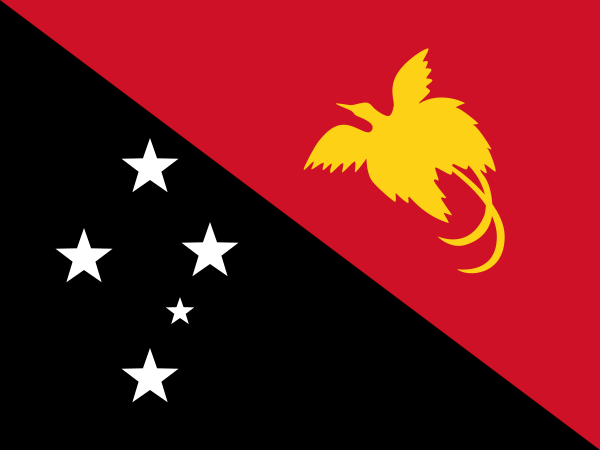
Safety in Papua New Guinea
A rating built from four independent indices, plus scams, laws and what to do when something happens
Rating calculated from the indices below
Indices checked on 10.08.2026
Position in global indices
Save these before you fly
The general picture
The picture: this is one of the more difficult countries in the world for personal security. High unemployment feeds street crime, and vigilance is required during the day as well as at night.
In the cities: never walk around Port Moresby or Lae, even if your destination is five hundred metres away. Use vetted transport and stay inside the guarded grounds of your hotel after dark.
Valuables: leave expensive watches and jewellery at home. Do not take your phone out on the street; step into a shop, a bank or a closed car if you need to check a map or make a call.
Tribal conflict: violent clan fighting flares up periodically in Enga and the Highlands provinces. Follow the local news, and if a road is closed because of a clash, do not attempt to drive it.
Women travelling alone: solo travel is strongly discouraged here because of the high risk of sexual violence. If you are travelling alone, join a group or hire a trusted local escort.
Medical care: there are no good hospitals outside the capital, and a helicopter evacuation costs thousands. Make sure your insurance covers that and includes emergency transfer to Australia, and check your own government's travel advisory before booking anything.
How tourists get scammed
Papua New Guinea is a country of extraordinary cultural diversity and very high crime. Most governments advise heightened caution or against travel to particular areas.
Port Moresby and Lae. Cities with high violent crime including armed group robberies ("raskol"). Nobody walks at all, by day or night. Movement is by car with a trusted driver only.
How trips work. Virtually all foreigners come either for work or on an organised escorted tour. Independent travel around the country demands a level of preparation incomparable with an ordinary trip.
Taxis. Street taxis should not be taken. Use hotel or operator transport only.
Cash. Cards work on a limited basis and ATMs are few. Carrying large sums is dangerous.
Excursions. The Kokoda Track, climbing, and diving off Kimbe and Madang are arranged through operators. Check the licence and whether there is communication on the route.
What gets you fined or jailed
The geography of risk. Port Moresby, Lae, Mount Hagen and the highlands have high crime and periodic intertribal conflict. Hela province and parts of the highlands have seen outbreaks of violence. The islands — New Britain, New Ireland, Milne Bay — are noticeably calmer.
Customary law. Traditional dispute resolution, including compensation practices, operates across much of the country. This matters to a foreigner after a road accident: stopping at the scene can be dangerous, and local practice is to drive to the nearest police station rather than remain.
Land. Almost all land is under communal ownership. Passing through, photographing and visiting places require the community's permission. A guide arranges this.
Photography. People and ceremonies only with permission. Military and police facilities are off limits.
Drones. Permission is required.
Drugs and alcohol. Some provinces restrict alcohol sales. Drugs are prohibited.
Roads. There are almost no roads between regions; travel is by local airlines.
Health: vaccines, medicines, care
Malaria is very high risk. Among the highest in the world outside Africa, including drug-resistant strains. Prophylaxis is unconditionally essential, as are repellent and a net.
Vaccinations. Hepatitis A and B, typhoid, Japanese encephalitis, rabies and polio. A yellow fever certificate is required from arrivals out of endemic countries.
Tuberculosis and HIV. Prevalence is high.
Water. Bottled only.
Healthcare is extremely weak. Port Moresby has basic private clinics. Outside the capital there is essentially none. Anything serious means evacuation to Australia (Cairns or Brisbane), which is expensive and takes time. Insurance with air evacuation is essential and must work in PNG.
Diving. World-class sites, but hyperbaric chambers are few. Diving must be a named item on your insurance.
Earthquakes and volcanoes. The country lies in a zone of high seismic activity, and the Tavurvur volcano destroyed Rabaul.
Emergency numbers: 000 or 112, with unreliable response.
Police: how to handle them
Papua New Guinea ranks low on the Corruption Perceptions Index, and the police are undermanned and do not cover much of the territory.
Do not resist a robbery. Attackers are often armed, bladed weapons included.
Reporting theft. Reports are taken, but do not expect an investigation.
Escorts. Standard practice for foreigners: a driver, a known route, daylight hours, and no independent walks. Hotels arrange transfers and they should be used.
Intertribal conflicts. These flare up periodically in the highlands and roads are closed. A local operator monitors conditions.
Consular assistance. Presence is limited and capacity to help outside the capital is small.
What actually matters. PNG is a country of incredible nature and culture that people genuinely visit: diving, the Kokoda Track, the sing-sing festivals in Goroka and Mount Hagen. But a trip here is arranged through an operator and planned as an expedition rather than a holiday.
What else to check
The rating is built from open international indices and foreign-ministry advisories; links to the primary sources are in the cards above. Conditions change faster than annual reports come out — check current travel advice before you go.