 Города и дороги
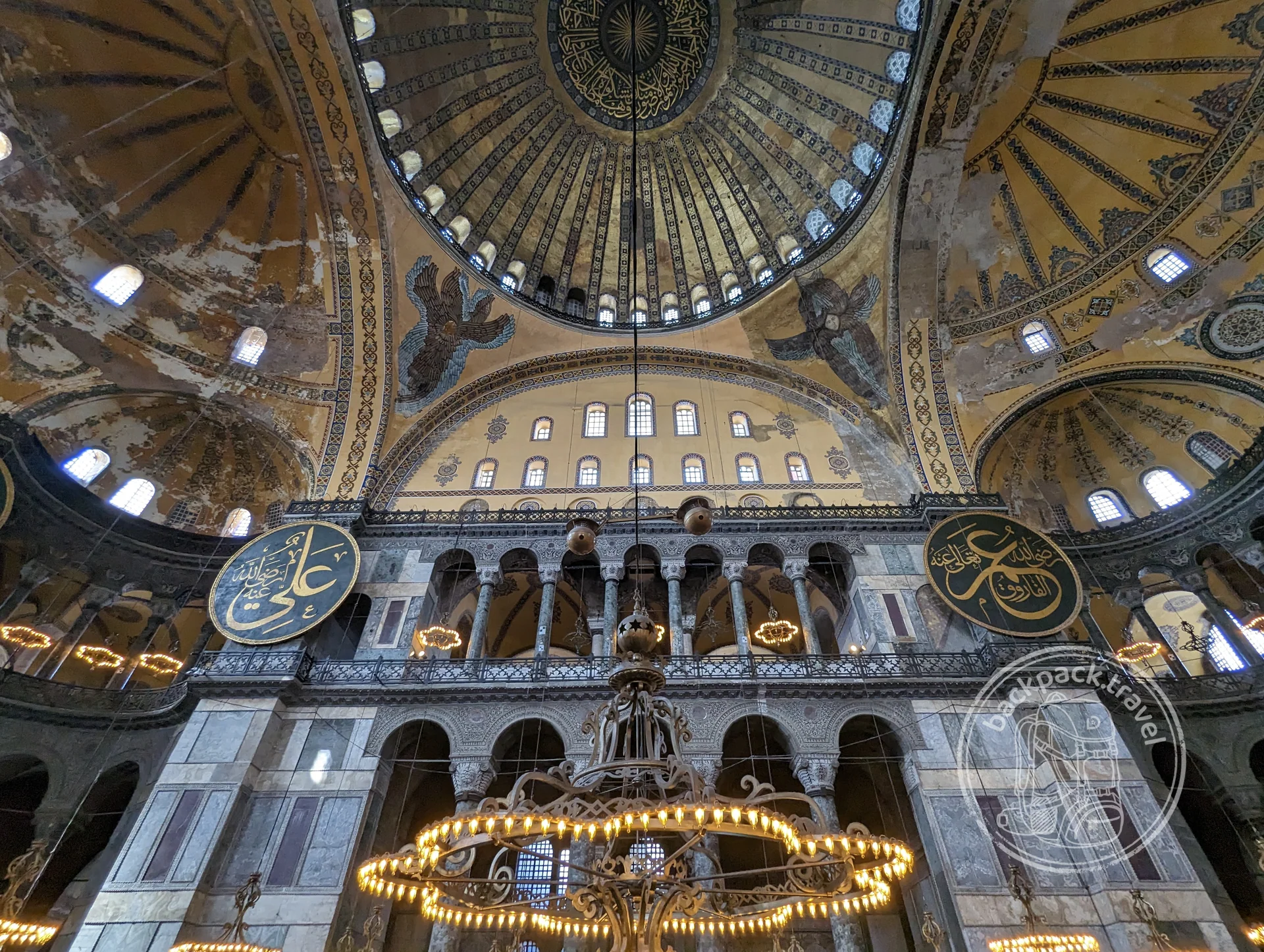
Hagia Sophia was built between 532 and 537 on the order of the emperor Justinian: in five years Anthemius of Tralles and Isidore of Miletus raised a dome about thirty-one metres across to a height of fifty-five.
How the dome stands
The device the whole building rests on is a dome on pendentives supported by two half-domes, so the interior seems not roofed over but opened upwards. Forty windows at the base of the dome give an even, diffused light, and it was because of this that contemporaries wrote the dome seemed suspended from heaven on a golden chain. Twice, at the end of the tenth century and in the middle of the fourteenth, the dome partly collapsed, and both times it was rebuilt.
Cathedral, museum, mosque
For almost a thousand years this was the chief cathedral of the Christian world. After 1453 it became a mosque, in 1935 a museum, and since 2020 it has functioned as a mosque again.
What survives
Of the Byzantine decoration there remain the marble facing of the walls, the carved capitals and the gold mosaics of the upper levels. Beside them hang eight enormous round medallions bearing the names of Allah, the Prophet and the first caliphs, painted in the nineteenth century. The chandeliers are lowered on long cables almost to the floor, so the whole structure reads at a glance from below.
Visiting
Visitors and worshippers now use different entrances: sightseeing runs through the upper galleries, which is where the mosaics are, while the ground floor remains a prayer hall. Foreign visitors pay for a ticket; entry is free only for those coming to pray. On Fridays the building closes to visitors around midday, and on other days it shuts briefly for each of the five daily prayers.
- Address
- Sultanahmet, Istanbul · tram T1 to Sultanahmet
- Opening hours
- Summer 8:00–19:00, winter from 9:00; Fri shut 12:00–14:30
- Prices
- 25 EUR for foreign visitors, upper galleries
Lists and awards
On the map
Reviews (0)
No reviews yet. Be the first!
Updated