 Города и дороги
Topkapi Palace was founded in the 1460s under Mehmed II on the headland between the Sea of Marmara, the Bosphorus and the Golden Horn, and for almost four centuries it remained the chief residence of the Ottoman sultans. The grounds cover more than seventy hectares, making it one of the largest palace complexes of its age.
Four courtyards
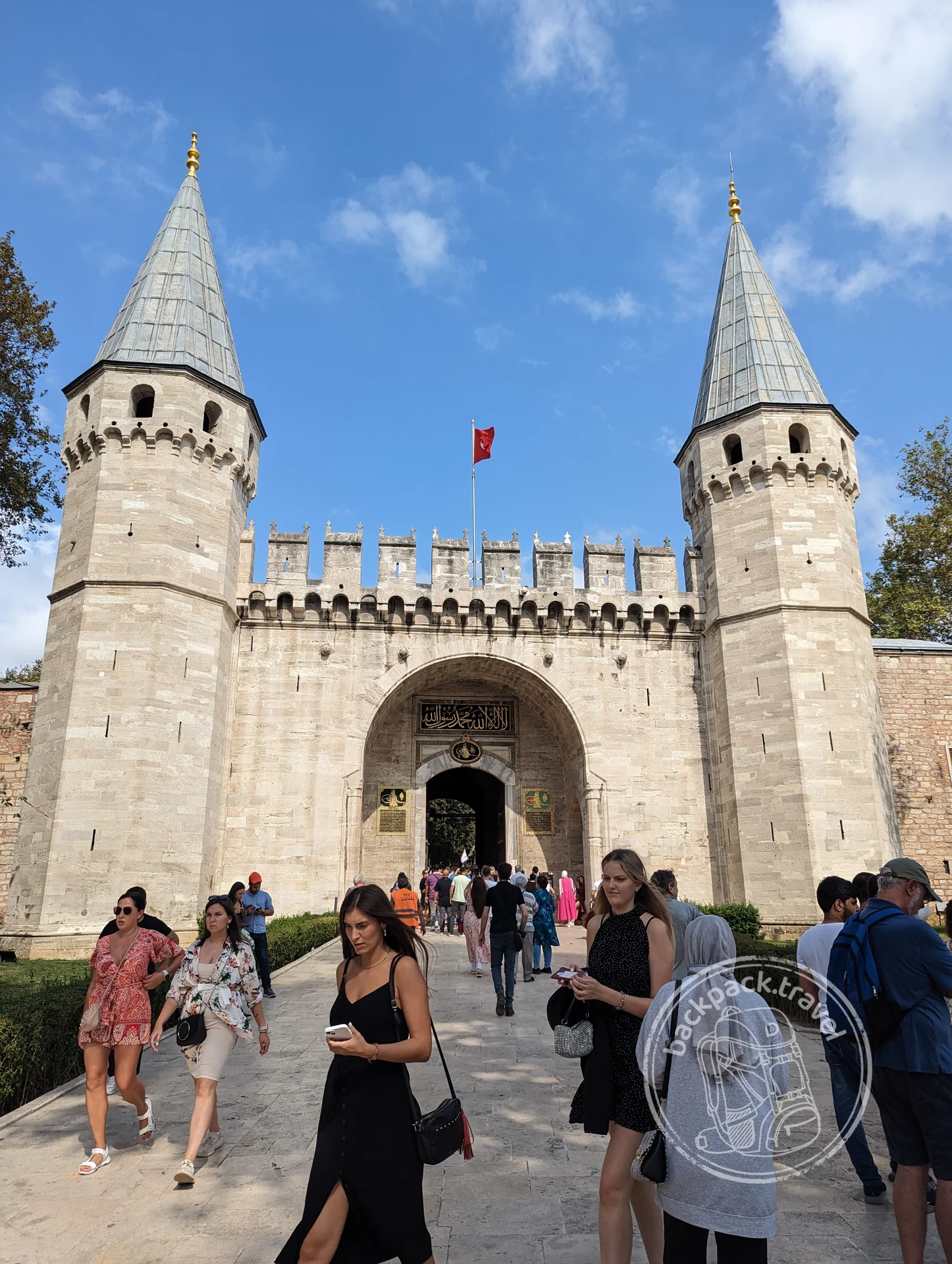
The plan is unlike that of European palaces: not a single building but a sequence of four courtyards, each open to a narrower circle than the last. The first stayed almost public. Petitioners reached the second through the Gate of Salutation with its two octagonal towers, and there the imperial council sat and the palace kitchens worked. Beyond the Gate of Felicity began the sultan's private ground, closed to outsiders altogether.
The Harem
The Harem, with well over two hundred rooms, was extended and rebuilt across centuries; its earliest parts date from the sixteenth. It is a maze of its own, of courtyards, baths and tiled chambers, and it takes a separate ticket that the main one does not cover.
Treasury and relics
The Treasury holds the Topkapi Dagger, with three emeralds set in its hilt, and the Spoonmaker's Diamond, one of the largest cut diamonds in the world. A separate pavilion keeps the Islamic relics brought back after the conquest of Egypt in 1517, when the Ottoman sultans took the title of caliph.
Views and practicalities
The gardens of the fourth courtyard look out over the mouth of the Bosphorus and the Asian shore, worth reaching even once the rooms have worn you down. By the end of the nineteenth century the court had moved to Dolmabahce, and in 1924 the palace became a museum. The queue at the entrance is long almost always, so it is worth buying a ticket in advance.
- Address
- Sultanahmet, Istanbul · tram T1 to Gulhane
- Opening hours
- Wed–Mon 9:00–18:00, shorter in winter; closed Tue
- Prices
- 2750 TL, Harem and Hagia Eirene extra
Lists and awards
On the map
Reviews (0)
No reviews yet. Be the first!
Updated