Description
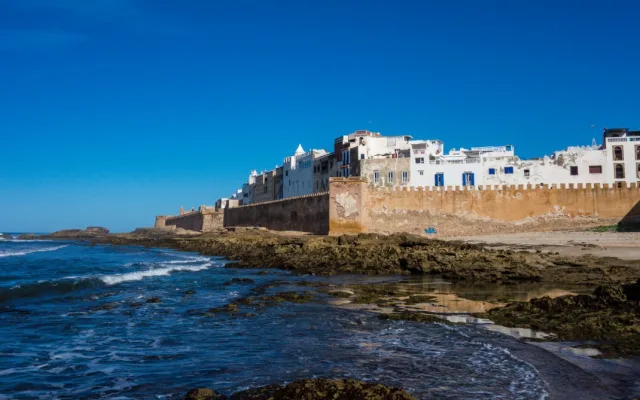
The white city of wind on the Atlantic — ramparts, a fishing port, kitesurfing and the Gnawa festival.
Wiki
Essaouira is the most relaxed town in Morocco: white walls with blue shutters instead of the ochre of Marrakesh, a constant Atlantic wind instead of heat, and a fishing port instead of tourist bazaars. Around 80,000 people, 175 km west of Marrakesh, and a reputation as a place people come to for two days and stay a week.
The town
The Portuguese built the fortress of Mogador here in the 16th century, but the present town is younger: in 1764-1769 Sultan Sidi Mohammed ben Abdallah commissioned the rebuilding of the port from Théodore Cornut, a French engineer who had been taken captive by the Moroccans. Hence a rare feature for Morocco — a regular grid of streets inside a medina laid out on European lines. In the 19th century a substantial share of the country's Atlantic trade passed through Essaouira, and the Jewish community grew to nearly half the population.
The medina was inscribed on the UNESCO World Heritage list in 2001.
What to see
- The medina — compact, with straight streets that are easy to navigate. No cars inside.
- Skala de la Ville — the rampart on the north-west with its row of bronze cannon and a view of the ocean breaking on the rocks. The town's most recognisable shot; Astapor for Game of Thrones was filmed here.
- Skala du Port — the second rampart, above the fishing harbour, with its 18th-century tower and gate.
- Place Moulay Hassan — the main square of the medina: cafés, street musicians, and the way out to the port.
- The fishing port — the liveliest place in town. In the morning the blue boats come back, the catch is unloaded and sold on the spot, and rows of grills nearby will cook whatever you choose in front of you.
- The Sidi Mohammed ben Abdallah Museum — ethnography and town history in a restored 19th-century mansion.
- The Mellah — the former Jewish quarter, partly restored, with a synagogue and the old cemetery outside the walls.
- Essaouira beach — wide, long and almost always windy. Swimming is chilly, but this is one of the Atlantic's main sites for windsurfing and kitesurfing: the wind holds at around 25-50 km/h for most of the year. Schools and rentals line the seafront.
What is nearby
- The Mogador Islands (Îles Purpuraires), two kilometres offshore — a reserve and a nesting site for Eleonora's falcon. Landing is not permitted; you look from a boat or from the ramparts.
- Sidi Kaouki, 25 km south — a wild beach and a surfers' village, windier and emptier than the town.
- Diabat, 5 km away — the village Jimi Hendrix visited in July 1969. Local legend credits it with the song "Castles Made of Sand", although that was released two years earlier, in 1967; the ruins by the village have nothing to do with it either.
- The argan cooperatives on the Marrakesh road — the region around Essaouira is the main producer of argan oil, and the women's cooperatives show the whole process from kernel to oil.
The festival
The event of the year is the Gnaoua World Music Festival at the end of June: four days of concerts on the squares and the seafront, with Moroccan Gnawa masters playing alongside jazz and world musicians. Most stages are free, the town is packed and rooms go early.
Food and prices
What you should eat is fish. Grilled sardines, fish tagine, oysters (the local ones are reckoned the best in the country) and sea urchin in season. At the port you pick your catch from the counter and pay by weight plus grilling — 93-186 dirhams ($10-20) for two. Lunch at a café is 65-140 dirhams ($7-15) and dinner at a restaurant 168-326 dirhams ($18-35). Argan oil at a cooperative is 93-186 dirhams ($10-20) a litre, appreciably cheaper than in the medina shops.
A petit taxi around town costs 19-47 dirhams ($2-5), and a grand taxi from Marrakesh 186-280 dirhams ($20-30) per person.
Transport
Essaouira-Mogador airport (ESU) is 18 km out, served by Ryanair and Transavia; a taxi to the centre is 140-186 dirhams ($15-20). Supratours and CTM coaches run from Marrakesh in three hours for 75-112 dirhams ($8-12); a grand taxi is faster, about two and a half hours. The medina is walking only — cars cannot enter.
When to go
April to October, 18-25°C. The ocean keeps the temperature even all year: even in July and August it is 22-28°C, and Essaouira works as an escape from a forty-degree Marrakesh. In winter it is 12-18°C with a strong wind. The kite and windsurf season runs April to October, and the Gnaoua festival falls at the end of June.