Description
The Red City — Jemaa el-Fna square, the medina, the souks and the palaces.
Wiki
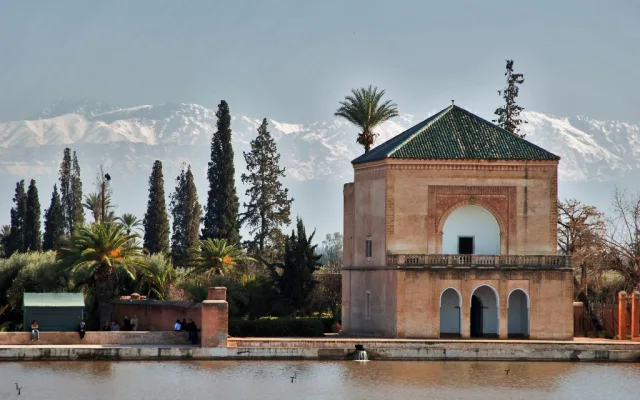
Marrakech is one of the four imperial cities of Morocco and its cultural capital, spread at the foot of the snowy peaks of the Atlas Mountains. Founded in 1070 by the Almoravid dynasty, the "Red City" got its nickname from the mud-brick walls and buildings of terracotta pisé, which give it a single ochre-pink tone at sunset.
History and appearance of the city
Over a thousand years Marrakech flourished under the Almoravids, the Almohads and the Saadians, each of whom left a mark on its architecture. The city served as a staging post on the caravan routes linking sub-Saharan Africa with the Mediterranean — spices, gold and ivory flowed from there into the local bazaars. The historic core is encircled by fortress walls some 19 km long, with several gates known as babs, and beyond them, on the western side, lies the colonial quarter of Gueliz, built by the French at the beginning of the 20th century.
Main sights
- Jemaa el-Fna — the heart of the city and a UNESCO intangible heritage site. In the morning people sell orange juice, tell fortunes and show trained monkeys here, and after dark the square turns into a smoking open-air restaurant, cooking snails, kebabs and sheep's head.
- The medina and the souks — an interweaving of covered trading rows divided by craft: leatherworkers, blacksmiths, cloth dyers, and sellers of babouche slippers and copperware. The famous dyeing works in the tanners' quarter keep to medieval methods.
- The Bahia Palace — a 19th-century residence with inner courtyards, orange gardens and ceilings of carved cedar painted by hand.
- The Saadian Tombs — the necropolis of the sultans, walled up in the 18th century and only rediscovered in 1917; the main chamber is decorated with columns of Carrara marble.
- The Ben Youssef Madrasa — once the largest Islamic school in North Africa, with exquisite carved stucco and zellij mosaic.
- The Koutoubia Mosque — the symbol of Marrakech, whose minaret of about 77 metres was the model for the Giralda in Seville.
- The Majorelle Garden — a cobalt-blue villa with a collection of cacti, rescued by Yves Saint Laurent; a museum devoted to Berber culture works alongside it.
Food
Moroccan gastronomy combines Berber, Arab and Andalusian traditions. Its basis is the tagine, stewed in a conical clay dish with lamb, chicken, prunes or preserved lemon. No less popular are fluffy couscous, served on Fridays, the hearty harira soup of lentils and chickpeas, and the sweet-savoury pastilla, a layered pie filled with poultry, cinnamon and icing sugar. Meals are invariably accompanied by mint tea with a great deal of sugar, which is regarded here as a gesture of hospitality.
Where to stay
The classic Marrakech option is the riad, a traditional house with an inner courtyard, a fountain and a roof terrace. Such guest houses are hidden deep in the medina and create a sense of seclusion in the middle of a noisy city. More modern hotels with pools are concentrated in Gueliz and the fashionable Hivernage district.
Transport
Menara International Airport is about 5–6 km from the centre; you can get there by taxi or on city bus number 19. Around the city run the petits taxis (small, for short trips) and grands taxis (large, for longer routes and the suburbs) — it is worth agreeing the fare in advance. The medina is almost entirely pedestrian, though mopeds and carts sometimes squeeze along its narrow derbs.
What to see in four days
Four days are enough to explore the city and its surroundings without rushing. Devote the first day to Jemaa el-Fna and the labyrinth of souks, the second to the palaces, the tombs and the madrasa, set the third aside for the Majorelle Garden, the museums and time by the pool, and the fourth for a trip out of town: to the Ouzoud waterfalls, into the Ourika valley, or over the Tizi n'Tichka pass towards the ksar of Ait Ben Haddou.
Practical advice
Haggling at the markets is the norm: the custom is to knock the first price down several times over, while keeping a friendly tone. It is better to dress modestly, covering shoulders and knees. The most comfortable times to come are spring (March–May) and autumn (October–November), when the heat eases; in summer the thermometer often passes 40 °C. It is easy to get lost in the medina — do not hesitate to navigate by the Koutoubia minaret and keep an offline map to hand.
Photos